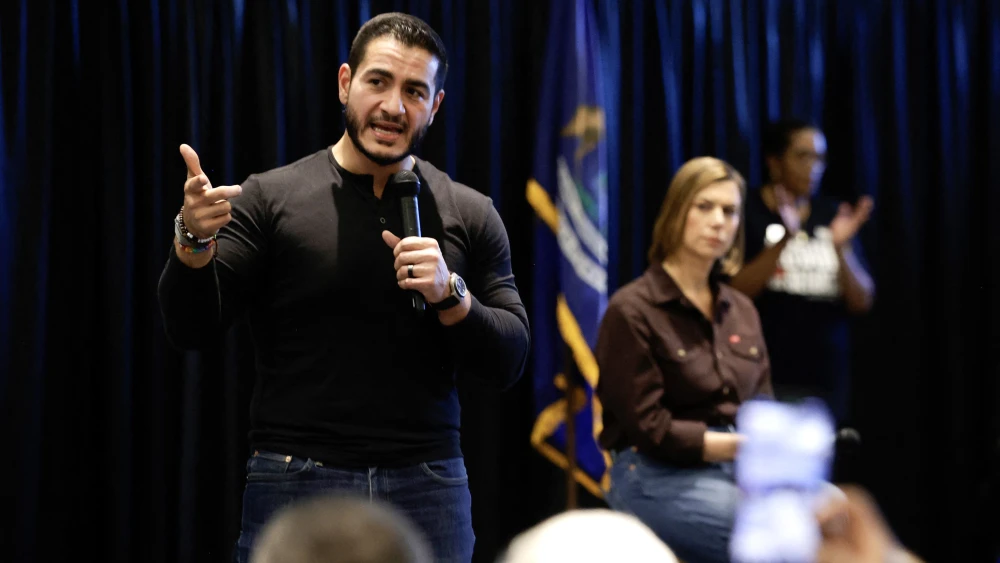

Sen. Elissa Slotkin’s (D-Mich.) decision to campaign on behalf of Dr. Abdul El-Sayed, the Democratic candidate for Senate in her state, was, she says, a function of a desire to help someone who would be on what she calls “Team Fight” rather than “Team Flight.” By that, she meant someone who would battle President Donald Trump alongside her in the U.S. Senate, rather than seek compromises with the Republican administration like her more moderate colleague Sen. John Fetterman (D-Pa.).
In taking this stand, she has fallen in line with the rest of her party in backing El-Sayed. But in framing the question as one of “fight” or “flight,” she was deliberately avoiding the historic implications of her choice. One more Democrat in the Senate could give her party control of both houses of Congress, and make it easier for them to impeach and try Trump, regardless of the partisan nature of such a procedure.
Given that even under those circumstances, a conviction and his ouster from office would likely be impossible, the stakes won’t involve the future of the republic as much as handing Democrats the sinecures and power that come from being in the majority.
But electing an open antisemite like El-Sayed would be truly momentous not just for the Jewish community, of which Slotkin is a member, but for its implications for the future of her party and the nation. From that perspective, characterizing the decision as one of “fight” or “flight” is actually quite apt. But the truth is that what she and a host of other Jewish Democrats, including Senate Minority Leader Chuck Schumer and Michigan Attorney General Dana Nessel, are doing is engaging in “flight” rather than fighting to hold the line against antisemitism inside her party at a time when it is surging around the globe.
‘No such thing as Jewish voters?’
What made her decision to join forces with El-Sayed particularly interesting was revealed during a joint interview with him on the MS NOW cable-TV channel.
In it, Slotkin didn’t just play the loyal Democratic soldier swallowing the indignity of endorsing a man who seeks to drive the overwhelming majority of American Jews out of the public square. In doing so, she is supporting someone who embodies the illiberal red-green alliance of leftists and Islamists that is taking control of liberal parties around the world.
When asked about the fact that most Michigan Jews, including the majority who are loyal Democrats and politically liberal, simply won’t go along with electing an antisemite, Slotkin’s reply was succinct.
She said, “There’s no such thing as the Jewish voters, just like there’s no such thing as the Muslim voters or the black voters. People have their own views, and the things that they prioritize are going to drive their vote.”
In a sense, she’s right. Citizens vote as individuals and not as part of groups. And, indeed, most American Jews have not voted in lockstep on issues like Israel, even if the majority of them are supporters of the Jewish state. That is especially true of Jewish Democrats, who have always placed Israel’s security below many domestic concerns, whether it was health-care costs or legalized abortion. It’s something that has particularly frustrated Trump, whose pro-Israel policies and efforts to fight antisemitism in education have not been rewarded by most Jewish voters.
To some extent, that’s also true of other groups, like Muslims and African-Americans, though both of those constituencies have been more likely to treat issues relating to their community’s safety as a priority. By contrast, liberal Jews tend to treat universal concerns as more important than those that personally concern them. As writer Cynthia Ozick famously said, “Universalism is the ultimate Jewish parochialism.”
Tolerating antisemitism
But as Jews in Michigan and elsewhere have come to learn in the three years since the Oct. 7 Hamas-led Palestinian Arab terror attacks on Israeli communities incited an unprecedented increase in antisemitism, El-Sayed’s candidacy is not, strictly speaking, about voters’ views about the Jewish state. It’s about their willingness to tolerate the mainstreaming of Jew-hatred here in the United States.
So, when Slotkin seeks to deny that there is such a thing as “Jewish voters,” she’s signaling something very different from the fact that not all Jews cast votes solely on the basis of a candidate’s views on Israel. Along with other Democrats, both Jewish and non-Jewish, she is seeking to establish something far more important.
For them, party loyalty remains more important than opposition to antisemitism or, as Nessel said last month, the continued existence of the State of Israel. She expanded that idea and said that it was even worth it to “sacrifice the comfort, safety and security and even the very future of our own people” for the sake of a victory for the Democrats.
Slotkin is not quite so explicit in her indifference to the plight of the Jewish people, either in Israel or the United States at a time when antisemitism is raging, especially among the left-wing base of the Democrats. But by declaring that there is no such thing as a Jewish vote, even when it concerns the fight for her people’s survival, Slotkin is actually going further. She is calling for the erasure of Jewish communal interests from the public square, essentially telling Jews who disagree to shut up and fall in line.
While Slotkin, Nessel and Schumer claim that the real issue on the ballot in Michigan is a referendum on Trump, it’s important to point out that although El-Sayed’s implacable hostility to the president is not in question, it wasn’t the issue that carried him to victory in the Democratic primary.
Spreading blood libels
El-Sayed won his party’s nomination not so much by excoriating Trump but by targeting Jewish supporters of Israel, whom he accused of seeking to purchase Congress. He portrayed his moderate Democratic opponent, Rep. Haley Stevens (D-Mich.), as a stooge of the nefarious plot to purchase and manipulate American foreign policy by AIPAC and the Jews.
El-Sayed’s use of that traditional antisemitic trope—his spreading of blood libels against Israelis committing “genocide” in Gaza, or being an “apartheid” and illegitimate “ethno-state” that has no right to exist—should have been a deal-breaker for any decent politician who cares about the way his rise illustrates the mainstreaming of Jew-hatred. So, too, should his refusal to condemn or even acknowledge that the Muslim Brotherhood is an international Islamist terror movement.
But for Jewish Democrats like Schumer, Slotkin and Nessel, elevating someone who holds such views, which they would not hesitate to denounce as beyond the pale if uttered by a Republican who echoed the similar views of a far-right antisemite like former Fox News host and current podcaster Tucker Carlson, to the Senate is not too high a price to pay for increasing their share of power in Washington.
Part of that price means not just denouncing the idea of Jews voting to defend their community. It means declaring that worries about Jewish security being threatened with harassment, intimidation and violence by advocates of the “Free Palestine” movement deserve to be minimized or dismissed altogether.
The evidence of the last three years contradicts that blithe assumption.
A security crisis for Jews
The vast increase in anti-Jewish hate crimes throughout the country, most of which are associated with anti-Zionist and blatantly antisemitic rhetoric and positions, has created a crisis for American Jews unlike any they have ever faced in this country. While not all Americans fully comprehend what is happening, it has not escaped the notice of most Jews that every synagogue, Jewish school and institutional building now requires extraordinary security measures to ensure that advocates for “Free Palestine” and “From the river to the sea” don’t inflict harm on them. Meanwhile, neighboring churches and mosques don’t need such protection.
Yet those who agree with El-Sayed and New York City Mayor Zohran Mamdani that calls to “globalize the intifada”—a demand for terrorism against Jews, wherever they live, and Jewish genocide—are not worthy of condemnation are telling the Jews that their lives and security are unimportant when compared to the chance of adding another Democrat to the Senate.
This isn’t happening in isolation from what has happened elsewhere in American society. In education, the media, publishing, pop culture and the fine arts, Jews and Jewish concerns are increasingly being challenged, marginalized and even erased.
This is all being done in the name of toxic left-wing ideas like critical race theory, intersectionality and settler-colonialism that divide humanity into two impermeable and permanently warring groups: “people of color,” who are always victims no matter what they do, and “white” oppressors, who are always in the wrong. Despite being the most persecuted minority in history—something that continues to this day in the form of the aforementioned surge of antisemitism—Jews are classified by left-wing ideologues as among the latter.
That’s why left-wingers on college campuses or concert stages feel free to falsely accuse the Jews of committing “genocide” while ignoring the fact that the goal of the side they are supporting in the Middle East conflict—Hamas and the Palestinians—is the actual genocide of half of the Jews on the planet who live in Israel. Moreover, they do so from a sense that they are attacking bad people and helping the good guys. They spew Jew-hatred while thinking of themselves as progressive and enlightened humanitarians.
That’s bad enough. But when Jews with leadership roles in our democratic republic tell other Jews to accept antisemitism, they are effectively siding with those who accept this skewed view of the world.
Still, it only works if the Jews who haven’t bought into this insanity, regardless of their political views, insist that Jewish security and antisemitism are not issues on which reasonable people should be required to agree to disagree.
A vote for Jewish survival
There needn’t be such a thing as a “Jewish vote” when it comes to a host of issues on which partisans disagree—from levels of taxation, social issues and foreign policy. But there has to be one when it comes to Jewish survival, both in Israel and the United States. Jews needn’t be fans of Trump, or any Israeli politician or political party. But those with a sliver of self-respect or concern for their fellow Jews and Americans, in general, should regard antisemitism as a litmus test of decency, if not self-interest.
This is not about, as Slotkin insists, the idea that “people want to see a Jewish woman and a Muslim man being able to get along, debate, push and pull each other, and move the state forward.”
What we expect from Jews in politics is recognition that normalizing hate isn’t about moving anything forward. It’s sacrificing a vulnerable minority on the altar of partisan politics. That isn’t progressive or pragmatic. It’s immoral. And we should treat any Jewish politician who makes that exchange as beneath contempt and unfit for the public trust.
The normalization and the mainstreaming of Jew-hatred, such as what we’ve seen with the embrace of El-Sayed, isn’t about what you think about either major party, since neither cannot be entirely trusted on the issue. Yet at a time when security at their houses of worship is outsourced to hired armed guards, the issue of Jewish safety is one on which no Jew can remain silent.
Erasure of Jewish concerns cannot be tolerated. Decent persons, Jew and non-Jew alike, must never accept the notion that they are obligated to be quiet about this or any issue relating to the safety of their families when threatened by ideologues.
On such grounds, a Jewish vote must exist, but it must also be seen as part of a broader bipartisan faction, albeit one based on zero tolerance for bigotry.
Politicians like Slotkin may be too cynical or tainted by toxic ideology to understand what they are doing and the consequences it will have for all Americans. Nevertheless, they shouldn’t be allowed to get away with telling the Jews to be quiet about threats to their safety any more than if she were telling African-Americans not to oppose politicians who were fine with black genocide.
Jonathan S. Tobin is editor-in-chief of JNS. Follow him: @jonathans_tobin.