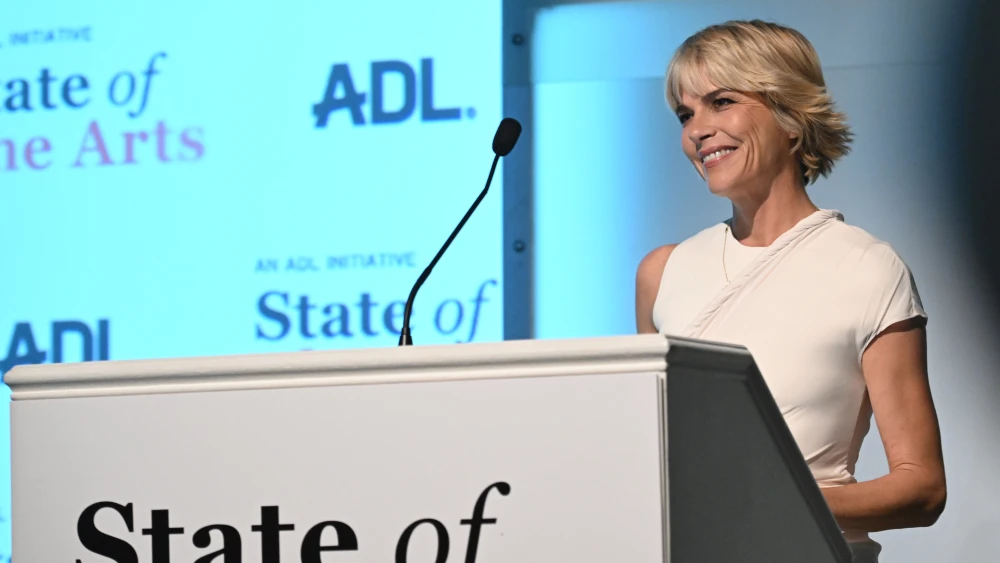

In the fall of 2023, Selma Blair stood on the South Lawn of the White House being honored for her advocacy at an event marking the anniversary of the Americans with Disabilities Act. By February, she no longer had a career.
On Oct. 1, speaking at the Anti-Defamation League’s State of the Arts reception at the Jewish Museum in New York, Blair described what happened in between. The list is the part that stays with you: her agency, her lawyer, her publicist, her book agent, her social-media manager, her son’s godmother and her manager, a friend of 30 years and a fellow Jew.
Then five words that anyone who has ever run a business will recognize: “No one returned my calls.”
Start with what Blair did, because honesty requires it. Four months after the Oct. 7, 2023 massacre, under a video attacking Rep. Rashida Tlaib (D-Mich.) and then-Rep. Cori Bush of Missouri for voting against a bill to bar Oct. 7 perpetrators from the United States, Blair wrote that the congresspeople should be deported and that Islam had destroyed Muslim countries.
That is a statement about a faith of nearly two billion people, not about Hamas, and it was wrong. Blair knew it. She deleted it, apologized and told the ADL audience she still means the apology. I am not going to defend a comment its own author does not defend.
However, I am interested in the phone.
I have spent 35 years in shipping and logistics, including advising companies on deals. Mine is a retainer business: A client pays me to be in their corner before the outcome is known. That is what anyone who hires a representative is buying: a person who will still be there during the bad year.
In my world, clients become liabilities all the time. A carrier strands cargo or a founder says something stupid on a panel. When that happens, there are two honorable choices: You stay and help fix it, or you pick up the phone and say, “I can’t represent you anymore; here is why; here is your file.” Both cost something, but the second costs five uncomfortable minutes.
There is a third choice, and it’s the one Blair describes: You let it ring. You let silence do the firing, so you never have to own the decision or say the reason out loud.
At the time, The Hollywood Reporter wrote that it was Blair’s decision to change management teams and that her agency confirmed the split without giving a reason. I cannot reconcile that with Blair’s account. However, I can judge the conduct she describes. “I still don’t know what any of them were thinking,” she said. A person who gets the call at least knows where she stands.
In Blair’s telling, she did not get a decision; she got a disappearance. “Not rang less,” she said of the phone. “Just stopped.” A phone does not stop on its own. Someone decides not to pick it up.
‘Apparently,’ Blair said, ‘I was too toxic to keep and too valuable to take down.’
I am not arguing against consequences. I believe singer Ed Sheeran’s tour should either have warned ticket buyers about opening act Macklemore’s anti-Israel politics or taken him off the bill. Melissa Barrera lost a role in Scream VII over her anti-Israel posts, and the studio said so.
Blair noted from the podium a petition promoted by Javier Bardem to strip Pink of her UNICEF ambassadorship for objecting to Macklemore’s set, and Blair is right that it was a campaign to punish a woman for an opinion.
People on every side have paid for what they have said. My argument is not about who had it worse. It’s about how it is done.
Blair told the room she has drawn her own conclusions. She believes her post was merely the excuse, rather than the reason. Four months after Oct. 7, a Jew openly expressing a deep connection to Israel was someone others felt was safer not to know. I cannot prove she is right, but the line between Jews and Israel has never been ours to draw—others draw it for us. Silence leaves it to the person on the other end of the line to supply the reason, and since Oct. 7, Jews in every industry have learned which reason to fear.
The Jewish question here is not the easy question. When someone has done nothing wrong, the moral question is straightforward. The harder question is what we owe one of our own when she actually has done something wrong. You can tell her she was wrong. You can demand she do better. You can end a business relationship. What you cannot do is vanish.
Blair told the audience she stood in her backyard that winter saying the Shema and wondering whether she had imagined the last 25 years.
The cost was not confined to her career. She has a son. He had already watched his mother go through chemotherapy and a bone-marrow transplant. That winter, she said, he watched her become afraid of the world. “Careers come back,” she told the room. “Years of his childhood do not.”
Then there is the detail a dealmaker cannot get past. One brand, she said, stopped paying her but kept her name and face in its Super Bowl ad for weeks. “Apparently,” she said, “I was too toxic to keep and too valuable to take down.”
I have not seen the contract in question, but if that is what happened, it is hard to square with a principled objection. You do not keep using someone you find indefensible to sell product.
One phone kept ringing. Blair’s closest friend, an attorney, refused to let her vanish and went to work. That is the standard. He did not have to endorse what she wrote. He had to answer.
Blair’s worry now is for the next one: the actress with a single credit, the comic six months in; someone with no name, no cushion and no lawyer for a best friend. The ADL says it is building a place for those people to call. That’s good. But the first fix is cheaper than any program, and it is available to every Jew in every industry this week, as we mark three years since Oct. 7.
Return the call. Say the hard thing if it needs saying. Say you are leaving if you are leaving.
Blair is making a documentary about antisemitism called Hineni, which is the answer Abraham gives God when he is called: “Here I am.” It is not a statement of agreement. It is the minimum you owe someone who trusted you.