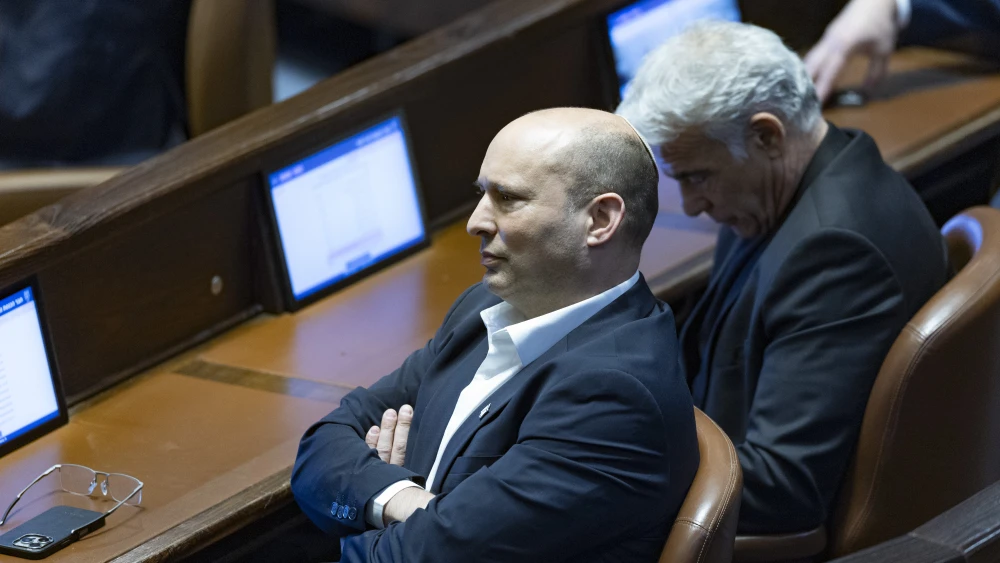

“There’s a rule in politics: When Bennett and I are silent, it means something is happening,” Yair Lapid said at the Knesset swearing-in ceremony.
What does that tell us about the opposite, far more common situation, when Lapid and Bennett are talking? More importantly, to borrow a question once popular in gossip columns: Are the two still an item, or have they broken up?
It’s hard not to feel sorry for former Prime Minister Naftali Bennett, who now has two ticking time bombs to defuse, preferably without anyone noticing.
During the election campaign, he promised neither to rely on Arab parties nor to join a government with the Haredim. Now Gadi Eisenkot is trying to install a minority government with the support of Ra’am and the Joint List, while Avigdor Liberman is racing to form a 61-seat coalition with Shas and United Torah Judaism.
I haven’t spoken to Bennett lately (as noted, he’s keeping quiet), but his predicament is obvious.
A government dependent on Arab parties would be headed by Eisenkot; one with the Haredim would be headed by Liberman. Bennett would take all the entirely justified criticism for breaking his election promise, without even getting the prime minister’s job in return.
Presumably, he would welcome a national unity government in which he could serve as a senior minister (finance? foreign affairs?) and have a full term to rethink his political future.
On the face of it, what stopped him from doing what Liberman did? Just as Liberman declared unequivocally on day one that a minority government was out of the question, a similar statement from Bennett ruling out the Haredi option would have killed off a possibility that runs directly counter to his election platform. About the only thing more problematic for Bennett than complete capitulation to the Haredim would be a unity government with the emir of Qatar.
Four problems prevent Bennett from taking that step.
First, his partner. Lapid wants Netanyahu out of office at any cost, regardless of the coalition’s composition. Their joint campaign ended in bitter disappointment, and there is serious doubt that they will ever join forces again. Some believe the two have already separated while still sharing the same political home, though neither presumably has any interest in airing their differences in public.
Second, Bennett’s Knesset faction. In an effort to stem the flow of voters toward Eisenkot, Bennett ended up with an elected slate further to the left than he had intended. It does not include a single religious Zionist, for example. That leaves him less room to maneuver.
Third, his base. It is doubtful that Bennett’s new voters would tolerate his joining a government with Netanyahu.
Fourth, and most serious of all, the lack of an alternative. Bennett has no independent path to a government with the right, because 53 plus seven still falls short of the 61 seats needed for a Knesset majority.
Another election? Whoever is seen as responsible for forcing one will pay a heavy political price.
That is why Eisenkot and Liberman are largely ignoring Bennett, pursuing their initiatives over his head in the belief that, with no alternatives available, the pressure will eventually force him to fall in line.
The former prime minister may not always excel at the ballot box, but he is Israel’s undisputed champion of post-election poker, even when dealt a mediocre hand. So far, he has kept his cards close to his chest. He just studies his hand, watches the faces of the other players and says nothing.
A weeping ace
Miriam Peretz, an Israel Prize laureate, a national symbol of resilience and hope and the mother of two fallen IDF soldiers, is now also, as of this week, the mother of a Knesset member from the Yashar! party.
This week, she told friends in shock what had happened to her son. Elisaf Peretz had published a social media post advocating a Zionist government, something that should have been entirely uncontroversial. In response, he was subjected to a torrent of insults and abuse, as though he had proposed serving under Itamar Ben-Gvir in a coalition rather than simply expressing his party’s official position.
His troubles, however, pale beside those of Benjamin Netanyahu. At 77, the prime minister finds himself in an unfamiliar position: He is the subject of the coalition negotiations, but not an active participant in them. Put simply, his ability to control events is extremely limited.
Normally, Netanyahu always has something to offer: a reserved place on a party slate, a government position or an intriguing political alliance. Now, heading a caretaker government with 46 Knesset seats but without the most important thing of all—the mandate to form a government, which currently rests with Eisenkot—he is trying to gather intelligence on the other side’s plans.
Instead of recruiting defectors from the opposing camp, Likud has been rattled by rumors of defections in the opposite direction. MK David Bitan is one of the names being mentioned with concern (he denies it, of course). Netanyahu has no government to offer the Haredi parties, no positions to hand out to potential defectors and no clear political future to promise them.
At the beginning of the week, Netanyahu was convinced that a minority government dependent on Arab parties would be brought to a vote within days. Then every alarm bell started ringing over the prospect of cooperation between Liberman and the Haredim.
On the morning of the Knesset swearing-in ceremony, following a lengthy overnight conversation with United Torah Judaism Chairman Yitzhak Goldknopf’s successor, Yisrael Eichler? No, with Asher, a temporary all-clear was sounded.
“If you join the coalition,” Netanyahu told United Torah Judaism’s Yaakov Asher, “they will appoint an attorney general and 10 Supreme Court justices. And then even a majority of 70 seats won’t help you. You’re furious about the way the judicial system operates, but you’re about to entrench it for the next 30 years.”
Whether or not the conversation had anything to do with it, the briefings that subsequently emerged from Haredi circles took on a tougher tone.
Bennett may not always excel at the ballot box, but he is Israel’s undisputed champion of post-election poker.
And then came the speech at the Knesset swearing-in ceremony.
Netanyahu had prepared a relatively conciliatory address, but somewhere along the short walk from the Prime Minister’s Office to the Knesset’s Chagall Hall, it turned into the speech we ultimately heard.
It was not the first time this had happened this year. Since retiring, Sara Netanyahu has been spending more and more time at her husband’s workplace. So have newly elected MK Yaakov Bardugo and longtime adviser Natan Eshel. All three favor a hard line, bordering on aggression.
“Did you see how Miriam Peretz applauded those remarks?” Likud figures said with delight.
But Peretz is not necessarily the audience they need to win over.
Likud’s objective is to ensure that in two or three months, if the Liberman-Haredi alliance is thwarted, members of the anti-Netanyahu bloc will face a choice: a minority government followed by another election, or a national unity government with Netanyahu serving first as prime minister under a rotation agreement.
Eisenkot’s reasoning is that if the country immediately heads to another election, relying on Arab parties would not constitute a permanent arrangement. It would merely be a temporary maneuver designed to remove Netanyahu from the Prime Minister’s Office.
To accomplish that, he will need Liberman, but above all, he will need every member of his own Knesset faction.
Did MKs who vehemently oppose a government dependent on Arab parties emerge from Netanyahu’s speech feeling that national unity deserved a chance? Or did they come away feeling precisely the opposite?
One only had to look at the party leaders’ faces in the traditional group photograph. They looked like a family posing for a photograph at a wedding, where Mom and Dad are divorced, the brothers and sisters aren’t speaking to one another, and the photographer, blissfully unaware of any of it, shouts: “Saaaaay cheese!”
Upside-down world
“We are not abandoning any of our principles,” Gadi Eisenkot declared.
Not quite. In such a scenario, one banner would have to be lowered: that of Degel HaTorah, the Haredi party. And its leaders have absolutely no intention of doing so.
Like a traveler starving and dying of thirst in the desert, Haredi politicians are now gazing at Liberman’s oasis and wondering: Is it real, or just a mirage? Could it be that the most ruthless politician of them all, the man who knew their every weakness from up close and then used that knowledge to make their lives miserable, right down to their bottles of sugary drinks and disposable plates, is now offering them everything they could possibly want?
The Haredim are wondering whether it’s too good to be true. One theory circulating in Haredi circles this week is that Liberman is offering them the moon because he knows Eisenkot and Naftali Bennett cannot match his promises.
The idea, according to this theory, is to position himself for the post-Netanyahu era on the right, when he could join forces with the Haredi parties.
The Haredi political operatives want power. As in Likud, the higher up the party hierarchy you go, the less affection there is for Netanyahu. The rank and file, however, would find it hard to stomach a prolonged partnership with a Reform rabbi, Yair Golan, Bennett and the center-left in general.
Since Rabbi Elazar Menachem Shach’s famous 1990 speech denouncing the left, the Haredi parties have never joined a government without Likud unless that government already commanded a majority without them. That is not the case now, and the implications are clear. It is worth recalling that Rabbi Dov Lando, nearly 40 years Shach’s junior, opposed Shach’s position at the time.
What the Haredim really want is a unity government that includes them. They have concluded, correctly, that the renewed courtship of their parties means a reconciliation between the two major political blocs would not leave them as the sacrificial lambs, contrary to earlier assessments.
What seemed impossible to swallow before Liberman’s about-face now looks feasible. Who would sit in the opposition and protest concessions to the Haredim? Liberman? Yair Golan, who suddenly remembered this week that his hand was extended to the very people he had called “parasites”? Perhaps the Arab parties would demand universal conscription? Or Itamar Ben-Gvir?
The problem is that it is not up to the Haredim. Eisenkot and Liberman are signaling that there will be no unity government. All these concessions will be theirs only if they cross the political divide.
Their mistake so far has been to focus their efforts exclusively on Rabbi Lando’s inner circle. That is why a problem is now emerging for them in the form of MK Meir Porush (UTJ).
The Slonim Rebbe, the Hasidic leader who torpedoed the military conscription bill and is regarded as Porush’s patron, is emerging as a staunch opponent of joining the government. Religious conservatism and deeply rooted right-wing convictions are working hand in hand here. As far as he is concerned, a government with the left simply will not happen.
Originally published by Israel Hayom.