


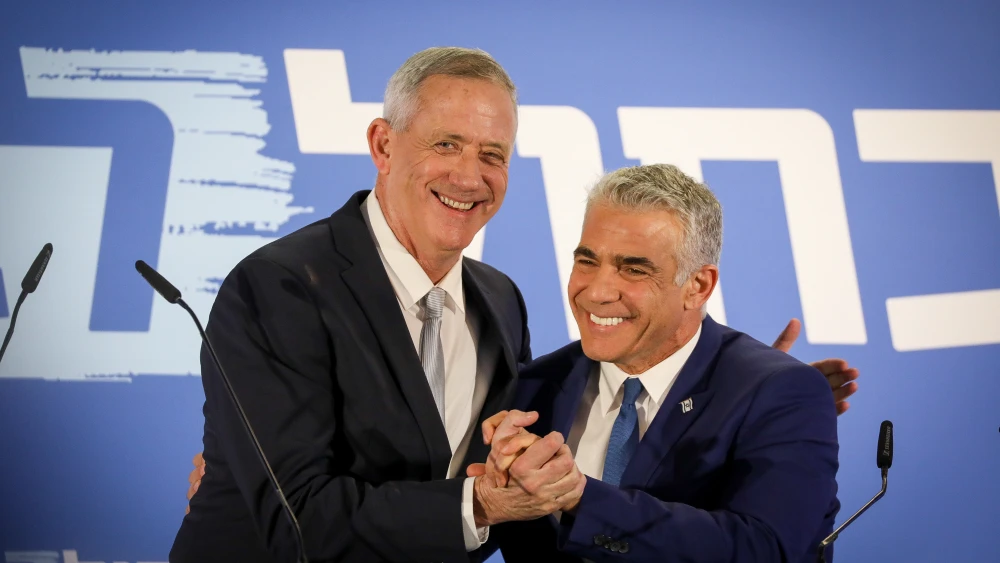
Ever since entering the political race, former Israel Defense Forces’ Chief of Staff Benny Gantz’s approach has been to blur the distinction between right and left. The connections he has made and the alliances he has forged have all been subject to this goal.
It appears that Gantz and his advisers recall the electoral success of Yitzhak Rabin in 1992 and Ehud Barak in 1999, achieved, among other things, thanks to the smart branding of left-wing candidates as members of the center. But immediately upon entering the Prime Minister’s Office, both Rabin and Barak adopted the policies of the left.
Just like in the 1990s, this current attempt to flaunt the centrist label is a sham. In Israeli politics, there is no real center because a majority of the issues and challenges facing the Jewish state require a decisive choice between two alternatives known as “right” and “left.” When the time comes to make major decisions, one cannot be a little on the right or a little on the left, just as one cannot be “a little bit pregnant.” So, for example, in the ultimate test of the vote in the Knesset on the nation-state law, Yair Lapid’s Yesh Atid Party chose to vote with the left. Those who oppose the declaration that our country is the state of the Jewish people and that no other nation has collective national rights in it belong on the left regardless of how many times they succeeded in throwing around the word “center” in a minute-long speech.
There are at least three other tests that can help differentiate between right and left; two concern policies and one political pragmatics. When taken together, Lapid and Gantz, now allied in the Blue and White Party, must necessarily be seen as being on the left.
The territorial integrity test: The Likud and the nationalist camp support Israeli sovereignty between the Jordan River and the Mediterranean Sea. Lapid and Gantz, however, foresee the establishment of a Palestinian state and the expulsion of Jews from their homes. At a time when the right has drawn a clear conclusion from the 2005 disengagement from the Gaza Strip—opposition to any future eviction of Jews, Gantz and the left support additional withdrawals. The evacuation of settlements will be carried out as part of future agreements, Miki Haimovich, a member of Gantz’s Israel Resilience Party, has promised us.
The economic test: Under the leadership of Prime Minister Benjamin Netanyahu, Israel has come a long way from its Socialist past to its current thriving economy. While the right aspires to remove the remaining barriers that keep this from being a total economic breakthrough, the economic left and its satellites in the Histadrut labor federation are interested in maintaining their power. The decision to add Histadrut chairman Avi Nissankoren and other members of the economic left to the party’s list is a clear signal from Gantz of his preferred alternative.
The political alliances test: All of the right-wing parties have stated that they would recommend that the president task Netanyahu with forming the next government; all of the left-wing parties have just as adamantly said they would task Gantz with the job.
The political map is divided into two camps, right and left, according to a clear ideological key. The radical left, Meretz, for example, but even those further left, like the communists and the Arab nationalist and Islamist parties, have embraced the idea of forming a political alliance with Gantz. It seems they understand full well just what is hiding behind the centrist mask.
Ariel Bolstein is the founder of the Israel advocacy organization Faces of Israel.


