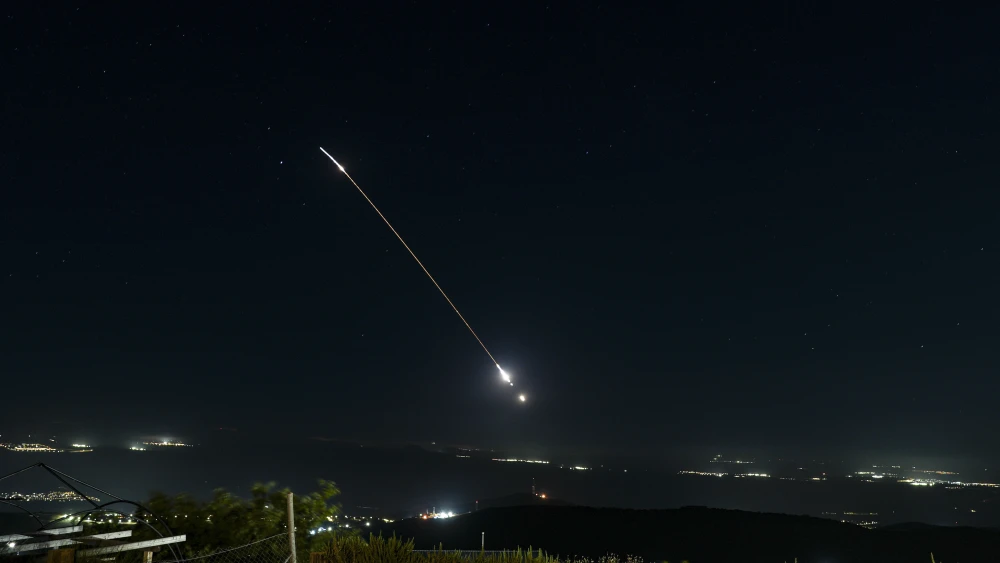

Among the many consequences of the recent exchanges of fire between Iran and Israel—and against the backdrop of Israeli strikes in Hezbollah’s Dahiyeh stronghold—one stands out in its simplicity.
For at least a few minutes before rushing to shelters, Israelis awoke on Monday morning with a refreshing sensation: the feeling that they were once again free to fight for their own survival.
The restraints that U.S. President Donald Trump had effectively placed on the hands of Israel’s government and military were cut—or at least loosened. Israel recovered not only its right to self-defense, but also its ability to escape an Iranian trap in which any response to aggression was portrayed as a threat to ongoing negotiations.
The formula devised by Tehran is simple: Dialogue with the United States is possible only if Israel ignores Hezbollah’s attacks.
Yet Hezbollah, despite suffering significant setbacks, remains armed, financed and directed by Iran. Despite ceasefire agreements reached in March and April, the terrorist organization has continued launching missiles at northern Israel, emptying border communities and targeting Israeli forces deployed in southern Lebanon to prevent Hezbollah from rebuilding its military capabilities.
Neither the United Nations Interim Force in Lebanon (UNIFIL) nor the government of Lebanese President Joseph Aoun, despite its stated intentions, has succeeded in disarming the group.
On Sunday, a particularly intense barrage of missiles threatened communities across northern Israel, including a school group visiting Kibbutz Neot Mordechai. Israeli Prime Minister Benjamin Netanyahu then acted on warnings he had issued repeatedly, ordering strikes in Beirut’s Dahiyeh district, Hezbollah’s military and strategic headquarters. One building used by the organization was targeted.
Iran’s response marked what appeared to be a strategic shift. Rather than relying solely on its proxies, Tehran moved directly to its defense, launching large-scale attacks against Israel, including strikes toward Tel Aviv and Jerusalem, following earlier attacks in the north.
But during the night, another strategic decision emerged.
Despite what was widely perceived as Trump’s opposition to escalation, Netanyahu ordered Israeli fighter jets to strike targets inside Iran, including missile launchers and petrochemical facilities.
This is where the deeper challenge begins.
Trump has made clear that he wants negotiations with Iran to continue. His message to both sides has essentially been: enough. One side attacked, the other responded; now stop.
Iran agreed—but with a condition that effectively leaves Lebanon hostage to Tehran’s interests.
Israel, Iran declared, must refrain from attacking Hezbollah—conveniently referred to by Tehran as “Lebanon”—or else “far heavier measures than those already undertaken” would follow. In other words, the war would continue.
That is hardly an outcome Trump welcomes.
Yet almost immediately after the Iranian statement was issued, Hezbollah—which had remained conspicuously quiet for some 30 hours during Iran’s operation and rarely acts without guidance from Tehran—resumed firing at Kiryat Shmona, Metula and other northern communities.
Northern Israel was once again under terrorist attack.
Israel, therefore, appears to face a dilemma while Washington watches closely.
But is it really a dilemma?
The relationship between Jerusalem and Washington is too close, too strategic and too deeply integrated for either side to imagine that Hezbollah’s aggression should go unanswered. U.S. Central Command and the various coordination mechanisms linking the two countries operate continuously. There have been no reports of serious disputes or breakdowns in communication.
U.S. Ambassador to Israel Mike Huckabee strongly condemned Iran’s attacks. Likewise, Israeli officials explaining the operation against Iran emphasized both Israel’s commitment to its alliance with the United States and its determination to retain the freedom to punish those who attack it.
Israel’s ambassador in Washington, Yechiel Leiter, underscored both the necessity of Israel’s actions and Jerusalem’s commitment to maintaining close coordination with Washington. Explaining the operation against Iran, Leiter emphasized that Israel’s objective was not escalation for its own sake, but the defense of its citizens against an existential threat.
His message reflected Israel’s determination to preserve its strategic partnership with the United States while retaining the freedom—and the obligation—to strike those who attack it.
With precision and determination, Israel’s course appears to be the only realistic one in the dangerous region it inhabits.
There is little chance that Netanyahu will allow Iran to posture through Hezbollah’s Lebanese front while Israel absorbs the consequences.
This is the Middle East.
It is also logical that Israel’s decisive response has once again given the Gulf states and the broader Sunni Arab world a reason to revisit the prospect of a useful anti-Iranian alignment—one that could reshape the region.
That is an outcome Trump may well find attractive.