
In recent decades, the use of Passover as a metaphor to bolster all sorts of issues that are unrelated to the specifically Jewish subject matter of the seder has become commonplace. Since Rabbi Arthur Waskow, a political activist who came out of the far-left Jewish Renewal movement wrote his “Freedom Seder” in 1969, the holiday has been routinely hijacked to promote a variety of causes, good and bad—from the struggle for civil rights in the United States and feminism to radical environmentalism, open-borders policies on immigration and even, courtesy of the antisemitic Jewish Voice for Peace group, anti-Zionism.
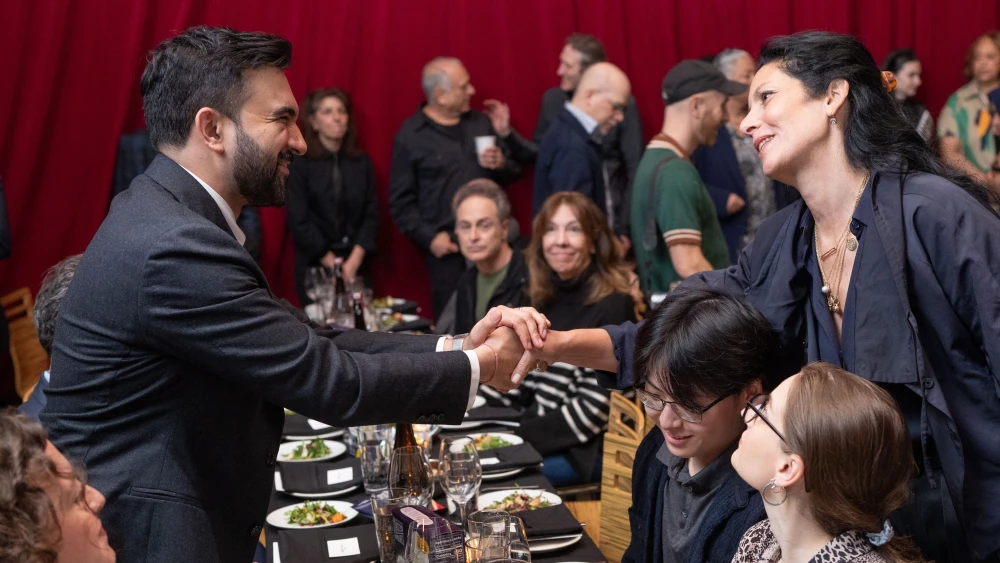
So, the appearance of New York City Mayor Zohran Mamdani at a “post-modern” seder held at Gotham’s City Winery was hardly groundbreaking. Though not intended as an actual Passover seder, but rather, as its promoters claimed, a “supplemental event,” its purpose was an attempt to use a sacred day on the Jewish calendar to pursue a different agenda.
We shouldn’t waste too much time complaining that Mamdani, whose celebrations of Muslim holidays at his Gracie Mansion official residence are rigorously orthodox, would likely regard similar parodies of his faith’s rituals and traditions as Islamophobic and might provoke violence from his supporters. But since, for good reason, neither American Jews nor Israelis think it sensible to mock and twist Islam in this manner, that’s not something likely to happen.
A parody seder
Those who attended and participated—like former CNN host turned left-wing political activist Don Lemon (who read a version of “The Four Questions”); Terence Floyd, the brother of Black Lives Matter icon George Floyd; and Israeli Rabbi Amichai Lau-Lavie, better known as the “drag queen rebel” who challenges “patriarchy and supremacy” while playing a character called Hannah Gross—were not there to honor Jewish tradition.
Instead, they read texts treating Passover as an excuse to promote Mamdani’s socialist economic agenda and the effort to demonize the Trump administration’s efforts to enforce immigration laws.
But the key point of this parody was that nowhere in this faux Haggadah was there any mention of one of the central points of the Passover saga. Israel is the end point of the Exodus, when the Jewish people would be able to live in freedom in the land promised by their Creator, who took them out of bondage in Egypt. Yet, as in other postmodern versions of the seder, Israel wasn’t mentioned at the City Winery shindig.

That’s hardly surprising given that the featured speaker at this travesty was a man whose political career has revolved around his obsession with delegitimizing and erasing the State of Israel while demonizing its supporters. Antisemitism has been integral to his identity as a public figure from his days as the founder of a chapter of the Jew-hating Students for Justice in Palestine at Maine’s Bowdoin College. The same is true of his wife, Rama Duwaji, whose support for the Palestinian atrocities committed in southern Israeli communities on Oct. 7, 2023, and her denial of the rape of Jewish women, has caused outrage among many Jews. It’s apparently considered no big deal by Mamdani’s supporters and apologists in the liberal press.
Nevertheless, he and his supporters seem to think that having him show up at an event where Jewish symbols are invoked—and then twisted to support efforts to destroy Jewish life—will help depict him to the public as a friend of the Jewish people.
A collapse of Jewish peoplehood
The most depressing aspect of this shocking suggestion is that a great many of New York City’s Jews are not offended. Exit polls showed that 33% of Jews voted for Mamdani. A subsequent breakdown of the vote by age, provided by the SSRS poll, reported that among voters aged 18 to 44, Mamdani beat his leading opponent—former New York Gov. Andrew Cuomo—by a 49% to 47% margin, while losing to him among older Jewish voters by a 72% to 23% margin.
Even as we acknowledge that these results are a reflection of opinion in a deep-blue city where far-left politics are normative in a way unknown in many other places, those numbers are deeply troubling. The results speak volumes about the collapse of a sense of Jewish peoplehood among younger American Jews, especially the non-Orthodox. In part, it’s a product of high rates of intermarriage and assimilation, along with general Jewish illiteracy produced by a lack of education in their heritage and faith. As such, it’s hardly surprising that so many young Jews simply don’t care about Israel, or have embraced a version of Jewish universalism that validates anti-Zionist and even antisemitic political causes.
And rather than just voice our pain about the way a man who opposes the existence of the one Jewish state on the planet uses the rituals of Judaism to bolster the war against Jews, we should ponder how many American Jews will celebrate Passover in a way that also diminishes or altogether leaves out the importance of the land of Israel and Jewish peoplehood in their own seders.
According to the most rigorous demographic studies conducted by the Pew Research Institute, Passover is the single most commonly observed holiday by American Jews, with approximately 70% attending a seder every year. That makes it an annual opportunity for Jews to reconnect with their heritage and that all-important sense of peoplehood that is integral to the festival of freedom. Indeed, the seder is the ultimate family-education experience that many people rightly emphasize with entertaining props and other gimmicks to interest the children gathered round the table.
But let’s be honest and acknowledge that many of the ones now held are merely holiday dinners preceded by minimalist versions of the first part of the seder, which traditionally comes before the festive meal.

The message of the seder
As a result, either out of impatience with the postponement of dinner mandated by the full reading of the Haggadah or general disinterest in the complete text, much of the meaning of the evening is lost. That’s especially true when it comes to the elements of the Haggadah that reinforce its place in the continuum of Jewish history and the challenges Jews face in every age.
Even the most assimilated Jews have some idea that they are supposed to imagine themselves as having personally been liberated from Egypt along with their ancestors. Still, too many often skip the key verses that remind them of the purpose of the ritual, or simply don’t bother or worse, don’t even understand their significance. One wonders what they think when they read—if they do read it—the line that is as resonant today as it was when recited in the Warsaw Ghetto during the Holocaust or every previous time when Jews were under siege: “For not only one [enemy] has risen up against us to destroy us, but in every generation, they rise up to destroy us. But the Holy One, Blessed be He, delivers us from their hands.”
Can they comprehend the continuity from the time of the Exodus to every subsequent effort to destroy the Jewish people, such as the genocidal plans of Hamas, Hezbollah, the Houthis and their Iranian paymasters? Or have they so internalized antisemitic propaganda about the war on Israel that they now think their Jewish brethren fighting for survival—and dodging in and out of bomb shelters at all hours of the night and day—are the latter-day Egyptians or, God forbid, German Nazis?
Will they see that the point of the Jewish journey out of Egypt is to both embrace the law they are being given and the place where they can openly practice it? Or will they instead imagine that the Jewish homeland, where half of the world’s Jews now live, is just a place where “white” oppressors reside?
‘Next year in Jerusalem’
And how many get to the end of the seder to recite or sing the words that conclude it, “Next year in Jerusalem”? Do they realize that wherever they happen to live, the land of Israel is integral to universal Jewish identity? Or will they instead, as the celebrants at the City Winery and other anti-Zionist “seders” insist, conceptualize a version of Judaism and Jewish life in which that land, which is so central to the faith, is simply excised?
The lesson of the seder isn’t political. But if you are paying attention to the Haggadah, it cannot help but remind you of the Jewish state’s importance and the need to rally around it at a time when Jews are being attacked by those who intend their genocide. Those who choose Mamdani-style seders aren’t just signaling their identification with individuals who seek to marginalize and ultimately slaughter Jews. They are cheating themselves of an experience that will solidify their identity and strengthen their ability to resist the forces seeking to extinguish Jewish life.
The holiday should be a joyous occasion that is hopefully spent with family and friends. But no matter where you fit on the religious or political spectrum, Passover should be a moment for reflecting on the fragility of Jewish life in a world where antisemitism is again surging, as well as the need to stand in solidarity with fellow Jews, wherever they are, but especially where they remain embattled.
Chag Pesach Sameach!
Jonathan S. Tobin is editor-in-chief of JNS (Jewish News Syndicate). Follow him: @jonathans_tobin.