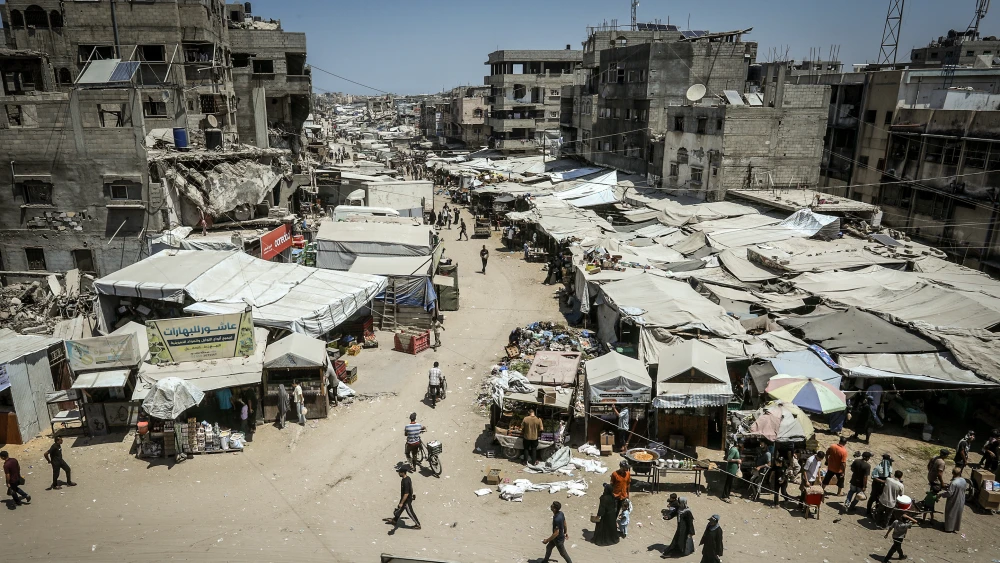

Ever since Israel’s injudicious abandonment of Gaza to Palestinian-Arab control in 2005, the Gaza Strip has stubbornly defied resolution. Ever since the imbecilic Oslo Accords in 1993, the dominant paradigm, forged by the dictates of political correctness, has been that, sooner or later, the political process must culminate in some form of self-rule of the coastal enclave by some Palestinian-Arab entity.
Prescient warning ignored
Initially, this was conceived as being the PLO-dominated Palestinian Authority, until it was violently ejected from Gaza in 2007 by Hamas, after losing the parliamentary election one year previously—the last ever held in the Palestinian-controlled territories—to the radical Islamist movement.
Significantly, as early as 1992, more than a decade prior to the Disengagement, I warned that abandoning Gaza would lead to death, disaster and destruction for both Jew and Arab alike.
Sadly, subsequent events proved my prognosis tragically accurate and underscored the folly of ignoring it.
In the article, I argued that the only solution for attaining stability in the Gaza Strip is the humanitarian relocation of the Arab population to third-party countries, which would extricate them from the iron grip of their tyrannical leaders, who have led them astray for decades—from disaster to debacle, time and time again.
However, the adherents of political correctness continued to try to foist self-determination on a hapless population clearly incapable of handling such a challenge with any degree of success.
Indeed, Gaza is an enclave that has very little to sustain it as an independent entity, with insufficient sources of drinkable water and no energy resources. It is totally dependent on foreign aid, with a minuscule private sector and a bloated public one, riddled with corruption and crippling cronyism.
Tectonic shifts in perception
Although Gaza was given massive financial aid from international donors—making it among the highest per capita recipients in the world—Hamas promptly appropriated much of the money and material aid for military infrastructure and weapons.
It took the tectonic shifts produced by the cataclysmic events of Oct. 7 to shake perceptions loose from the prevailing ideological dictates and failed orthodoxy. This was reflected in U.S. President Donald Trump’s initial suggestion to remove the Gazan population from the Strip and transfer its governance from the Gazans to other, more competent hands.
Sadly, Israeli Prime Minister Benjamin Netanyahu did not seize the historic opportunity, strike while the iron was hot and lead a vigorous campaign urging its global adoption. Instead of capitalizing on the historic opportunity to dramatically widen the Overton window on the future of Gaza, he chose to hand it off to second-tier members of the coalition who possess far less international stature. Accordingly, the idea lost much of its initial momentum, drifting haphazardly to the outer margins of the international debate.
Regurgitating recipes for failure?
It should be understood that any policy proposal that does not entail large-scale population removal is merely a variant of previously tried and failed formulas of autonomy and/or Oslo.
Moreover, these recipes typically entail full demilitarization of Gaza, limit the political rights of Gazan Arabs and preclude granting them fully fledged sovereignty. This leaves Israel open to charges of “apartheid,” which in this case would be justified, since precluding or curtailing political rights on the basis of ethnic origin is the archetypal definition of apartheid.
Accordingly, even if one believes that it is possible to locate some yet-to-be-identified Palestinian Arab who has both the sincerity and authority to create peaceful coexistence with the Jewish state, without a massive Israeli military presence to sustain his incumbency, there is no guarantee how long he will remain in power or that he himself will not have a change of heart and renege on prior commitments. Moreover, he could well be replaced by a more radical successor, either by the bullet—being forcibly overthrown—or by the ballot—being voted out of power.
Indeed, any proposed solution that entails allowing most of the Gazan population to remain in the Strip must advance some plan for securing the enclave’s border with Sinai, which, for various reasons, could well revert to being the lawless, jihadi-ruled expanse it once was. Clearly, any demilitarized Gazan regime will not have the means to secure this border against ideological extremists or heavily armed criminal elements—with or without the collusion of the Egyptian army in the peninsula.
An inescapable algorithm
Accordingly, the future governance of Gaza can be articulated by an almost mathematical analogy:
- Israel can determine who rules Gaza and how it is ruled only if it rules Gaza itself.
- It can rule Gaza without being accused of “ruling”—read, subjugating—another people, the prevailing anti-Israel refrain, only if that other people is not under Israeli rule.
- This can be achieved only if the “other people” are removed from the confines of the Gaza enclave.
This is not rocket science. Nor is it an expression of “right-wing” extremism. To the contrary, it is merely an articulation of sound political science—and reasoned common sense.