


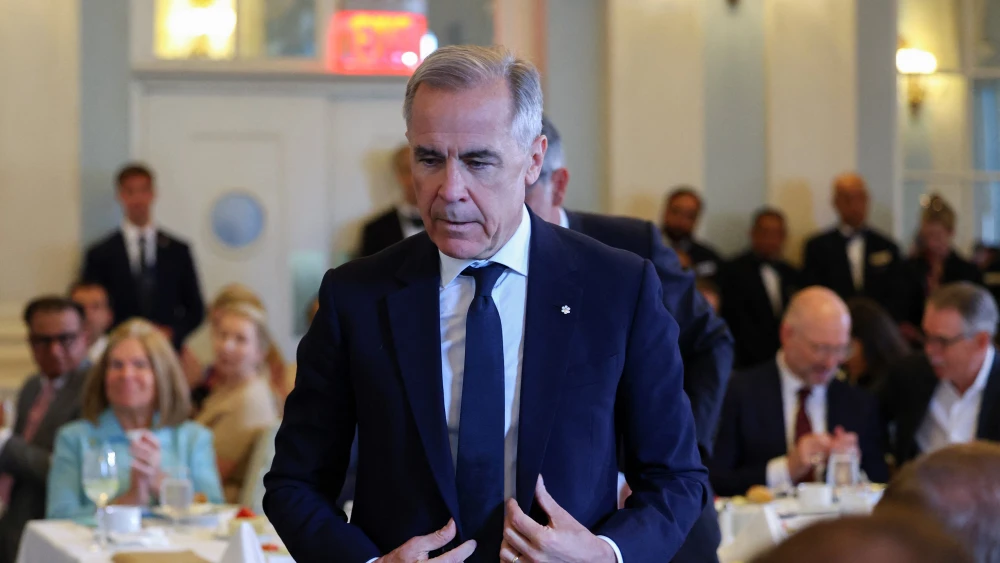

Mark Carney came to the office of prime minister promising that the adults were back in charge. Canadians were told that competence would replace performance and evidence would replace mood—that a veteran banker would govern by reality rather than by ideology. What they have received is a master class in political confabulation.
Confabulation is a clinical term that describes a patient who fills the gap between reality and belief with a story convincing enough to make an incoherent world feel whole. The confabulator is not quite lying, because he has persuaded himself first. The story simply matters more to him than the facts. No subject exposes the habit in Carney more nakedly than antisemitism.
Standing in Toronto’s Holy Blossom Temple, Carney recently said aloud what Canadian Jews have been desperately saying for years. He called antisemitism a scourge and solemnly conceded that the country’s civic compact is failing them. He cited—with the solemnity of a man reading his own eulogy—the firebombed synagogues, the bullets fired into Jewish schools, the more than 6,800 antisemitic incidents B’nai Brith recorded in 2025, the highest tally since it began counting in 1982. He noted, solemnly, that two-thirds of all religiously motivated hate crimes in Canada target 1% of its population.
The diagnosis was flawless. It was also the easy part because solemnly naming a disease costs a politician nothing and absolves him of treating it.
Having named it, he bewilderingly prescribed the disease as its own cure. His remedy was the Ministerial Advisory Council on Rights, Equality and Inclusion, chaired by his identity minister, Marc Miller, and fuzzily wrapped in the warm language of national unity and social cohesion.
To build it, Carney first abolished the office meant to fight antisemitism directly. The post of special envoy on combating antisemitism, vacant since Deborah Lyons resigned, was quietly dissolved and stirred into a general committee, whose first anemic assignment is not to act but to study the nature, scale and drivers of a rapidly metastasizing phenomenon Canadian Jews can already recite in their sleep.
Then came the membership. One appointee, former cabinet minister Omar Alghabra, once led the Canadian Arab Federation and objected to the press calling the Al-Aqsa Martyrs Brigades terrorists, despite it being an organization Canada itself lists as a terrorist entity. Another, the litigator, Avnish Nanda, has represented the campus activists whose encampments became the staging grounds for the very intimidation Carney now piously deplores.
Asked about this, Miller officiously declined to discuss the backgrounds of individual members, preferring sanctimonious retreat to the claim that it would be naive to expect perfection. It was a rather curious defense. The government did not appoint these people in spite of their records. It read the records and appointed them anyway.
Apply the test Ottawa would use anywhere else. Assembling a council against anti-black racism, would it recruit figures known for minimizing it? Confronting anti-Asian hatred, would it head-hunt the people who contextualize it? The questions answer themselves. Only with the oldest hatred do the rules invert, and figures who would be disqualified from speaking about any other prejudice are suddenly credentialed as experts on this one.
The mechanism is no mystery. Progressive institutional life has spent a decade redefining antisemitism so narrowly that any hostility to Jews is laundered clean the moment it is ritualistically routed through anti-Zionism. Jewish students encircled by mobs chanting for revolution become a free-expression seminar. Synagogues behind security barriers become unfortunate but unrelated. Crowds lionizing terrorists become voices of peaceful resistance, to be understood amid complexities too subtle for the unenlightened to grasp.
The result is a singular feat of moral gymnastics in which antisemitism is condemned in the abstract and excused in every particular. Carney’s council is that contradiction duly issued an office and a letterhead, a body that lets the government announce that it is fighting Jew-hatred while reassuring the academic and activist networks that have spent years promoting it while simultaneously supplying the alibi.
What Carney would not mention in that synagogue is the part of the story that implicates him. His own government’s conduct toward Israel has inflamed the Canadian street as surely as any encampment, and Jewish leaders noticed the silence at once.
Begin with the arms embargo. Heckled at a Calgary rally by a man accusing him of abetting genocide in Gaza, Carney did not flinch. “I’m aware,” he said. “That’s why we have an arms embargo.”
He handed it over the way a mugged man hands over his wallet, a wink and a boast offered to an apparently pro-Hamas heckler as groveling proof of camaraderie with a movement that has made no secret of its genocidal ambitions toward Jews.
Consider what an embargo is. It is among the gravest instruments a state keeps in reserve—the brand reserved for apartheid South Africa, for Gaddafi’s Libya, for juntas and ethnic cleansers, for regimes beyond the moral pale. It is the diplomatic mark of Cain.
Carney has stamped it not on a génocidaire but on the one Jewish state, fighting on seven fronts after the worst slaughter of Jews since the Holocaust. To make the gesture cohere, he must invert the entire moral order of the war, recasting the besieged as the aggressor and the people baying for their destruction as the aggrieved. Played like a true confabulist.
And who is being soothed? Not a peace movement. The crowd screaming at Carney about genocide is the latest detachment of an army that has promised one since before Israel drew breath.
As five Arab armies massed in 1948 to strangle the day-old state in its cradle, Azzam Pasha, secretary-general of the Arab League, told an Egyptian newspaper precisely what victory would look like, promising “a war of extermination and momentous massacre.”
That program was never retired, only rebranded.
The annihilation pledged by the invading armies is the identical demand chanted today as “from the river to the sea,” a call for a Jewish state’s erasure in the stolen vocabulary of liberation. The mob that chants it is a marvel of confabulated solidarity, the green-haired campus ignoramus beside the equally ignorant keffiyeh-clad militant, a coalition with no common cause and exactly one through line: a visceral hatred of Jews.
That is the constituency a confused and collusive Canadian prime minister chose to reassure. The embargo was his tribute to it.
Then there is “Palestine.” In September, Carney had Canada recognize this phantom state at the United Nations. He acknowledged the Hamas-led slaughter of 1,200 people in southern Israel on Oct. 7, 2023. He acknowledged Hamas’s standing refusal of Israel’s right to exist and the genocidal threat it poses to every Israeli. He named all of it—solemnly, of course—and then handed the cause those murderers serve the precise prize it has demanded for three-quarters of a century—the prize the armies of 1948 marched to seize by force.
Oct. 7 was meant to be the morning the fog lifted, the day the last believer in a two-state idyll saw the movement as it has always proudly described itself. But the confabulist does not revise his story to fit the massacre. He revises the massacre to fit the story, files the largest murder of Jews in 80 years under a regrettable context and rewards the authors with statehood. Israel said recognition on these terms legitimizes the barbarity of Oct. 7. It was right.
So, what should Canadian Jews do, beyond enduring another “balanced” committee engineered to offend no one but the people being hunted?
First, vote like a community that has run out of patience. For generations, they delivered reflexive loyalty to a party that now performatively stages its concern in a synagogue, while folding their protector into a diversity panel and recognizing a hostile state over their objections. That loyalty bought them advisory councils and fine words.
Conservative Party leader Pierre Poilievre demanded that Carney apologize for a decade of fear left to fester. An apology would be wildly insufficient, but it would at least concede the moral reality that eludes Ottawa’s governing class: that the failure is not of understanding, but of responsibility.
Second, prepare for the increasingly inescapable possibility that Canada is yet another country in which Jewish life can no longer be assumed. This is neither panic nor surrender. It is adult realism. When a prime minister boasts of an embargo against the Jewish state to a jeering Jew-hating crowd, when synagogues need police cordons and schools take fire, a prudent community plans. That means treating aliyah as a live option, rather than someone else’s romance. To prepare for a move to Israel is not to abandon Canada, per se. It is to refuse to be trapped by sentiment in a place that has begun to tell its Jews they are on their own.
Canada deserves honesty. Its Jews deserve protection. They have been handed neither, only a prime minister who has perfected the art of appearing to stand on both sides of the same barricade—comforting the frightened and their tormentors in a single breath, and calling it leadership.
They have been given “Carney the Confabulator.” The wiser among them will read the gift for what it is and begin to pack. Or at least invest in better locks.



