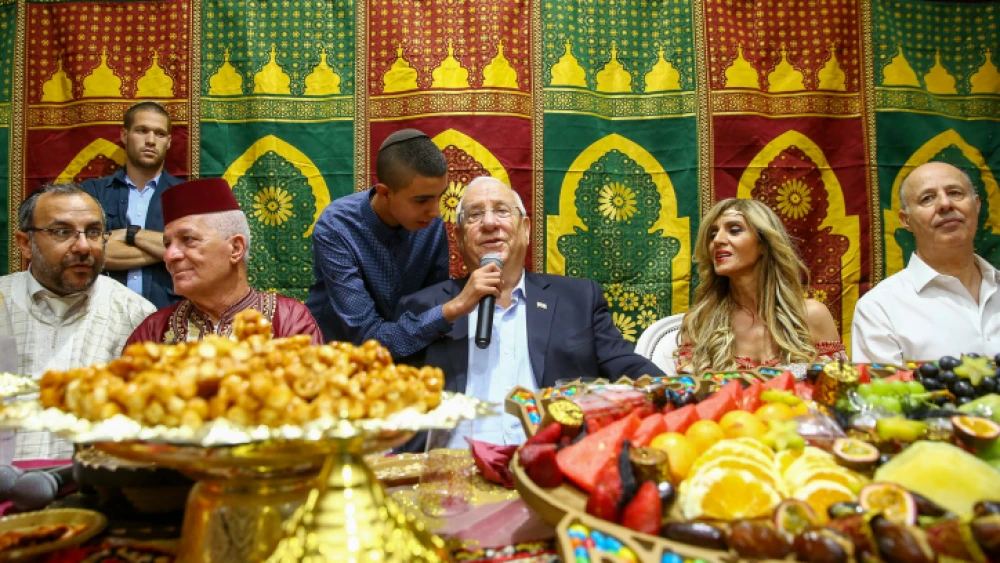

On Thursday night, as sundown falls on the holiday of Passover, Sephardic Jews everywhere will celebrate the centuries-old tradition of Mimouna. This is the night when Jews open their doors to their neighbors, offering tables lavish with sweets to usher in a year of sweetness and good fortune.
If there’s a Jewish ritual that calls for maximum social connection, Mimouna is it. As I wrote in a column years ago, “Mimouna represented the love and intimacy of a neighborhood. There’s nothing like popping in to see 10, 20, 30 different neighbors on the same night, most of whom you see all the time.”
This year, after centuries of continuity, Mimouna parties around the world will come to a stop, conquered by a tiny virus.
I know, there is still livestreaming, there is still Zoom, there is still FaceTime and all those magical digital instruments that help us approximate reality.
But not for Mimouna.
Not for a ritual where the very essence is the physical gathering of people.
Not for a ritual that tingles with the excitement of real-time human connection.
Not for a ritual where the smell of moufletas, those mouth-watering Moroccan crepes gently caressed with butter and honey, are central to the experience. (Does Zoom have a new aroma feature?)
Mimouna is also about romance. As I wrote: “According to folklore, Mimouna was known as the ideal night to meet your sweetheart. It was a night when doors and hearts were open, and young men and women, dressed in their finest, would move and mingle like butterflies from one party and sweet table to another.”
As my friend Rabbi Daniel Bouskila discussed on my podcast this morning, none of that human connection can be captured on a digital platform. This is hardly a criticism of technology, which has kept humanity connected during these pandemic times, when much of the world is under “social distancing” lockdown.
I bring up the “Mimouna exception” because sometimes it’s healthy to accept our limitations. We’re used to being able to do pretty much everything we want. Not having a Mimouna party? Unthinkable.
This year, COVID-19 has quarantined Mimouna parties. Sure, the sweet tables will be made, the blessings will be given (Rabbi Bouskila will be livestreaming Mimouna on the SEC Facebook page), the Zoom parties will do their best, but everyone knows it won’t be the same.
As with so many other areas of our lives, the pandemic times are forcing us to accept a new reality.
As we feast on our moufletas this year and show them off on Zoom, and as we wish one another blessings of sweetness and good fortune, we can hope that those blessings will come to fruition before Mimouna 2021.
That hope is Jewish resiliency.
David Suissa is editor-in-chief and publisher of Tribe Media Corp and Jewish Journal. He can be reached at davids@jewishjournal.com.
This article was first published by the Jewish Journal.