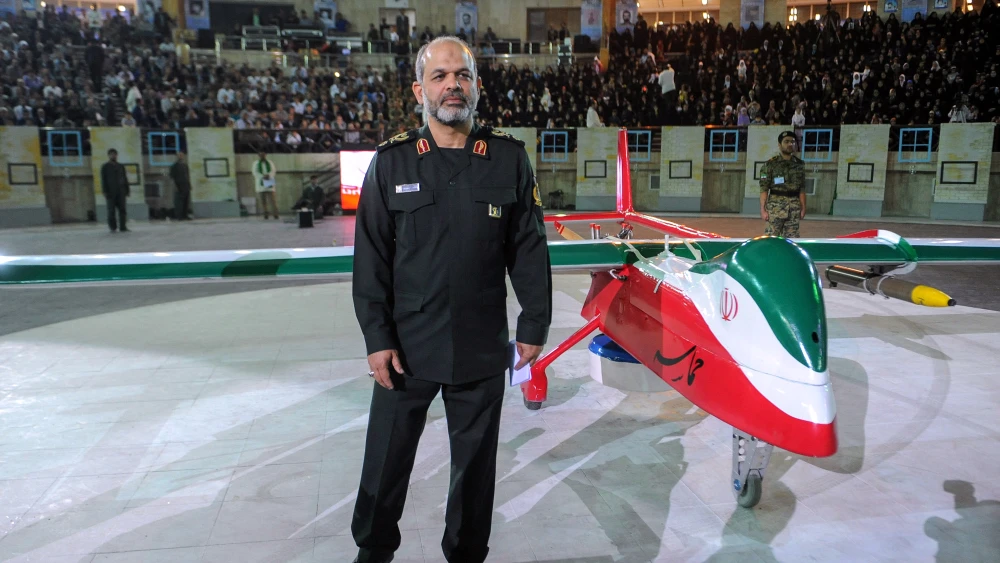

Three months after what many Iranians describe as a national catastrophe—the butchery of some 45,000 patriotic protesters during the January 2026 nationwide uprising—and only weeks after the death of Ayatollah Ali Khamenei, a notorious dictator has re-emerged at the center of Iran’s Shi’a mafia structure.
The return of Ahmad Vahidi is not a routine bureaucratic reshuffle. It is a deliberate signal, aimed both at a restless domestic population and foreign adversaries closely watching Tehran’s next move.
Vahidi is no ordinary official.
A long-standing figure within Iran’s military establishment, he rose through the ranks of the Islamic Revolutionary Guard Corps during the 1980s, serving in senior intelligence and military roles before going on to command the Quds Force from 1988 to 1995. The fact bases of the IRGC and the Quds Force—military institutions of the Islamic terrorist regime in Tehran—have no connection to the Iranian people.
In that position, Vahidi played a formative role in shaping Iran’s approach to regional power projection and its use of asymmetric terrorist networks beyond its borders.
During the early 1990s, as Iran’s regime expanded its regional footprint, elements of the IRGC operated within a broader network of Islamist actors, including in Sudan under Omar al-Bashir. Intelligence reporting over the years has pointed to various forms of contact between Iranian operatives and figures later associated with Al-Qaeda, particularly in the context of Afghanistan. Accounts have also noted how some operatives were able to transit through Iranian territory under opaque conditions, raising longstanding questions about the nature and extent of those interactions.
Vahidi’s name is most closely associated with the 1994 bombing of the AMIA Jewish community center in Buenos Aires, which killed 85 people and injured hundreds. Argentine prosecutors have identified him as one of the senior officials involved in the planning of the attack, and he has remained the subject of international arrest requests ever since.
In Iranian political discourse, he is considered worse than German Nazi Party leader Adolf Eichmann. Although Eichmann was abducted in 1960 by Mossad from Argentina and transferred to Israel, so far, Mossad operatives in operations in Tehran have not been able to repeat history in his case. And so today, Vahidi is the de facto leader of the mullahs’ regime and the ruling junta in Iran.
His connections to senior jihadist figures, including Ayman al-Zawahiri, have also drawn scrutiny from intelligence services such as the CIA and Mossad.
Against the backdrop of this dark history, Vahidi has continued to move within official circles. In 2019, he traveled to Bolivia without being detained, underscoring the limits of international enforcement mechanisms. During Iran’s 2022 anti-regime uprising that was met with systematic brutality and lethal force, he supported the arrest of dissenting figures—reflecting a consistent alignment with the regime’s coercive approach to internal unrest.
The regime has never relied solely on diplomacy as an instrument of statecraft. Alongside formal negotiations, the IRGC and its intelligence branches have long functioned as central pillars of regime survival, tasked with both external operations and internal control.
It is from within this ecosystem that figures like Vahidi emerge and are elevated. His reappointment should therefore be understood not as an administrative decision, but as a political message. At a moment of mounting internal pressure and regional strain, in addition to heightened confrontation with Israel and the United States, Tehran appears to be reinforcing its reliance on hardened security actors.
After more than four decades in power, the Shia Islamic Caliphate is facing one of the most serious crises in its history. Domestically, the erosion of public trust—driven by economic hardship, political repression and generational shifts—has weakened the regime’s social base. Regionally, Iran’s strategy of relying on terrorist proxy networks and asymmetric warfare has become increasingly costly and, in some cases, less effective.
At the center of this system remains the IRGC, which functions as the regime’s ultimate guarantor. Leadership changes within it are rarely accidental. They tend to reflect broader strategic calculations and are often aligned with the priorities of the highest levels of power. In this context, Vahidi’s elevation suggests a preference for continuity, discipline and control over experimentation or reform.
Despite the spotlight on visible political figures, the true operational gravity lies with senior IRGC commanders. They coordinate intelligence flows, missile forces, ground operations and relationships with allied non-state actors—forming the regime’s operational backbone. In times of instability, they emerge as the system’s de facto crisis managers.
From a strategic perspective, Vahidi’s return may indicate that Tehran is preparing for a period of sustained tension rather than immediate escalation. For Israel, the signal is layered. Iranian decision-makers are likely aware that Israeli operations—particularly those targeting IRGC-linked infrastructure and networks—have imposed real costs. The ascent of this fanatical and socially unmoored figure can thus be interpreted as an effort to re-establish deterrence without breaching thresholds that risk direct confrontation.
This approach aligns with Iran’s broader doctrine of calibrated ambiguity. Rather than engaging in overt conflict, Tehran has often preferred to operate through indirect means—leveraging missile capabilities, drone systems, proxy groups and deniable actions to shape the strategic environment while maintaining plausible deniability.
For the United States, the message is somewhat different but no less significant. The elevation of a figure like Vahidi signals that, despite sanctions and diplomatic pressure, the IRGC continues to project institutional resilience. It also reflects an implicit calculation that Washington may be reluctant to enter into a prolonged or large-scale confrontation, particularly in a complex global environment.
This does not necessarily mean that Tehran is seeking immediate escalation. On the contrary, it may point to a strategy centered on endurance—managing pressure over time while preserving core capabilities and avoiding direct conflict when possible. Strengthening internal command structures is consistent with this approach.
At the same time, external signaling cannot be separated from domestic realities. The IRGC today functions not only as a military force but also as a central actor in internal security. Ongoing social and economic pressures, combined with persistent public dissent, pose a continuing challenge to regime stability. In this environment, tighter coordination between intelligence and enforcement mechanisms is likely to be a priority.
These internal dynamics, in turn, shape Iran’s external behavior. A system under domestic strain may seek to avoid large-scale war, but it may also rely more heavily on asymmetric actions abroad to manage perceptions, mobilize loyal constituencies and shift attention away from internal vulnerabilities.
Iran’s terrorist network of regional partners remains an important component of its strategy, but it is also under pressure. Groups such as Hezbollah and Hamas face their own political and operational constraints, requiring more selective use and closer coordination. This suggests a period of recalibration rather than expansion.
Looking ahead, the question of succession looms over the entire system. As Iran’s leadership ages and questions of legitimacy deepen, the IRGC is increasingly positioned as a key arbiter of future power arrangements. Senior appointments made today may therefore carry implications beyond immediate security concerns, shaping the balance of influence in a potential post-Khamenei era.
In this context, figures like Ahmad Vahidi are not only assessed for their operational capabilities but also for their reliability and alignment with the system’s core priorities. In practice, the rise of such a notorious, lethal figure underscores that these enforcers exist for one purpose alone: the preservation of the regime. Loyalty and ideological consistency remain the central criteria for advancement.
The recent changes within the IRGC should be viewed as part of a broader strategic adjustment rather than a symbolic gesture. By elevating a figure with deep roots in the security apparatus, Tehran is signaling continuity, resilience and a readiness to navigate a prolonged period of uncertainty.
For policymakers in Washington and Jerusalem, understanding these internal dynamics is essential. Iran’s trajectory is not defined solely by public statements or diplomatic gestures, but by the configuration of power within its security institutions. In that sense, personnel decisions can offer a clearer window into strategic intent than rhetoric alone.