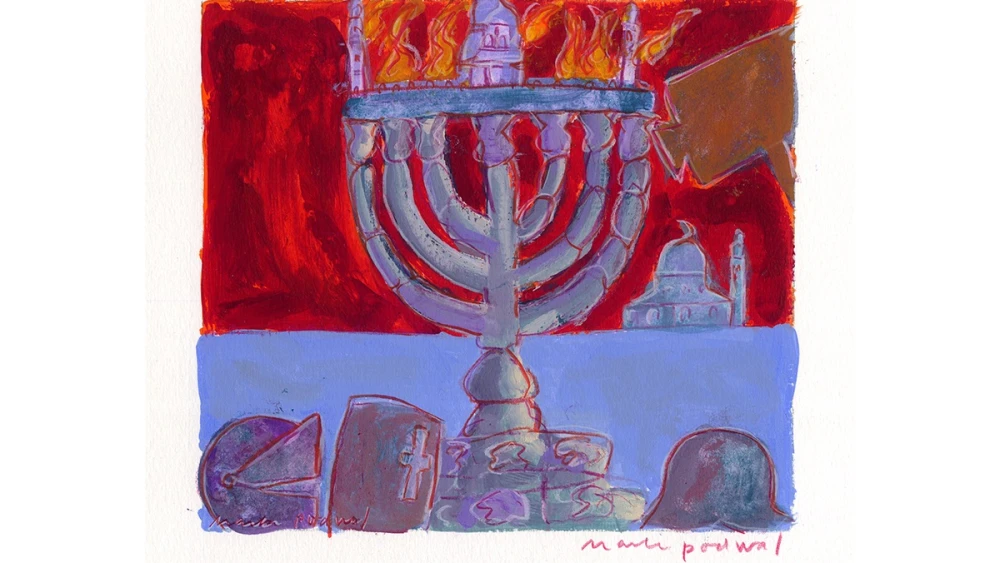
The Tisha B’Av fast is an opportunity both to mourn the destruction of Jerusalem and of the Jewish Temples that occurred some 2,000 years ago and to defend the Jewish state today, rabbis told JNS.
“We need not only to mourn for a destroyed Jerusalem. We need to defend the live Jerusalem,” Rabbi Ari Berman, president of Yeshiva University, told JNS. “We’re being called to defend Jerusalem today, and that’s truly our opportunity, responsibility and mission.”
Berman is one of several Orthodox Jewish leaders who told JNS that their messages for Tisha B’Av, which begins on Wednesday evening, will focus on action beyond mourning.
Traditionally regarded as the Jewish calendar’s saddest day, commemorates the destruction of the First and Second Temples in Jerusalem and other calamities in Jewish history.
It is customary to refrain from eating and drinking, bathing or washing for pleasure, applying lotions or oils, wearing leather shoes and engaging in marital relations during the roughly 25-hour fast.
“A lot of our challenge today is that we’re seeing people lie about the Jews and undermine the Jewish story and Zionism,” Berman told JNS. “We’re seeing it in our politics today, and people are waiting to see. What are the Jews going to do?”
“We need to respond with absolute clarity and with truth, and we need to defend Jerusalem,” he said.
Rabbi Josh Joseph, executive vice president and chief operating officer of the Orthodox Union, told JNS that there is a danger of focusing too much on contemporary issues during the fast day.
“If you’re just rallying because there’s a negative tension point, then as soon as you can solve for that tension point, did you really come together?” he said.
At this time last year, Jews were still praying for the return of the Israeli hostages in Gaza. That unity has dissipated since then, he said.
“We came together,” he said. “We got the hostages back. It was amazing. But then the hostages are back, and all of a sudden, we start falling into some of the past divisions that we have internally.”
‘All people of moral conscience’
Rabbi Yaakov Glasser, of Young Israel of Passaic-Clifton, N.J., told JNS that he plans to reflect this year on the return of the hostages to Israel, Israeli soldiers killed in battle and families changed permanently by war.
“The extraordinary events surrounding Israel’s confrontation with Iran reminded us both of the very real threats facing the Jewish people and of the remarkable divine protection and resilience that accompanied those days,” Glasser, who is also managing director of community engagement at the Orthodox Union, told JNS.
The global rise in Jew-hatred and recent attacks against Jews have also demonstrated that “the challenges of Jewish history are not confined to the past,” he said.
“At the same time, Tisha B’Av calls upon us to look inward,” and the events commemorated on the fast day remind that “internal discord left the Jewish people vulnerable,” Glasser said.
Tisha B’Av is not intended only for Jews or even only for observant Jews, according to Joseph.
“The notion of coming back to the Beis Hamikdash,” or Temple, “is God fulfilling His promise not just to the Jews but to humanity,” he told JNS.
Berman, of Yeshiva, agreed. “The vision of the Temple is not just for the Jewish people, but it’s for all of humanity,” where “truth and kindness, where the inspiration to act with truth and kindness or to live lives of truth and kindness, are for all,” he said.
“That’s why not just Tisha B’Av, but our mission itself, is not just for the Jewish people,” he told JNS, “but really all people of moral conscience to work together to bring goodness, to dispel hate and to bring goodness to the world.”