
The Islamist terrorist group Hamas has been regrouping by relocating its operations to Europe and activating sleeper cells.
On June 6, Greek authorities arrested a Hamas terrorist in Agios Nikolaos, a popular tourist resort on the island of Crete. The terrorist was preparing a deadly attack on Israeli targets with the declared goal of “putting Hamas back on the map.”
The arrested terrorist belongs to a terrorist cell that includes at least seven members, five of them stationed in Cyprus, another European Union member state in the Mediterranean. The cell was activated and preparing attacks on Israeli targets.
Israel’s Foreign Ministry applauded the dismantling of the terror cell, commenting on X that “from Greece to Cyprus, authorities continue uncovering Hamas-linked terror activity on European soil.”
The 37-year-old Palestinian from the Gaza Strip was arrested after a joint operation, codenamed “Odin,” by Greece’s National Intelligence Service (EYP) and the counter-terrorism unit.
After questioning, he admitted being a member of Hamas, having contacts with other individuals and participating in activities to carry out a terrorist attack against Israeli targets.
On Monday morning, the terrorist was charged with four felonies: establishment and participation in the Hamas terrorist organization, training in the manufacture and use of explosives to carry out terrorist acts, traveling to receive training for terrorist acts and criminal support for terrorist purposes.
In his apartment in Athens, authorities found all the necessary equipment to produce bombs. He was still waiting to receive chemical agents after placing an online order.
The terrorist claimed he did not yet know his target and was waiting for instructions from his handler.
Scenarios include an attack with explosives against the Israeli cruise ship Crown Iris, which often visits the port of Agios Nikolaos, or Israeli targets in Cyprus. Other European countries would also be targets, according to statements by the Greek minister of citizen protection.
The Hamas terrorist arrived in Greece in July 2023, posing as a refugee from the Gaza Strip. He received international protection status and relocated temporarily to Germany, where he joined local Hamas networks.
He returned to Greece in the summer of 2025, moving between Athens and Crete during the summer season.
Over the last period, he had been employed as an electrician at a luxury hotel in Agios Nikolaos. According to local residents, he maintained a low profile, residing with three other Palestinians in a motel paid for by his hotel employer.
Still, the terrorist cell was beginning to advance its terrorist plan.
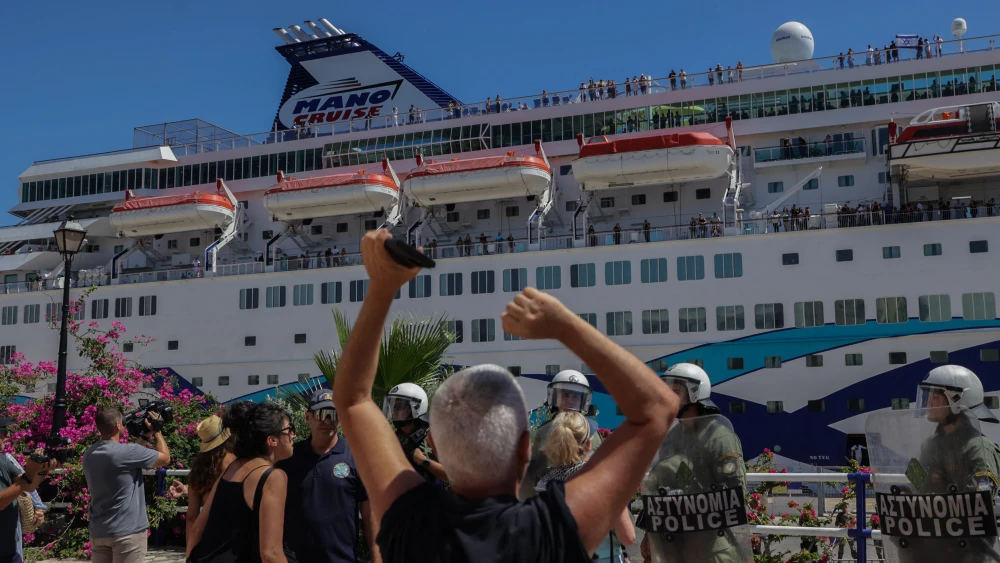
According to Greek media, in October 2025, he was questioned by Greek police, along with four other Palestinians, for participating in an anti-Israel demonstration at the port of Agios Nikolaos during the arrival of the Israeli cruise ship Crown Iris. The five individuals were released after no evidence was found against them.
New intelligence later led to the dismantling of the terrorist cell and his arrest.
Greek authorities placed the Hamas terrorist under surveillance, especially after cooperation with Germany’s Federal Intelligence Service (BND) regarding his residence there, where he met with Hamas members.
Intelligence from Cyprus, where a Hamas cell was dismantled in recent weeks, led to his identification and arrest.
In late May, acting on a lead from Israeli intelligence, Cypriot law enforcement authorities arrested four Palestinians following credible intelligence on their activities and the discovery of material that could be used in the manufacture of explosives.
One of the terrorists, aged 38, had entered the Republic of Cyprus through the Turkish-occupied northern part of the island. During the investigation, authorities identified a phone number as a key link in the terrorist network, which led to Crete, where the arrested member of the cell was residing.
The Cyprus-based group was coordinating with Hamas operatives planning to attack IDF soldiers at the Anatot military base near Jerusalem. The terrorist cell was receiving money through an international network, and at least two more members remain at large in Greece and Cyprus.
“Hamas’s networks in Cyprus operate as flexible hubs of logistical support and operation control, using the island’s geographical proximity to Lebanon and Israel,” Marios Poullados, news director of the Cypriot media outlet Sigma Live, told IPT.
“Hamas is using Cyprus to transport weapons, for digital communications and preparing attacks. Cypriot authorities cooperating closely with Greece, Israel and German intelligence agencies have proven effective in dismantling the terrorist networks, especially as there is a large number of Israelis residing in Cyprus. Greater emphasis has to be given to the way Hamas’s networks use Turkey’s occupation of the northern part of Cyprus to infiltrate the EU.”
The handler and military trainer of the terrorist cell is a top-ranking Hamas official residing in Malaysia who has been fully identified by Greek intelligence services.
According to Greek authorities, the Malaysia-based handler was in constant communication with the terrorist cell operating in Greece and Cyprus.
At least three members of the terrorist cell received training in a Hamas camp in Malaysia in making explosive bombs from trade materials.
The terrorist arrested in Greece visited Malaysia twice, most recently in August 2025, residing there for at least 10 days. It was during this period that the terrorist cell received training and the operational plan for the Greece-Cyprus cell was finalized.
Malaysia, a Muslim-majority country with no diplomatic relations with Israel, has become a safe haven for Hamas. The ties between Hamas and Malaysia date back at least to the 2010s. Israel’s Shin Bet previously disclosed that a Hamas terror cell had received advanced training there.
In 2010, Hamas sent 15 men to Malaysia for a week-long paragliding training. Hamas used paragliders to infiltrate Israel during its Oct. 7, 2023, massacre.
A new modus operandi?
The dismantling of the Hamas cell in Greece and Cyprus shows that Hamas is changing its modus operandi by targeting Israelis abroad.
Hamas has maintained its transnational networks, aided by lax European asylum and migration legislation and by using neighboring countries such as Turkey as safe havens and transit routes.
“The neutralization of a Hamas-linked operational cell in Greece and Cyprus exposes a sophisticated, asymmetric proxy campaign that has effectively upgraded from localized regional conflict to hard kinetic warfare inside Europe,” Alexandros Niklan, a security analyst at Geopolitics & Daily News, told IPT.
What emerges is a transnational network including Malaysia, Turkey and Pakistan.
Malaysia acts as an operational base for Hamas members. Pakistan’s intelligence agency (ISI) also maintains an active presence in Malaysia, using the country as a base to support Kashmiri jihadist groups in India and coordinating with Hamas.
Turkey remains an important supporter of Hamas while facilitating the unhindered movement of terrorists into the European Union through its occupation of the northern part of Cyprus, as happened in this case.
As Israel continues its struggle against the Islamist regime in Iran and the terrorist networks of Hamas and Hezbollah, efforts to dismantle Islamist terrorist networks are accelerating across the region.
The danger of Hamas relocating its operations to European Union countries cannot be overstated.
In this context, coordination among European intelligence and security agencies remains a priority, as successfully demonstrated by Greece and Cyprus in dismantling the Hamas terrorist cell.