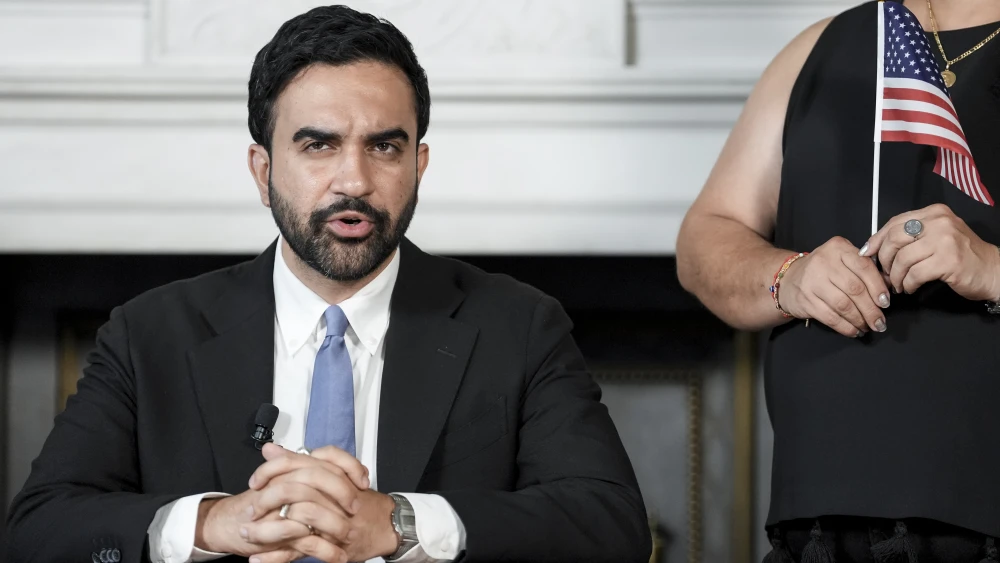

New York City Mayor Zohran Mamdani is once again making news, this time for going back on his campaign promise to arrest Israeli Prime Minister Benjamin Netanyahu if he comes to New York.
Jewish advocates are aghast. American patriots point out that this is yet another example of the Mamdani-supporting Democratic Socialists of America’s total rejection of American ideals.
But what did they expect?
What you are witnessing here is the broken windows theory in action because Jewish legacy and mainstream organizations have, for the most part, never dealt with anti-Zionism. It is what JNS columnist Benjamin Kerstein calls “the most racist ideology in the world … the logic of which is genocide.”
Indeed, Mamdani is not really the problem. He is the result of decades of avoiding the fight against anti-Zionism for fear of alienating progressive allies, terror of giving offense and wanting to be loved. It is the result of an American Jewish community locked into a single, outdated way of interpreting Jew-hatred and unwilling to confront, or simply not knowing how to confront, its most lethal contemporary form: anti-Zionism.
When the Russian-speaking Jewish community in America sent emails to the Anti-Defamation League in the early 2000s ringing the alarm bells, they were ignored. When Jews mobilized against the anti-Zionist ethnic-studies curriculum in California in 2017, they were vilified as “right-wingers” by the Jewish Community Relations Council. And when many begged Jewish leaders to walk away from their venerated “seat at the table,” they promised that staying at the table would give us a voice.
It was all left for the taking. And taken it has been.
The first window broke in 1993, when Students for Justice in Palestine was founded at the University of California, Berkeley. Almost no one heard the glass shatter.
At that time, SJP was decentralized, marginal and operating on the periphery of campus political life. Zionism was not yet treated as a moral crime in academia. The libels of apartheid, settler-colonialism and intersectionality were being seeded, but they had not yet taken root as orthodoxy. In 1996, Jewish Voice for Peace emerged to provide the movement with cover as the self-described “Jewish wing” of the Palestinian solidarity movement.
Still no repair.
The second window broke in 2004, with the launch of the BDS campaign, the academic and cultural boycott of Israel. This was no longer a student club tabling in the quad. It was an organized international campaign to recode the Jewish state as a pariah, modeled explicitly on the delegitimization of apartheid South Africa.
The third window broke in 2005, when Israel Apartheid Week was launched. It broke every single year afterward in an annual ritual of shattering, institutionalized on campuses across North America by SJP.
And how did the anchor institution of Jewish campus life respond to an event dedicated to the apartheid libel? With “parallel programming.” Hillels, which were never designed as advocacy or rapid-response bodies (their mission was solely to be a Jewish “home away from home”), hosted alternative events fostering positive Jewish expression.
The first window broke in 1993, when Students for Justice in Palestine was founded at the University of California, Berkeley. Almost no one heard the glass shatter.
Tellingly, it was the U.S. Commission on Civil Rights—a federal, non-Jewish body—that noted in 2006 that campuses have an anti-Zionism problem. A government commission saw the shattered glass before the Jewish legacy organizations whose entire purpose was to see it.
Windows kept on breaking over the next two decades, as SJP chapters brought their yearly demands that universities sever ties with Israeli universities. The chapters pushed their divestment resolutions, boycott votes and campaigns to end study-abroad programs and research partnerships with ruthless persistence.
And what guidance did administrators receive from Jewish leadership? When the ADL began tracking “anti-Israel” activism in 2010, it framed anti-Zionism as something that may “cross the line into antisemitism” when it demonizes, delegitimizes or applies double standards to Israel. But that is precisely what anti-Zionism, by definition, does. There was and is no line to cross.
Yet because major Jewish organizations adopted this language, administrators who looked to them for guidance understood anti-Zionism as something that might become bigoted under certain conditions rather than as something inherently directed at Jewish collective identity.
Indeed, in 2019, even those who crafted the International Holocaust Remembrance Alliance’s (IHRA) working definition of antisemitism, which was, by design, meant to include demonization of Israel, never named the hateful ideology at the heart of this demonization: anti-Zionism.
The fifth window broke inside the faculty lounge. This one mattered more than all the student activism combined, because professors conferred intellectual legitimacy on the movement.
Anti-Zionist events came to be routinely sponsored by academic departments. AMCHA Initiative studies from 2015 and 2016 found that campuses with even one faculty boycotter were at least four times more likely to suffer incidents of anti-Jewish hostility. The escalation culminated in the founding of the Institute for the Critical Study of Zionism at the University of California, Santa Cruz in 2021, an academic body whose very premise is that Zionism and Jewish identity are an object fit for “critical study” the way one studies white supremacy.
The window-breakers no longer needed to break in. They had faculty offices, department budgets, and now, an institute.
Then came the broken door. In 2023, Faculty for Justice in Palestine was created, growing to more than 80 chapters and giving professors an organized national vehicle for the movement, followed by the encampments—the seizure of the physical campus itself. FJP and SJP chapters called for “Zionists” to be removed from campuses, the banning of Hillel and Chabad, and the harassment and vandalization of “Zionist” institutions.
The vandals had kicked in the door and occupied the house.
Even then, staring at the smashed-in door, our institutions could not name what had broken it. Even the ADL’s 2022 statement that “Anti-Zionism is antisemitic, in intent or effect” pivoted almost immediately to a discussion of political criticism, rather than defining anti-Zionism or naming its core libels.
Here lies the confusion behind every unrepaired window: The American Jewish community persistently conflates anti-Zionism with policy disagreement, debates over borders, government decisions or dissatisfaction with an Israeli leader. That is not what anti-Zionism is. Its political vocabulary is not accidental. It is a totalizing hate of the Jewish people embodied in the Jewish state.
It was all left for the taking. And taken it has been—in city halls, schools, medicine, Hollywood and the arts, media rooms.
Mamdani did not break the windows. He walked through the shattered panes because those who were supposed to protect Jews against defamation remained silent about anti-Zionism.