
Just 10 days after Oct. 7, 2023, when Hamas began its fifth war on Israel, the terror group heard a useful broadcast from its patron, Iran.
The speech by the late Ayatollah Ali Khamenei brazenly mischaracterized Israel’s military defense as a “genocide.” Scores of experts in the laws of war dispelled the sinister depiction, calling the Israel Defense Forces “a professional military, ethically and legally committed to the protection of civilian life.”
Nevertheless, anti-Israel advocates worldwide echoed the Iranian lie.
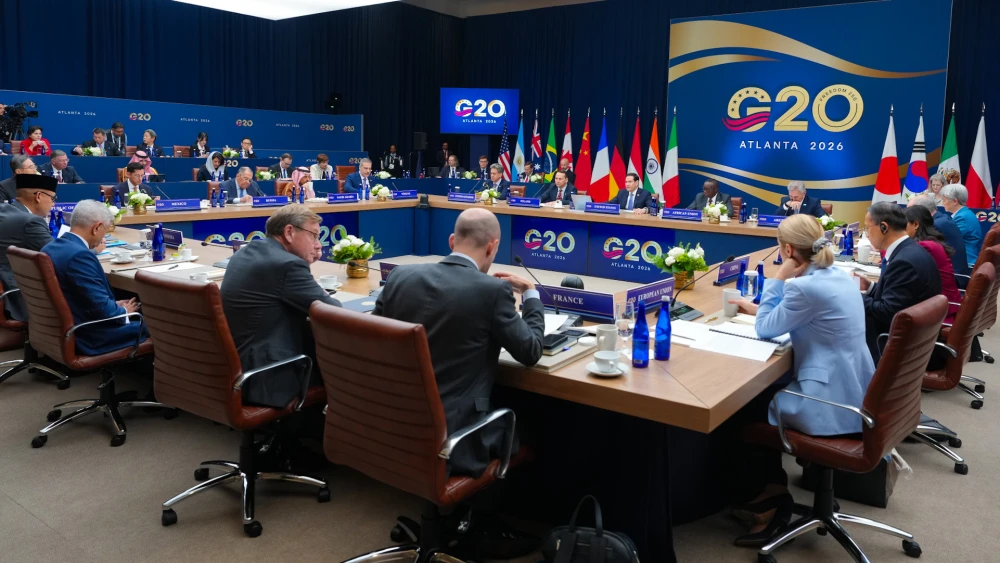
In the organization of the world’s top 20 economies, called the “G20,” most members have not labeled the war in Gaza a genocide. That group includes the world’s leading democracies: the United States, Canada, the United Kingdom, the European Union, Australia, Japan and South Korea.
The few G20 members that called the Gaza war a genocide were already vocal critics of Israel.
Those states were Russia, Brazil, Turkey, South Africa and Saudi Arabia. In Russia, antisemitism has permeated official policy for over a century. Except for the period from 2019 to 2023, Brazil has strongly backed the Palestinians, and even recognized a “State of Palestine,” since 2010. Turkey has actively supported Hamas and threatened Israel directly. South Africa, another Hamas supporter, began its unprovoked denigrations of Israel years before the Gaza war. The Saudis have never even recognized Israel’s right to exist.
Despite their hostile rhetoric, all five of these G20 players still trade with Israel. Thus, they grandstand for their Israel-hating constituencies without paying a high economic price.
Ultimately, these countries’ cynical leaders cannot publicly justify doing business with a country they accuse of annihilating the Palestinian people, so they each manage the contradiction in their own way.
Russia exports raw materials to Israel while Israel sends Russia agricultural produce, textiles and optical instruments. The annual exchange is worth $3.8 billion. Russia enjoys the arrangement while feigning sympathy for the Palestinians.
Various nations with economies below the G20 level mimic the ‘genocide’ virtue signaling but still trade with Israel.
In early 2024, Brazil’s current President Luiz Inácio Lula da Silva topped the ayatollah’s extremism by comparing the Gaza war to the Holocaust.
By the end of that year, however, Brazil and Israel still conducted annual trade worth about $1.9 billion, with Brazil exporting crude oil and beef to Israel while receiving fertilizer and chemicals in return. In 2025, Brazil embargoed direct oil exports to Israel but quietly kept shipping unknown volumes of fuel through third-party refineries.
Brazil never lobbied the other countries in its customs union to narrow the group’s collective free trade agreement with Israel. Those neighbors—Argentina, Paraguay and Uruguay—are broadening their ties with the Jewish state.
In 2024, Turkey announced the end of its commercial relationship with Israel but continued the trade at lower levels through intermediaries such as Greece and the Palestinians. Turkey itself remained a trade conduit by shipping Azerbaijani crude oil to Israel, a service that meets roughly 40% of Israel’s oil needs.
In December 2023, South Africa petitioned the International Court of Justice to declare Israel guilty of genocide. The case remains pending.
But the government never put its money where its mouth is. After filing the petition, South Africa actually increased its coal exports to Israel by 11% and continued to buy $177 million per year in Israeli pesticides and pharmaceuticals.
Saudi Arabia refuses to establish formal relations with Israel. Still, the two states cooperate against mutual enemies such as Iran and Hezbollah. In addition, they clandestinely exchange products, such as Israeli high-tech gear, in contracts worth hundreds of millions of dollars. By keeping their anti-Israel tirades public and their pro-Israel commerce private, the Saudi royal family avoids domestic dissent.
Various nations with economies below the G20 level mimic the “genocide” virtue signaling but still trade with Israel. For example, between 2025 and 2026, Ireland and Spain demonized Israel with the “g” word and banned Israeli imports from Judea and Samaria.
The cutback was no great sacrifice. Observers considered the import value of the banned goods “more symbolic than economic.” Indeed, Ireland remained the biggest buyer of Israeli integrated circuits, valued at about $3 billion per year. In 2025, Spain declared a complete halt to weapons procurement contracts with Israel, valued at $1 billion, but subsequently kept buying certain Israeli arms.
Some lawyers reason that an E.U. member state cannot freeze all trade with Israel due to potential liability under the E.U.-Israel Association Agreement. However, any E.U. leaders who genuinely believe Israel is exterminating the Palestinian people would presumably distance themselves from the supposed mass murderers, despite the legal risk.
Slandering Israel is an old game. The Jewish state has been battered by genocide lies and boycott attempts throughout its existence. Yet today Israeli goods are consumed by as many as 119 trade partners. Apparently, the natural forces of mutually beneficial commerce are stronger than any concocted defamation.