



The Western media’s failure to assign agency to Palestinians—to the point of effectively erasing Hamas and the impact of their decision to launch the Oct. 7 massacre—is so widespread that even thoughtful commentators on the conflict inevitably succumb to this illiberal framework.
A recent example of such myopia can be found in an Oct. 25 piece written by Tim Stanley, a columnist and podcast co-host at The Telegraph, titled “Benjamin Netanyahu is destroying the case for a Jewish homeland,” written two days before Israel’s elections.
Though Stanley didn’t write the headline, surreally suggesting that we’re in a pre-1948 world where the Jewish state’s right to exist is a matter of debate, it is, however, largely consistent with the general tone of the piece.
He begins by leveling sober criticism of Israel’s prime minister and a few of his ministers, while later acknowledging that the state defies any “easy definition.” For instance, Stanley writes: “Christians are occasionally spat at, but this is illegal and results in arrest.”
He criticizes the media’s obsessive focus and vilification of Israeli policies in Judea and Samaria, while quoting historian Simon Sebag Montefiore’s new book on the Middle East to undermine the Green Party’s “Zionist is Racism” libel. The column takes an ugly turn when Stanley writes that “there is a tragic case to be made that the Gaza war has left global Jewish populations more vulnerable, not less.”
First, his framing of the post-Oct. 7 conflict as “the Gaza war” erases the war’s cause: Hamas’s barbaric mass murder, rape, torture and mutilation of more than 1,000 Jews—antisemitic savagery that, like the Second Intifada, will be seen as having exacted a long-lasting trauma on citizens of the state.
The “Gaza war” wasn’t a war of choice, but one of existential necessity.
Further, while Stanley, in the following paragraph, cautions against blaming Diaspora Jewish victims for post-Oct. 7 antisemitism, that moral throat-clearing doesn’t render his argument that the “Gaza war” left the global Jewish population less safe any less baffling—and disturbing.
Israel didn’t declare war on Hamas after the terror group’s pogrom to make Diaspora Jews safer, but to defend its own population from a sadistic, antisemitic enemy on its border who sought the state’s destruction. Internal Hamas documents shared by The New York Times in 2024 confirmed that “Yahya Sinwar and top commanders hoped the Oct. 7, 2023 attack would trigger a regional conflagration causing Israel to collapse.”
Jews across the world faced rising antisemitism, which began to surge, crucially, weeks before the Israel Defense Forces’ ground invasion of Gaza on Oct. 27, as the result of the perverse dynamic by which Hamas’s slaughter of Jews energized the pro-Palestinian movement in the West.
Dave Rich, policy director of the Community Security Trust (CST) in the United Kingdom, commenting on the pro-Palestinian demos in London two days after the massacre, observed the following: “The mood [in London] was celebratory. Flares were lit, flags flown, slogans chanted. People danced. Thousands descended on the Israeli embassy before hundreds made their way to central London last night, blocking roads and filling the streets as they partied. This was an expression of joy, not an explosion of rage.”
Stanley does note that Israel had a “right to defend herself,” but then argues that the way Israel’s leaders have “prosecuted this conflict ... has turned a whole generation off Zionism.”
But he doesn’t offer an alternative course of military action or explain how other Western democracies, when faced with such a savagely brutal invasion of their homeland, would have fought such a war against an enemy who hides behind civilians and civilian infrastructure in a substantively different manner.
Further, his claim that the war has turned a whole generation “off Zionism” is contradicted by research conducted by the Institute for Jewish Policy Research, which showed that the proportion of British Jews identifying as Zionist rose from 59% in late 2022 to 66% by June 2025. In the United States, research in 2024 by the Jewish People Policy Institute showed that 80% of respondents identified to various degrees as Zionists.
In the penultimate paragraph, Stanley gets more personal when he writes that when he was a boy, “and memories of the Holocaust were fresher, creating a homeland for the Jews was still widely regarded as a human-rights cause.”
Now, he adds, “it is eclipsed in the Western imagination by the demand for Palestinian statehood, to which Israel is broadly perceived as an implacable, even cruel opponent.”
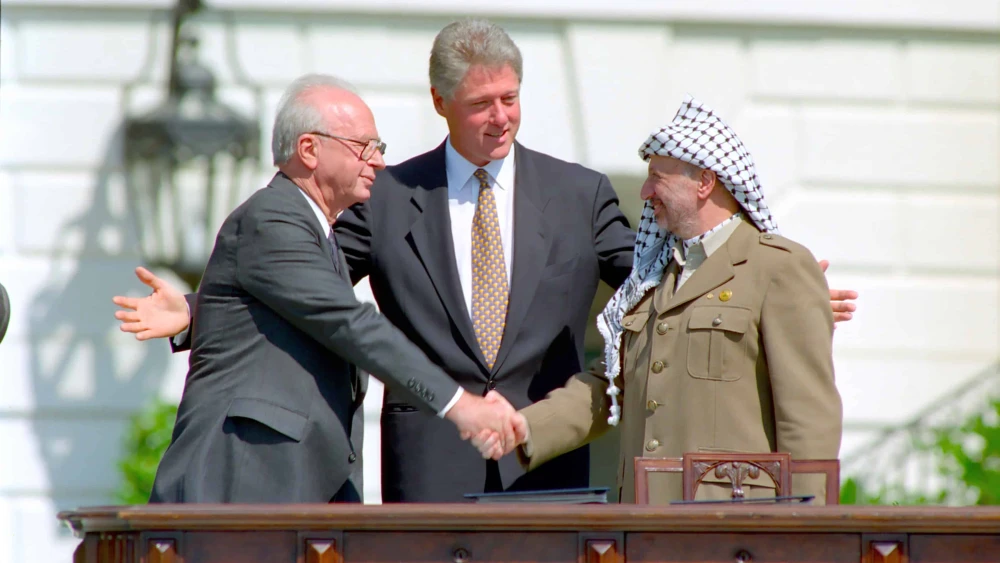
He ends by lamenting the failure of new leaders, such as former Israeli Prime Minister Yitzhak Rabin, who can look their own constituencies in the eye and say, “We must compromise for peace?”
It’s extraordinarily telling that the Telegraph columnist failed to recognize the failure of Palestinians leaders to “look their constituents in the eye” and say, “We must compromise for peace.”
In his myopic Israeli-centered tale, the Palestinians’ rejection of peace in 2000, 2001 and 2008 isn’t mentioned. Nor is the Second Intifada cited. The decision by PLO chief Yasser Arafat to launch a years-long campaign of murder against Jewish civilians began precisely when a contiguous Palestinian state was offered to him at Camp David and Taba, thus shattering the hopes of a generation of Israelis, leading most to believe that Palestinian peace was a mere chimera.
Nor, finally, does Stanley acknowledge Hamas’s rise to power after Israel evacuated every last Jew out of Gaza—the beginning of a 17-year reign of terror launched from the territory that culminated, on Oct. 7, 2023, in the worst antisemitic massacre since the Holocaust. The atrocities that occurred that day have affected Israelis in ways that political researchers and mental-health experts are only beginning to understand.
In short, missing from Stanley’s meditation on the Israeli-Palestinian conflict are the destructive, malevolent decisions of the latter party, a moral blind spot informed by a precept that denies that the normal laws of causation apply to Palestinians, insisting that no Palestinian action can ever be connected to a Palestinian outcome.
It would never occur to the journalist that Palestinian leaders—in their rejection of peace, obsessive hatred of Jews and embrace of conspiratorial explanations for their misery—have been the most “implacable, even cruel opponents” of Palestinian statehood.


