
Germany has spent generations teaching the world how to remember Jewish death. It is now confronting the more difficult and urgent task of defending Jewish life.
Eighty-one years after the collapse of the Third Reich, the nation that once sought to erase the Jewish people from history finds itself wrestling with a dilemma history never truly resolved: What does “Never Again” require when antisemitic hatred returns clothed in new language, symbols and political fashions?
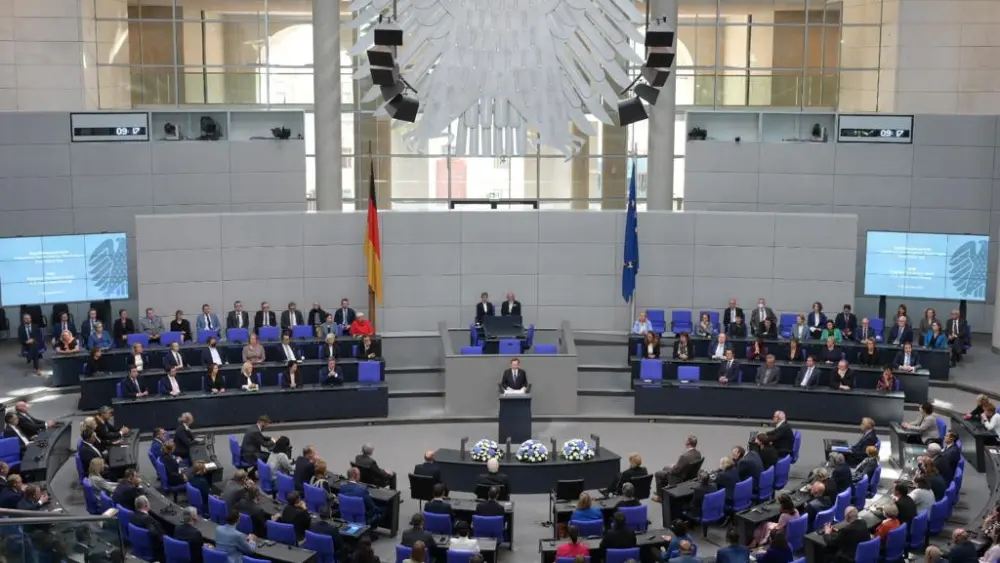
German legislative body, the Bundesrat, has advanced legislation that would make certain public denials of Israel’s right to exist or calls for the destruction of the Jewish state punishable by law. This would be the case only when such speech can incite antisemitic violence.
The proposal still faces legislative hurdles, and reasonable people may disagree about where the boundaries of protected expression should be drawn. Yet the significance of this moment extends far beyond parliamentary procedure. Germany appears to be acknowledging a truth much of the democratic world has spent years evading: the campaign against the legitimacy of the world’s only Jewish state is not always distinct from antisemitism. Increasingly, it has become one of antisemitism’s principal expressions.
The new legislation comes amid a grim reality.
Germany recorded a historic surge in antisemitic incidents following the Hamas-led massacre in Israel on Oct. 7, 2023. The numbers tell a troubling story, but statistics alone cannot capture what they represent. Behind every report stands a Jewish student who conceals a Star of David necklace beneath a shirt, a synagogue that requires armed protection and a family that weighs whether public expressions of Jewish identity are worth the risk. The figures are not merely data points. They are warning flares over a darkening horizon.
Germany has advanced legislation that would make certain calls for the destruction of Israel illegal.
For decades, Europe understood antisemitism primarily through the imagery of its most infamous incarnation. The hatred wore uniforms, marched beneath banners and announced itself with unmistakable symbols before descending into catastrophe. Entire generations were educated to recognize those signs, and rightly so. Museums were built. Memorials were erected. Wreaths were laid beneath stone and bronze. Heads were bowed. Promises were made.
Yet remembrance was never intended to be an end in itself. The purpose of memory is not to preserve tragedy behind glass. The purpose of memory is to prevent tragedy from reoccurring.
That is where Germany’s reckoning becomes significant. The nation is confronting the possibility that antisemitism in the 21st century does not always arrive wearing the face Europeans were taught to recognize.
The old hatred often declared that Jews possessed too much power. The new hatred frequently insists that Jews alone are unworthy of power. The old hatred sought to strip the Jews of their rights. The new hatred increasingly questions whether the Jews should possess the right of national self-determination. The vocabulary has changed, but the obsession endures.
This distinction matters because criticism of Israel is not antisemitism. No democracy is immune from criticism, and the Jewish state is no exception. Its governments can be debated, its policies scrutinized and its leaders challenged, just like those of any other democratic nation. Yet there remains a profound moral and intellectual difference between criticizing what a state does and demanding that a state cease to exist.
That distinction has become increasingly blurred in public discourse.
Across much of the West, slogans calling for the elimination of Israel are often treated as expressions of political idealism, rather than declarations that have profound negative consequences. Jews are routinely expected to regard calls for the dismantling of their national refuge as legitimate contributions to democratic debate. No other nation is expected to justify its continued existence before the tribunal of fashionable opinion. No other people is so frequently instructed to view the proposed destruction of its homeland as a matter of philosophical disagreement.
History offers little comfort when societies begin normalizing such ideas.
Auschwitz did not rise from the European landscape fully constructed. It began long before, when language eroded restraint, institutions surrendered judgment and respectable society learned to regard Jewish existence as a question rather than a fact. It began when hostility acquired legitimacy, prejudice found a vocabulary and hatred received permission. The machinery of destruction came later. By the time it arrived, the moral foundations that might have resisted it had already been hollowed out.
The purpose of memory is to prevent tragedy from reoccurring.
That is why Germany’s proposed legislation has significance beyond its immediate legal implications. Whether one ultimately supports or opposes the measure, it reflects an understanding that democratic societies cannot afford the luxury of deliberate blindness. They cannot commemorate Jewish victims of the past while dismissing threats against Jewish communities in the present. They cannot proclaim fidelity to “Never Again” while refusing to confront movements that openly deny the legitimacy of Jewish sovereignty.
None of this means that governments should criminalize every offensive opinion or controversial argument. Liberal democracies must remain vigilant in protecting free expression, particularly when questions of politics and foreign policy are involved. The preservation of liberty requires confidence rather than fear. Yet liberty also requires discernment. A civilization need not suspend moral judgment every time hatred learns a new vocabulary.
Germany’s burden in this debate is unique because German history is unique. No modern nation bears a greater responsibility to comprehend the potential consequences of minimizing, rationalizing or overlooking antisemitism. The memory of World War II and the Holocaust imposes obligations that reach far beyond ceremonies, speeches and annual rituals of remembrance. It demands vigilance, clarity and, above all, the courage to recognize old dangers when they appear in unfamiliar forms.
The ultimate test of “Never Again” is not whether Europe will remember the dead. The dead ask nothing of us. The test is whether Europe possesses the clarity and courage to protect the living.
Germany’s proposed legislation will not end antisemitism. No law possesses that power. Hatred is older than governments, constitutions and the institutions tasked with containing it.
Yet the legislation reflects a recognition that much of the democratic world still struggles to embrace: a call for the destruction of the world’s only Jewish state does not become enlightened simply because it is wrapped in the language of activism rather than the language of conquest.
Memory is sacred, but memory alone is not a shield. The true meaning of “Never Again” is not found in how faithfully a nation mourns Jews after they are gone. It is revealed by whether that nation possesses the courage to defend Jews while they are still here.