


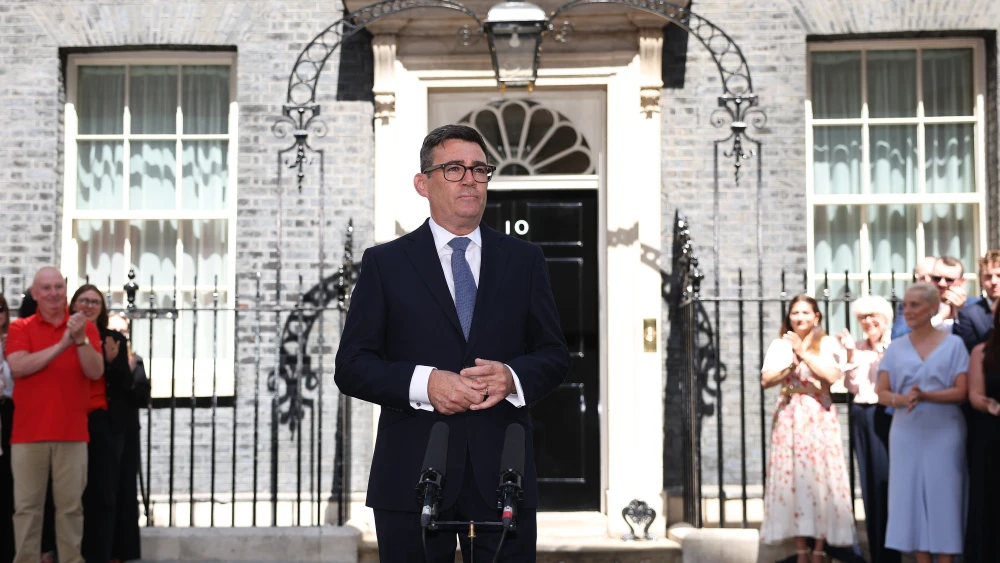
Andy Burnham became Britain’s prime minister on Monday, making him the country’s seventh leader since 2016 after replacing Keir Starmer, who resigned following mounting internal pressure and a series of political setbacks.
Burnham, 56, the former mayor of Greater Manchester, was elected leader of the governing Labour Party on July 17 after running unopposed. He secured the backing of Labour lawmakers and party affiliates after Starmer announced he would step down as party leader last month.
In his first remarks outside 10 Downing Street, the prime minister’s official residence and office, Burnham vowed to “make this moment a circuit breaker for Britain.”
“We will change politics, to make it more collaborative, more about problem solving than point scoring,” he said. “We will take power out of here and carry it into every postcode in the land so that they can do more—and in doing more, build a new economy where we put life’s essentials back under stronger public control to make them affordable to you again.”
Burnham pledged a “10-year plan” to address Britain’s cost-of-living crisis, reduce homelessness and expand public control over essential services. He also promised reforms to education, increased mental health support for young people and the construction of more public housing.
Though he did not mention Israel in his first speech as prime minister, he told The Guardian on July 17 that many people believed Starmer’s government “didn’t get it right” in its response to Israel’s war against Hamas in Gaza.
“I am sorry about that. The response has too often not been good enough. We need to do better,” he told the newspaper.
Burnham also said there was “increasing evidence that war crimes appear to have been committed” in Gaza, but stressed that “it must be for the international courts to determine, rather than politicians.”
He called for consideration of “further sanctions” on Israel and said Britain should examine measures “to ban trade in goods with illegal settlements.”
There is “no contradiction between a zero-tolerance approach to antisemitism and holding the Netanyahu government to account,” he said. “I will always take a fair and balanced approach and stand up for what is right.”
Phil Rosenberg, president of the Board of Deputies of British Jews, congratulated Burnham on Monday.
“We welcome his early commitment to tackling antisemitism, and will work with his administration towards the UK playing its strongest role in global peace and security,” Rosenberg stated.
Ephraim Mirvis, chief rabbi of the United Hebrew Congregations of the Commonwealth, also welcomed Burnham’s appointment.
Burnham “assumes the immense responsibility of leadership at a time of great challenge, both at home and abroad,” Mirvis stated. “May he be blessed with the wisdom, strength and good judgment to keep our country safe and may his service bring prosperity and harmony for all.”
Starmer traveled to Buckingham Palace on Monday to formally submit his resignation to King Charles III, who accepted it. Burnham later met with the king, who invited him to form a new government, completing the transfer of power.
In his final address as prime minister, Starmer thanked the British public “for the opportunity to serve.”
“As I now pass the baton to Andy Burnham, I wish him every success,” Starmer said. “He has my full support.”


