


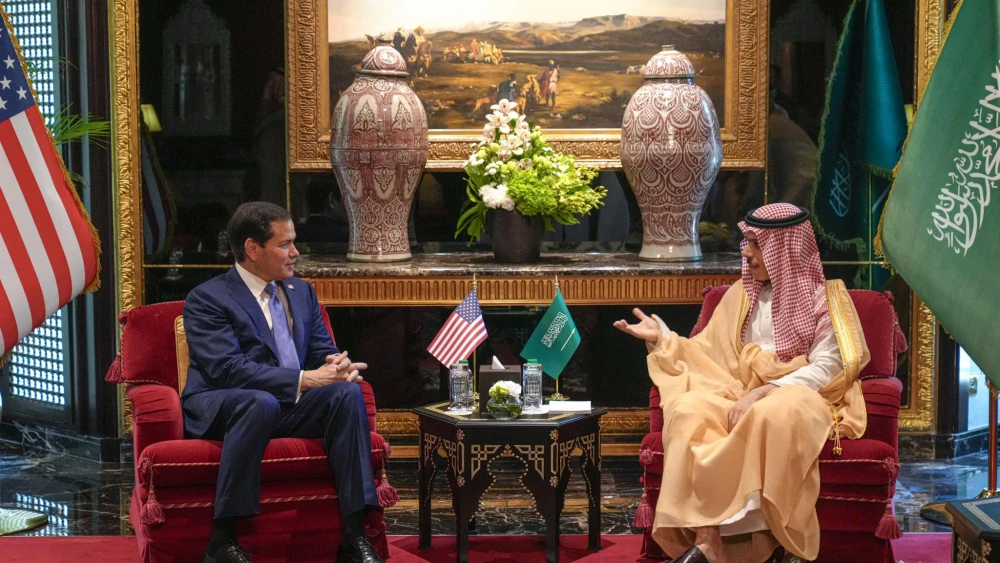
U.S. President Donald Trump has approved an agreement with Saudi Arabia that could allow the kingdom to develop civilian uranium enrichment capabilities, The Wall Street Journal reported on Tuesday, citing Trump administration officials.
The officials, who were not authorized to discuss the matter publicly, said the proposed 30-year agreement is worth tens of billions of dollars and would give U.S. companies a central role in developing Riyadh’s civilian nuclear infrastructure.
The agreement could be announced as early as Wednesday, people familiar with the matter told the Associated Press. It is expected to be submitted to Congress for review in the coming days.
Under the reported terms, the United States would approve uranium enrichment in the kingdom only if a joint U.S.-Saudi study concludes the move is justified.
The agreement is not expected to include the International Atomic Energy Agency’s Additional Protocol, which provides greater inspection and verification powers, according to one of the sources cited by the AP.
Saudi Arabia has long sought U.S. backing for a civilian nuclear energy program as part of efforts to reduce its dependence on oil.
The proposed agreement is expected to face scrutiny in Congress amid concerns that permitting uranium enrichment in Saudi Arabia could fuel a broader nuclear arms race in the Middle East.
U.S. Energy Secretary Chris Wright said in April 2025 that “there will definitely be a 123 agreement” with Riyadh, referring to Section 123 of the U.S. Atomic Energy Act of 1954, which restricts U.S. nuclear cooperation with Saudi Arabia until the two countries conclude a peaceful nuclear cooperation agreement.
“There’s lots of ways to structure a deal that will accomplish both the Saudi objectives and the American objectives,” he said at the time, while noting that Saudi authorities had yet to agree to Washington’s demands.
Section 123 defines nine nonproliferation criteria a state must meet to keep it from using the technology to develop nuclear weapons or transfer sensitive materials to other countries.
The U.S. and Israel have long signaled they are ready to accept the risks of a nuclear Saudi Arabia in return for Riyadh normalizing ties with Jerusalem, something Israeli Prime Minister Benjamin Netanyahu has said would be a “quantum leap … It will change Israel’s relationship with the rest of the Arab world.”
It was not immediately clear whether the deal reportedly approved by Trump would require Saudi Arabia to take any steps toward recognizing the Jewish state.
Former Israeli Defense Minister Avigdor Lieberman said on Wednesday morning that the reported agreement “crosses a red line.”
“This is how Iran started,” Lieberman, leader of the opposition Yisrael Beiteinu Party, told the Kan News public broadcaster. “Every military nuclear program starts as a civilian program.”
Lieberman, who is seeking to unseat Netanyahu in the Oct. 27 election, called the reported terms “completely unacceptable” and said it would trigger “an insane nuclear arms race” across the Middle East. He urged the Israeli government to “be firm and not stutter” vis-a-vis the Trump administration.


