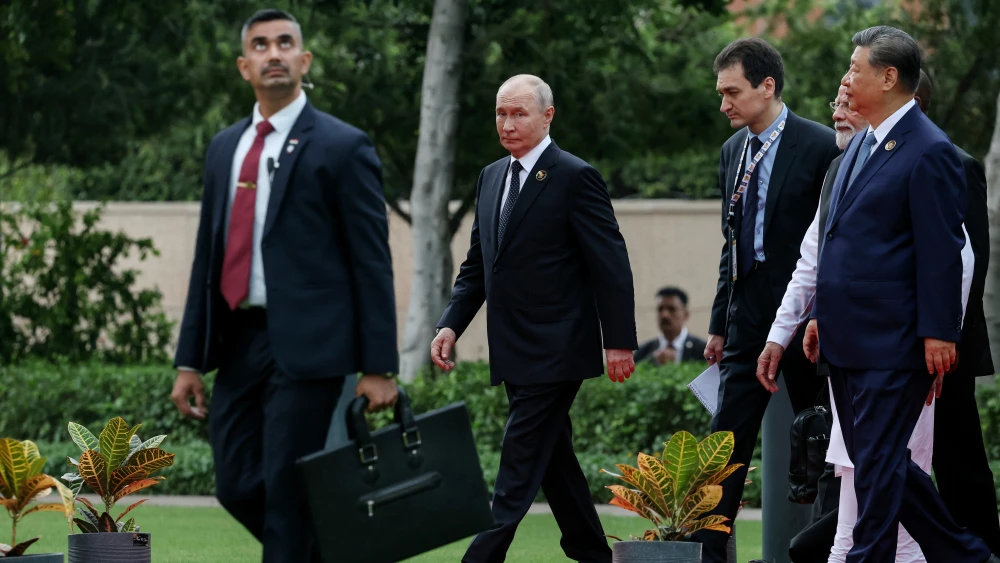

I’ve recently been following the traditionally anti-Western BRICS summit in New Delhi, which began on Sept. 12. Iran sent its president, Masoud Pezeshkian, to the conference to secure a condemnation of the United States and Israel for their war against the mullahs. He failed spectacularly.
BRICS stands for the original founders of the alliance: Brazil, Russia, India, China and South Africa. China and Russia perceived Western weakness and envisioned a coalition that could eventually undermine Western financial and political systems, as well as build new resistance from the “Global South”—a reference to Third World countries.
The alliance was officially formed in 2009 during the Obama presidency. Since then, China and Russia have enticed Egypt, Ethiopia, Indonesia, Saudi Arabia, the United Arab Emirates and Iran to join as major members of the coalition.
Yet the alliance has just refused to condemn either the United States or Israel for the war against Iran. It was a dramatic revolt by Middle Eastern countries against China, Russia and Iran itself. Indeed, despite the personal presence of China’s President Xi Jinping, Russia’s President Vladimir Putin and Pezeshkian, all three leaders failed to sway the attendees.
Al Jazeera, the voice of Middle Eastern radicalism, bemoaned the fact that there was no such condemnation. In reporting on its “key takeaways” from the summit, the news outlet lamented that it “called for restraint in the Middle East but avoided condemning the U.S.-Israeli strikes.”
The summit’s refusal to condemn Washington and Jerusalem wasn’t merely a victory for the United States and Israel; it also was a rebuff to American critics of the war. Democratic socialists, progressives and The New York Times may prefer to attack Israel and the Trump administration, but front-line Middle Eastern countries that attended the conference understand that Iran is the genuine enemy. Indeed, Iran’s brutal missile attacks against the Gulf states appear to be the main reason for Pezeshkian’s failure to secure a highly visible condemnation.
The message from India, in particular, was simple: In the real world, facts matter. In general, India appears to have been a somewhat moderating influence on the alliance. New Delhi said it organized “Sherpas” to guide communication between the parties. Moreover, most of the Western press has ignored that New Delhi has very close relations with Israel.
India is Israel’s largest defense customer, and the two countries enjoy military cooperation in many areas. The Mossad, Israel’s intelligence agency, regularly cooperates with the Indian intelligence service, including on counterterrorism, which includes opposing Iran and its proxies Hezbollah, Hamas and the Houthis.
As Bejoy Sebastian, a reporter who covers India and China, observed: “India essentially reconciled differences that arose from within and resisted attempts to turn the grouping into a platform of internal geopolitical scuffles or anti-West rhetoric.”
The revolt of the Middle Eastern nations underlined the reality that Tehran has alienated most of the Gulf states with its furious missile attacks on them. Only a few weeks ago, the UAE suspended all commercial, economic, trade and financial transactions with Iran. It announced the closure of its embassy in Tehran last March. While Pezeshkian and the UAE’s Crown Prince Sheikh Khaled bin Mohamed bin Zayed Al Nahyan met on the sidelines of the summit, the meeting likely produced very little for Tehran.
However, Danny Citrinowicz, a former head of the Iran branch in Israel’s defense intelligence establishment, cautioned about the limits of any early reconciliation between Iran and the UAE. He wrote on X, “Despite all the bad blood between Abu Dhabi and Tehran, the emerging Gulf approach, and particularly the UAE’s, is increasingly clear: manage the Iranian risk rather than push Tehran into a corner.”
He added, “This does not mean trust. Rebuilding even a basic level of confidence between the two sides will take years.”
This summit and its outcome appear to be a triumph for the Trump administration and Israel. In New Delhi this week, reality triumphed over political fantasy.