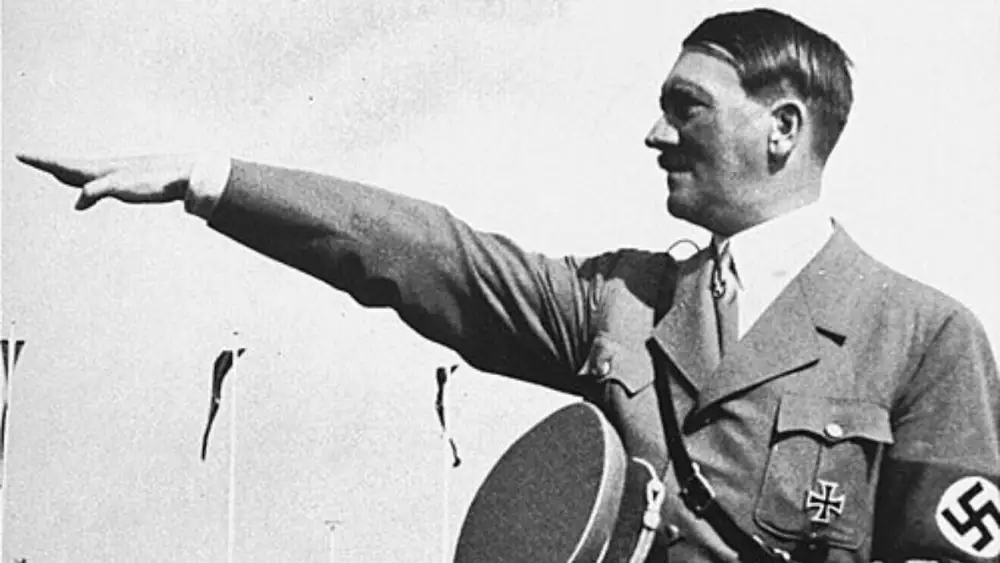

I am the grandson of Holocaust survivors and have worked in public relations for more than three decades. In late 1933, less than a year after Adolf Hitler became chancellor of Germany, one of the largest American public relations firms accepted a foreign government contract worth a reported $120,000 a year, the equivalent of nearly $2.9 million today.
The contract was paid through the German State Railways, an instrument of the German government. It ran through 1938.
That government was Nazi Germany. The firm was Carl Byoir & Associates. By 1933, the firm was one of the two or three largest American PR firms. Carl Byoir, the founder, was born in Des Moines, Iowa, in 1888 to Russian-Jewish immigrants. He had served during World War I as assistant chairman of George Creel’s Committee on Public Information: the federal propaganda apparatus established under Woodrow Wilson to sell American entry into the war. He founded his firm in New York in 1930. Three years later, he signed with Nazi Germany.
Byoir was not the only American PR pioneer Germany approached. Edward Bernays was solicited, too. Bernays was Sigmund Freud’s nephew, widely called the father of modern public relations and the most prominent figure in the American public relations industry of his generation. He turned the Nazis down.
He said publicly that he was concerned about how his techniques would be used by Joseph Goebbels, who had been appointed minister of the new German Ministry of Public Enlightenment and Propaganda in March 1933.
Bernays spent the rest of his life publicly opposed to the Nazi regime. He later wrote in his 1965 memoir Biography of an Idea that the Hearst foreign correspondent Karl von Wiegand, just returned from Berlin, told him at a dinner in 1933 that Goebbels had a copy of Bernays’s 1923 book Crystallizing Public Opinion in his propaganda library and was using it as a manual. During World War II, Bernays advised the U.S. Office of War Information against the regime that had appropriated his book.
Two founders of American public relations firms. Two contracts on the table. Two different answers. Bernays refused. Byoir didn’t.
In March 1934, the U.S. House of Representatives established the Special Committee on Un-American Activities, chaired by Rep. John McCormack of Massachusetts and Rep. Samuel Dickstein of New York. Dickstein, a Jew from Manhattan’s Lower East Side and the son of an Orthodox rabbi, drove the investigation of Nazi propaganda inside the United States. The committee’s principal targets were the German-American Bund—the domestic American organization aligned with the Nazi regime—and Carl Byoir & Associates.
Two founders of American public relations firms. Two contracts on the table. Two different answers.
Byoir testified before Congress in October 1934. He confirmed the contract, the fee, the routing through the German Tourist Information Office and his personal supervision of the account with the Nazis. He defended the work on three grounds: that tourism promotion was a legitimate commercial activity; that he himself, as a Jew, would not have served antisemitic ends; and that the firm distinguished between promoting Germany as a destination and promoting the German government as a political program. The committee was not persuaded. The contract continued anyway.
The committee’s recommendations contributed, four years later, to the passage of the Foreign Agents Registration Act (FARA) in June 1938.
FARA is a disclosure statute. It requires individuals and firms engaged in political activity in the United States on behalf of a foreign principal—any entity directed or financed from abroad, such as a foreign government or political party—to register with the Department of Justice and to publicly disclose the relationship, compensation, work product and channels of distribution. It is the single most important structural defense American democracy possesses against foreign propaganda operating inside the country. It is also, in 2026, increasingly under-enforced.
The Byoir firm registered under the act. It wound down its German account by the end of 1938, three years before the United States entered the war.
Carl Byoir was never criminally charged. The firm continued to grow into the 1960s; was acquired by Foote, Cone and Belding in 1978; and was folded into Hill & Knowlton in 1986. The Byoir name was retired from active use in the early 1990s. What remained was the contract, the testimony and the statute.
For the Jewish community, the case is important for two reasons.
The first is historical accuracy. The American public relations industry was founded by a generation that included Carl Byoir and Edward Bernays: two Jewish men from immigrant families, working in the same New York in the same decade and the same discipline. One of them took Hitler’s money. The other refused it. Both of those choices belong on the record. That one of the firms involved in laundering the public image of the Nazi regime overseas was led by a Jewish founder is not a peripheral detail of the history. It is one of its central facts. The case is also the template other firms have used in their defense in almost every comparable instance.
The second is structural. FARA exists because of the Byoir hearings. The statute is the only legal instrument the United States possesses that requires American firms representing foreign governments to disclose their relationships. Recent years have seen FARA enforcement decline sharply at the U.S. Department of Justice. Foreign principals with grave reputational liabilities, including regimes whose hostility to Jewish life and the State of Israel is documented and openly stated, continue to retain American firms registered under the act.
The disclosures are public. The work is legal. The work continues.
So many years later, we see evil incarnate continue, with Diaspora Jews like Byoir standing with evil—whether the Gulf state of Qatar, New York’s Jew-hating Mayor Zohran Mamdani or the many shouters of “Free Palestine.”
The Diaspora Jewish community should remember that history has taught us how this turns out. Ninety years on, we should remember that people have choices about where to stand. Both Byoir and Bernays did.
One can stand with one’s people or against them.
The full historical record on the Carl Byoir & Associates contract, including the McCormack-Dickstein hearings, the I.G. Farben parallel and origin of FARA, is available at: Everything-PR.