
Three recent reports—two from the Buckley Institute, a Yale-affiliated organization focused on free speech and intellectual diversity, and another from the Harvard Jewish Alumni Alliance (HJAA)—suggest that it is time for a reckoning at Yale. They describe an institution moving in directions that conflict with its stated ideals, and potentially, with the law.
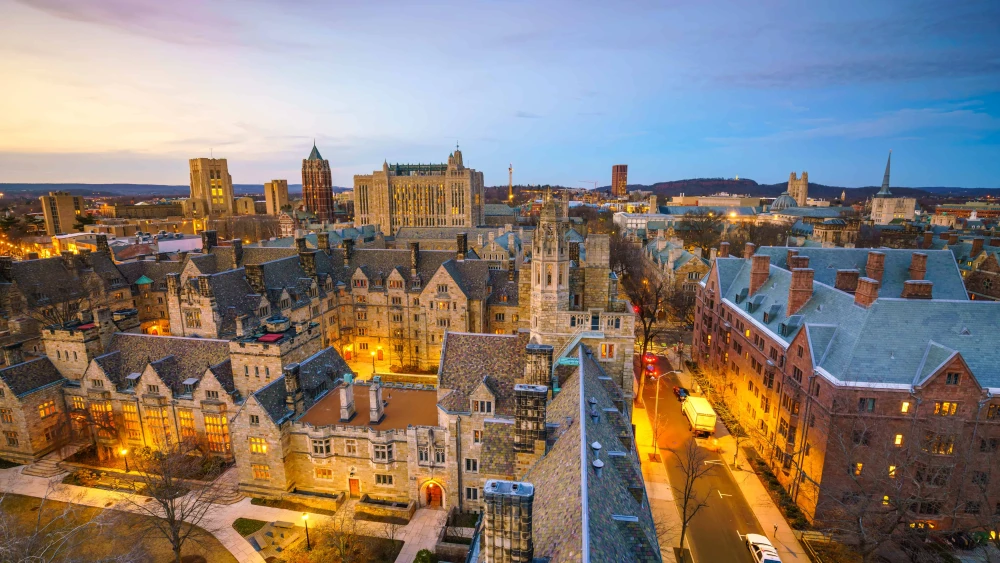
Drawn from the Bible’s Urim v’Tumim, Yale’s motto of Lux et Veritas (“Light and Truth”) appears emblazoned across campus in both Hebrew and Latin. Famously, Harvard’s motto claims Truth; Columbia’s invokes Light, while Yale lays claim to both. Failures at Harvard and Columbia have drawn national attention to the abuse of Jews on their campuses and the ideological environment that promotes it.
Yale, which has received far less scrutiny and faced far fewer consequences, is emerging as perhaps more disturbing. Although the extent of overt, disruptive and violent antisemitic and anti-Israel activity there may not be as visible as at some other universities, the school presents an equally, if not more, distressing story of creeping admissions practices hidden from public view, profoundly eroding Jewish life there.
Consider first the faculty. Buckley reports that 82.3% of Yale faculty are Democrats, and just 2.3% are Republicans—an astonishing ratio of roughly 36-1—with two out of every three undergraduate departments having zero faculty who are Republicans. That stupefying level of ideological uniformity inevitably constricts both the intellectual and social environment.
Like many elite institutions, Yale has made self-styled “Diversity, Equity and Inclusion” (DEI) tenets central to its academic and administrative life. These are not merely rhetorical commitments. In practice, they reflect assumptions about power and identity that influence not only the content of instruction but also how opportunity, attention and institutional protection are distributed. Buckley reveals the extent to which DEI still dominates at Yale despite the university’s dissembling attempts to evade scrutiny. HJAA’s data help quantify just how egregiously DEI orthodoxies and policies continue to discriminate against and disadvantage Jews.
In recent years, as part of an initiative to expand access and affordability, Yale added almost 1,300 undergraduate seats, though none went to Jews. Instead, during this time, the number of Jewish students at Yale declined by more than 250, equivalent to about one-third of Yale’s Jewish student population as it stands today. According to HJAA, “had Jewish enrollment simply held its 16.4% baseline share, there would be approximately 466 more Jewish students at Yale than there are today.”
Notably, peer institutions facing similar pressures produced different results. At Princeton University, Jewish enrollment declined far less; at Brown and Cornell universities, it held steady or even increased.
Beyond these reports’ findings, there are emerging concerns, reported by applicants and others familiar with the admissions process, of more overt discrimination in admissions. In recent years, it has been noted that Druze and Arab applicants from Israel are far more likely to be admitted to Yale than Jews. And it seems that this year, Yale may not have interviewed even a single Jewish Israeli. Israeli applicants report that they were not offered interviews at Yale despite being interviewed by peer institutions, including Harvard, Princeton, Stanford University and the Massachusetts Institute of Technology.
The Yale Daily News, reporting on the HJAA findings, notes the decline in Jewish enrollment and raises questions about its causes; the answer is not difficult to discern, and the effects are not limited to admissions. Students and faculty describe an environment in which Jewish identity is treated differently from other minority identities—less a basis for protection than a marker of perceived power. In some cases, that has translated into discomfort, exclusion, and, at times, open hostility and abuse.
In his 1985 book Joining the Club: A History of Jews at Yale, Dan A. Oren documented Yale’s fraught history of limiting Jewish enrollment by quota and other means. I arrived at Yale Law School as a student that same year, when the book’s publication was being celebrated and its revelations widely discussed, reinforcing the hopeful view that the era of anti-Jewish quotas at Yale was well behind it.
That optimism now appears to have been misplaced.
Yale once excluded Jews because they were not part of the White Anglo-Saxon Protestant (WASP) elite. Today, they are disadvantaged for the opposite reason. As in other DEI-tainted institutions, Jews are treated as part of an oppressive “privileged” class, outside the categories of protection, and worthy of disdain. While the rationale has ostensibly inverted, the results appear eerily familiar. In a system that once again prioritizes group identity over scholarship, Yale is punishing Jews.
Institutions that depart from merit as a governing principle rarely do so neutrally. Systems that allocate opportunity based on identity rather than achievement inevitably produce distortions.
Decades ago, Yale Law School’s Peter H. Schuck (my first-year torts professor) argued that the school “would be a stronger institution if there were more ideological diversity.”
He lamented that elite law schools “care much more about diversifying their skin colors, genders and surnames than about diversifying their points of view.” Today, the imbalance he identified is exponentially worse—more deeply institutionalized and self-perpetuating.
Last semester, I returned to campus to talk with Jewish students and faculty and to see for myself what was happening. What I observed on an anecdotal but pervasively consistent basis painfully reflected the data and trends now revealed by both Buckley and HJAA.
In the aftermath of the Hamas-led terrorist attacks in southern Israel on Oct. 7, 2023, the rise of conspicuous and at times violent antisemitism at Harvard and Columbia led to intense national scrutiny. Yale, by contrast, largely remained below that level of attention. On campus, it was suggested to me that this may stem not from Yale being less toxic but because New Haven, Conn., is a miniscule media market compared to New York and Boston, and therefore less attractive to outside agitators and less rewarding to provocateurs. But the campus has been far from immune to the same ugly behaviors.
Universities often invoke academic freedom as a shield against criticism. In practice, however, what is being defended is a parody of freedom that increasingly resembles a militantly doctrinal ideological conformity, with an almost total lack of genuine diversity, equity and inclusion.
That Yale has largely avoided the scrutiny directed at its peers has not insulated it from the same underlying maladies, only from the ameliorations that widespread attention to those problems might otherwise command.
In recent years, Harvard has drifted from its pursuit of “Truth,” and Columbia has proved unable to withstand the pressures of “Light.” Yale, whose motto claims both, appears instead to be combining the betrayals of each—visible in whom it hires, whom it admits, what it teaches, what it tolerates, and in whom it excludes and fails to protect.