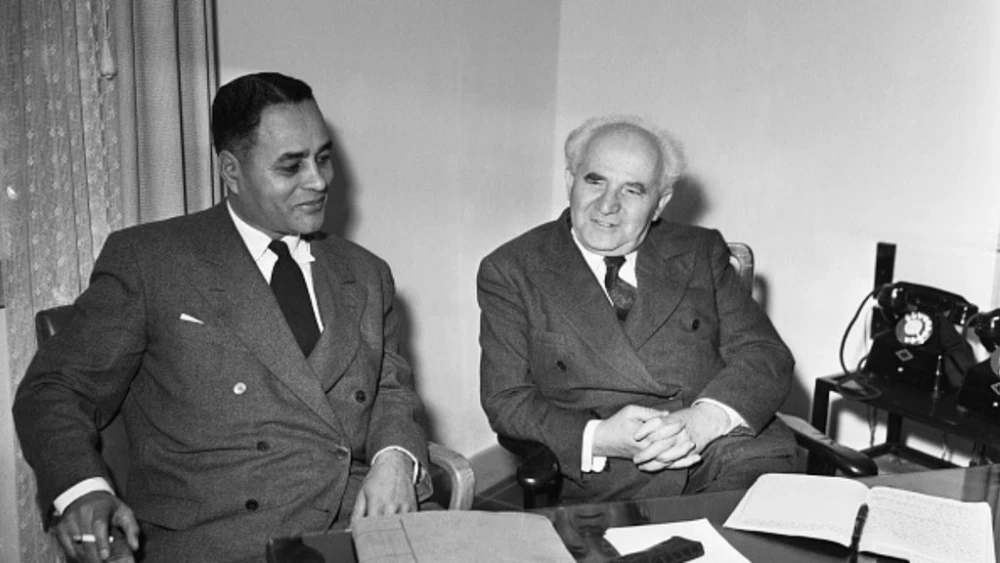

In 1950, the Nobel Peace Prize went to an American diplomat named Ralph Bunche. There was little question as to why.
Bunche, a senior U.N. official, had taken over the organization’s mediation efforts in the 1948 Arab-Israeli war after U.N. mediator Folke Bernadotte was assassinated in Jerusalem. Through painstaking negotiations, Bunche helped bring about the 1949 armistice agreements between the newborn State of Israel and Egypt, Lebanon, Jordan and Syria.
The Nobel Committee’s statement was refreshingly straightforward: Bunche received the prize “for his work as mediator in Palestine in 1948-1949.” He had actually made peace, or at least stopped a war.
Compare that with the Nobel Committee’s announcement on Oct. 9 that the 2026 Nobel Peace Prize would go to former U.N. High Commissioner for Human Rights Navi Pillay “for her efforts to promote peace and international law.” The committee praised Pillay for helping strengthen an international legal system capable of prosecuting war crimes, crimes against humanity and genocide.
Pillay’s biography is undeniably distinguished. She fought apartheid in South Africa. She served as a judge on the International Criminal Tribunal for Rwanda, where she played an important role in developing international law regarding sexual violence. She later served on the International Criminal Court and as the U.N.’s top human-rights official. Those achievements deserve recognition.
But are they peacemaking? That question becomes particularly relevant when we look at Pillay’s record concerning Israel.
Pillay has spent years publicly condemning Israeli policies and military actions. In 2014, as U.N. human rights chief, she accused Israel of possible war crimes during fighting in Gaza while also condemning Hamas rocket attacks. In 2021, she was appointed to chair the U.N. Human Rights Council’s permanent Commission of Inquiry concerning Israel and the Palestinian territories. The commission’s unusually broad mandate included investigating the “root causes” of the conflict and alleged systematic discrimination.
In 2022, Pillay’s commission concluded that Israel’s occupation had become unlawful because of its alleged permanence and de facto annexation. After Oct. 7, Pillay said the Hamas massacre and the ensuing Gaza war had not occurred “in a vacuum,” placing them in the context of decades of what she called dispossession and unlawful occupation. Her commission also found that Hamas and other Palestinian armed groups committed war crimes, including murder, hostage-taking and attacks on civilians.
Then came the commission’s most incendiary conclusion: that Israel had committed genocide in Gaza—a charge Israel categorically rejects, and that has become one of the defining controversies surrounding Pillay’s Nobel selection.
Whatever one’s view of those conclusions, Pillay has not been functioning as a mediator between Israelis and Palestinians. She has been functioning as an investigator, jurist and accuser. There is a difference.
There was a time when receiving the award meant that somewhere, enemies had stopped shooting at one another.
Consider earlier Nobel laureates associated with the United Nations:
• In 1957, Canadian statesman Lester Pearson received the Peace Prize largely for his role in creating the United Nations Emergency Force after the Suez crisis. His solution put international troops between combatants and helped bring the fighting to an end. The Nobel Committee credited him with a “crucial contribution” to deploying that force.
• In 1961, the prize went posthumously to U.N. Secretary-General Dag Hammarskjöld, who had devoted his tenure to trying to turn the United Nations into an effective instrument for resolving international conflicts. He died in a plane crash while engaged in a peace mission connected to the Congo crisis. The Nobel citation praised him for making the United Nations a constructive organization capable of carrying out the peacekeeping principles of its charter.
• In 1988, the U.N. Peacekeeping Forces themselves received the award. Again, the language is telling. The prize was given for “preventing armed clashes and creating conditions for negotiations.” These were men and women standing between hostile forces, monitoring armistices and creating the physical space in which diplomats might negotiate.
• In 2008, former U.N. diplomat and Finnish President Martti Ahtisaari was honored after decades spent trying to resolve conflicts in Namibia, Aceh, Kosovo and elsewhere. In Aceh alone, his mediation helped produce an agreement ending a conflict that had lasted nearly three decades and cost thousands of lives. The Nobel Committee honored him for his efforts “to resolve international conflicts.”
There is a more recent example worth considering. Whatever one thinks of Donald Trump (and opinions about him are hardly mild), the Abraham Accords were an exercise in old-fashioned diplomacy. His administration helped broker normalization between Israel and the United Arab Emirates and Bahrain, followed by agreements involving Morocco and Sudan. Embassies opened. Direct flights began. Trade, investment and tourism followed. Countries that had kept Israel at arm’s length began dealing with Israel openly. Trump has been nominated for the Nobel Peace Prize in connection with those agreements, but has never received it.
That doesn’t mean the Nobel Committee was obligated to give Trump a prize. But it does sharpen the question: If bringing previously estranged nations into diplomatic relations is no longer necessarily regarded as Nobel-worthy peacemaking, while investigating and accusing parties to a conflict is, what exactly does the Nobel Committee now mean by “peace”?
Earlier prizes were based on a clear understanding of peacemaking: It is getting enemies to stop fighting.
To be sure, the definition had already begun to broaden. In 2001, the United Nations and its secretary-general, Kofi Annan, shared the prize for their work toward “a better organized and more peaceful world,” with the Nobel Committee emphasizing human rights, as well as traditional peace and security.
Alfred Nobel’s original language has always allowed considerable latitude. His will spoke of promoting fraternity among nations, reducing standing armies and encouraging peace congresses. Over the decades, the committee has interpreted that mandate to encompass human rights, humanitarian work, democracy and international law.
But Pillay’s selection raises the question of whether the definition has now become so elastic that virtually any form of international political or legal advocacy can be labeled peacemaking.
International law matters. Accountability matters. Punishing genuine war criminals matters. But passing judgment on one party to a conflict is different from bringing two parties together. Indeed, a mediator must be very different from an investigator. They must be trusted sufficiently by both sides to walk into separate rooms, listen, compromise, cajole and eventually persuade enemies to put down their weapons.
Ralph Bunche did that in the Middle East. Martti Ahtisaari did it in conflicts around the world. Navi Pillay has played a different role. Her commission investigates. It assigns responsibility. It issues findings. It accuses.
The Nobel Committee is free to conclude that such work advances international justice. It is free to celebrate Pillay’s long career in international law. But perhaps we should stop pretending that justice advocacy and peacemaking are always the same thing.
There was a time when receiving the Nobel Peace Prize meant that somewhere, somehow, because of the laureate’s efforts, enemies had stopped shooting at one another. Ralph Bunche received his Nobel for helping Arabs and Israelis put down their guns.
Seventy-six years later, the Nobel Committee has given the same prize to someone whose role in that same conflict has been not to reconcile the parties, but to judge them. That tells us something; not merely about Navi Pillay, but about how dramatically the Nobel Peace Prize’s definition of peace has changed.