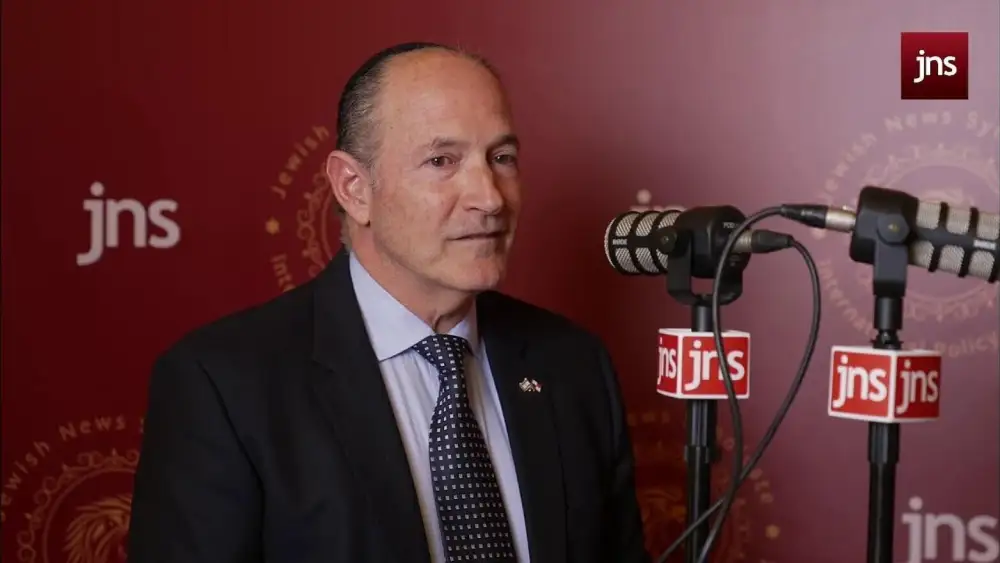
Not even five minutes into an interview with JNS, Ezra Cohen, the Panamanian ambassador to Israel who is seven months into his post, shares a joke about Israelis.
When one sees someone cutting the line in an airport, “probably an Israeli, right?” he says. “I found the other side of these Israelis. They are so caring for people.”
One day in Jerusalem, Cohen’s driver stopped suddenly, got out of the car, opened the trunk and retrieved a bag. He went to help a lady who had fallen. “After 20 seconds, there were 20 people helping this lady,” Cohen told JNS.
Another time, on a visit to Judea and Samaria, he saw a 26-year-old pregnant woman, with “a gun bigger than her size,” caring for a farm to prevent Arabs from coming in.
“We see this contrast of people,” the Panamanian envoy told JNS. “Israelis are on the move, but when it’s time to help, they stop everything and they assist and help their fellow Jew.”
Cohen, who is an observant Jew, worked in business starting at age 17. At 32, his company became the first Panamanian one listed on the NASDAQ stock exchange. He sold that company.
“I wanted to do something different,” he told JNS. “They tell me that I get bored when I do things routinely. I also like to innovate. So I wanted to give some time to my community.”
He became the executive director of Panama’s Jewish community—"a post that never existed,” he told JNS. Leading the country’s 14,000 Jews, divided between 10,000 Sephardim, 2,000 Ashkenazim and 2,000 Reform Jews, was “quite an interesting job,” he said.
Panama’s Jewish community today, which faces very little antisemitism, is “very active” in the country’s economy and represents many industries, according to Cohen. “We as Jews and Panamanians are always looking for the benefit of Panama as our own country,” he said.
After nine years, he questioned why he was still in a role he thought he would hold for a year or two. He saw it as preparation for the diplomatic post he now holds, and for which he is grateful.
“I’m enjoying it every day of my life,” he said.
Cohen speaks Hebrew and holds all of his meetings in Hebrew, which he sees as one “door opener.” Another advantage is being religious.
“When I meet ministers, most of them are religious Jews, so we kind of talk the same language,” he told JNS. “Also, I take care of the non-religious and I love them, because they’re Israelis. I’ve discovered a country and a people that my perception, being in the galut, in the Diaspora, it’s totally different.”
‘Everybody knows each other’
During Israel’s 12-day war with Iran in June, 16 evangelical pastors, three city mayors and 13 students were among the Panamanians stranded in Israel.
Families called Cohen asking for help evacuating their relatives. Cohen wanted to do so via Jordan and Egypt, but parents didn’t want their children going to those countries.
Cohen was able to get two groups out of Egypt. “I personally, with my wife, went to Eilat and made them a dinner in an Eilat hotel prior to moving to the Egyptian border,” he told JNS. “I wanted them to feel comfortable.”
The envoy asked the 32 people at the table to share something about their experience.
“If I would be in Panama, and I would learn about the war, I would never dare to come,” one person said. “But now that I’m here during the war, I am honored, and I was very happy to be here and to see how Israeli—they have a situation and how they solve the situation.”
Cohen called the owner of a cruise line, seeking seats for evacuees. He was told the boat was rented to Bank Leumi, so he called the bank CEO, who told him to hold on. That’s how thing go in Israel, he told JNS.
“Don’t send me an email and talk to my assistant,” he said. “No, hold on and let’s put him on the line and let’s solve this.”
He was able to get two groups out on the cruise ship. He also called the leaders of El-Al and Israir and secured seats on planes.
“It’s a big shtiebel,” he said of Israel. “Everybody knows each other.”
Lousy papaya
Cohen, who lives near the Mahane Yehuda open-air market off the main thoroughfare of Jaffa Street in Jerusalem, had trouble finding papaya, which he tends to eat for breakfast. Finally, he found one selling, but each papaya cost 30 shekels, some 30 times what papayas cost back home. And when he tried the fruit, it was bad.
“We’re working now with the Ministry of Health and the Ministry of Agriculture to bring papaya and also pineapple, because the pineapple in Panama is the sweetest of all,” he told JNS. “So we want to bring these kinds of products.”
Panama has water administration problems, even though some parts of the country have rain nine months a year, and cybersecurity concerns. Cohen hopes to bring Israeli expertise in both areas to Panama to help.
Cohen thinks that his business background is an asset in his work.
“I have a new meeting, and we talk. We finalize the meeting, and then I am on top of them. ‘So what’s next?’” he told JNS. “I’m pushing them. I would like to have my legacy be that I did something for my country. So when I go back after five years and I see what I did, what I built, this is my accomplishment.”
“Having meetings is great, but how you accomplish things, how you get results from those meetings,” he said, “it’s my business DNA that I want to make sure that at all times is there.”
Latin America
Israel needs to collaborate closely with Latin American countries that support the Jewish state, because they know Israel.
He cited Javier Milei, Argentina’s president, and Santiago Peña, the president of Paraguay, as supporters of Israel and noted that José Raúl Mulino, the president of Panama, was the country’s minister of defense. A decade ago, Israel helped Panama a lot with security matters, he said.
“Eventually, the neighboring countries in Latin America will see what Israel is doing for them, for these countries that have a relationship with Israel, and then they will understand that they are on the wrong side, and they need to start dealing with Israel, because Israel is only there to
help,” Cohen told JNS.
“Eventually, the truth will get into everybody’s backyard,” he said.