Newsletter
Newsletter Support JNS

Ra’am Party leader Mansour Abbas meets in Amman with Jordan’s King Abdullah

The two reportedly discussed Palestinian issues during their meeting, including attempts to restart peace talks between Israel and the Palestinian Authority.

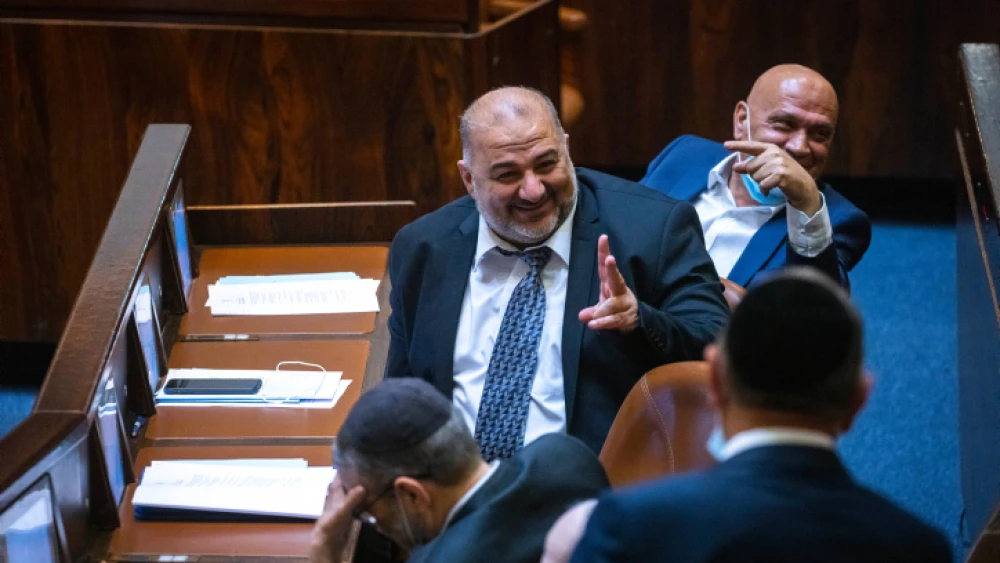
Ra'am Party head Mansour Abbas attends a plenary session at the Knesset in Jerusalem, June 28, 2021. Photo by Olivier Fitoussi/Flash90.
Ra’am Party head Mansour Abbas attends a plenary session at the Knesset in Jerusalem, June 28, 2021. Photo by Olivier Fitoussi/Flash90.

Ra’am party chairman Mansour Abbas met with Jordan’s King Abdullah in Amman on Tuesday, reported Israel’s Channel 12 news.

According to an additional report by Walla, sources in the office of Prime Minister Naftali Bennett said Abbas had updated the premier ahead of time and that Abdullah had invited Abbas to the meeting. There was no objection on Bennett’s part, the report said.

A statement released by Abdullah’s Office said Abbas had praised the king’s stance regarding the need to safeguard the status quo at holy sites in Jerusalem, as well as his support for eastern Jerusalem residents. The two reportedly discussed Palestinian issues during their meeting, including attempts to restart peace talks between Israel and the Palestinian Authority.

In July, Walla reported that Bennett had secretly met with Abdullah in Amman. After the meeting, the two countries announced agreements on Israeli water sales to Jordan, and trade arrangements.

Under the deal, Jordan will purchase an additional 50 million cubic meters of water from Israel and increase its exports to Palestinian Authority-controlled areas of the West Bank from $160 million a year to around $700 million, the countries announced in official statements.

The past year has hinted at the warming of relations between the two neighboring countries, which have had a peace agreement since 1994.
Industrial decay, hyperinflation, sanctions and the rise of the IRGC’s shadow economy have eroded the Iranian state’s capacity to govern.
If the terrorist group’s tactics fail to force an Israeli withdrawal from the buffer zone, it may resort to suicide attacks.
Heritage Minister Amichai Eliyahu said: “After years in which sites were neglected or looted, Israel is making historical corrections.”
Using this phrase against Israel is no less absurd than labeling sport-hooliganism and violence at mass demonstrations in the West as officially sponsored, government-sanctioned violence.
“Nearly eight years after the shooting, our gratitude and admiration for the heroic bravery and selfless dedication of the first responders that day endures,” said U.S. Attorney Troy Rivetti.
Yitzhak Ben-Hebron escaped Arab riots as a child and later returned to rebuild the Jewish community in the holy city.