Berlin would reject any demand from the regime in Tehran for Washington to unfreeze Iranian assets as a condition for the resumption of nuclear talks, Germany’s Federal Foreign Office said on Monday.
“If ... new conditions are being set by Iran for talks to be resumed, then we reject that,” said a German Foreign Office spokesman, according to Reuters.
On Saturday, Iranian Foreign Minister Hossein Amir-Abdollahain told Iranian state television that Iran had requested that the United States release “at least” $10 billion in frozen Iranian assets to prove it was serious about rejoining the 2015 Joint Comprehensive Plan of Action (JCPOA).
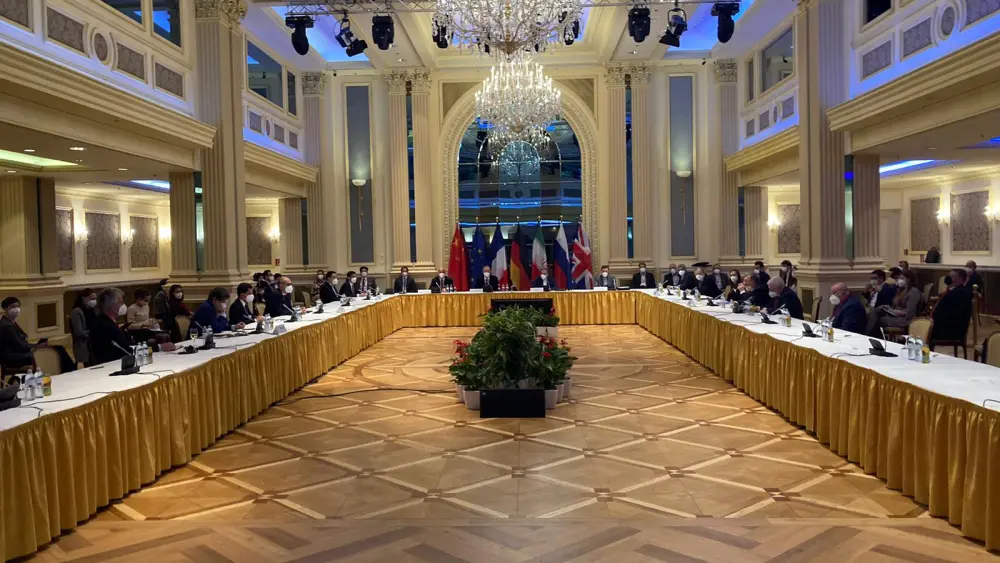
The U.S. unilaterally withdrew from the JCPOA in 2018 under the Trump administration, re-imposing sanctions lifted by the agreement. Under President Joe Biden, the United States is looking to rejoin the agreement, and there have been six rounds of talks in Vienna on the issue so far. However, talks stalled following the election of Iranian President Ebrahim Raisi in June, and no date has yet been set for their resumption.
According to Amir-Abdollahain, U.S. officials reached out to the Iranian government last month at the United Nations General Assembly in New York about restarting the talks.
“I told the mediators [that] if America’s intentions are serious then a serious indication was needed … by releasing at least $10 billion of blocked money,” he said.
The Americans, he added, were unwilling to do this.
“They are not willing to free $10 billion belonging to the Iranian nation so that we can say that the Americans once in the past several decades considered the interests of the Iranian nation,” he said.
U.S. Special Representative to Iran Robert Malley told Bloomberg TV in an interview on Sept. 3 that while the United States was prepared to be patient with Tehran regarding negotiations about a return to the JCPOA, it “can’t wait forever.”
Malley said that while Iran’s request for more time was understandable, its rapidly advancing nuclear program could render additional negotiations pointless.
On Monday, the German Foreign Office called on Iran to resume the talks “as soon as possible,” adding that Germany expects an agreement on a specific date, according to AP.