


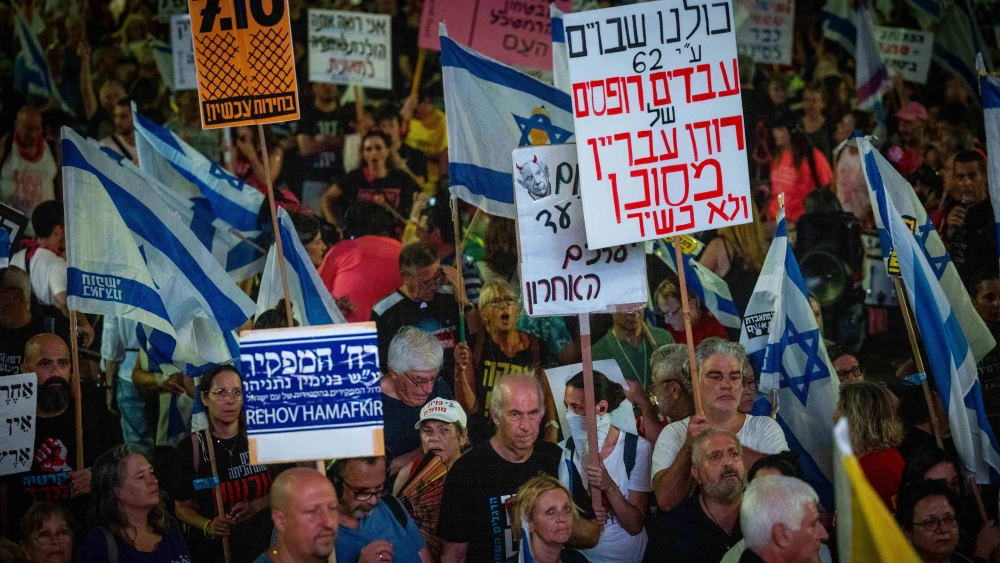
Two U.S. House committee chairs want to know if American taxpayers helped fund the massive protests against Israeli Prime Minister Benjamin Netanyahu’s 2023 judicial reform.
In a letter that JNS obtained, House Judiciary Chair Jim Jordan (R-Ohio) and Foreign Relations Chair Brian Mast (R-Fla.) asked six organizations for all relevant documents and communications regarding any funding from the U.S. State Department or through the U.S. Agency for International Development, a federal agency that the Trump administration aims to shutter, reassigning some of its duties to the State Department.
The chairs asked that the organizations provide the information to the committees by April 9.
The letters went to two Israel-based non-governmental organizations—Blue and White Future and the Movement for Quality Government in Israel—and four in the United States: Jewish Communal Fund, Middle East Peace Dialogue Network, PEF Israel Endowment Funds and Rockefeller Philanthropy Advisors.
The committee chairs accused the groups, which reportedly received millions of dollars in federal funds, of “attempting to undermine Israel’s democratically elected government” by opposing the proposed judicial overhaul. Israel was rocked with protests against Netanyahu before the Oct. 7, 2023, attack by Hamas.
“Media reports later revealed that these protests were funded in part by U.S. grant money that had been funneled through various American and Israeli non-governmental organizations to groups directing the protests,” the lawmakers wrote.
That was an improper, and possibly criminal, use of the funding, Jordan and Mast wrote.
“The use of federal grants in this manner not only jeopardizes America’s relationship with one of its closest allies but also undermines core civil liberties protected within the United States and Israel,” they wrote.
At the time, the U.S. government backed the protests and opposed Israeli judicial reform. Support for or opposition to Netanyahu’s proposals has broken along party lines in the United States.
“This is obviously an area about which Israelis have strong views, including in an enduring protest movement that is demonstrating the vibrancy of Israel’s democracy, which must remain the core of our bilateral relationship,” then U.S. President Joe Biden told the New York Times in July 2023.


