Newsletter
Newsletter Support JNS

New IAEA head seeks answers from Iran

“We have so far not received an entirely satisfactory reply” from Iran regarding uranium traces found at an undeclared site, says IAEA head Rafael Grossi.

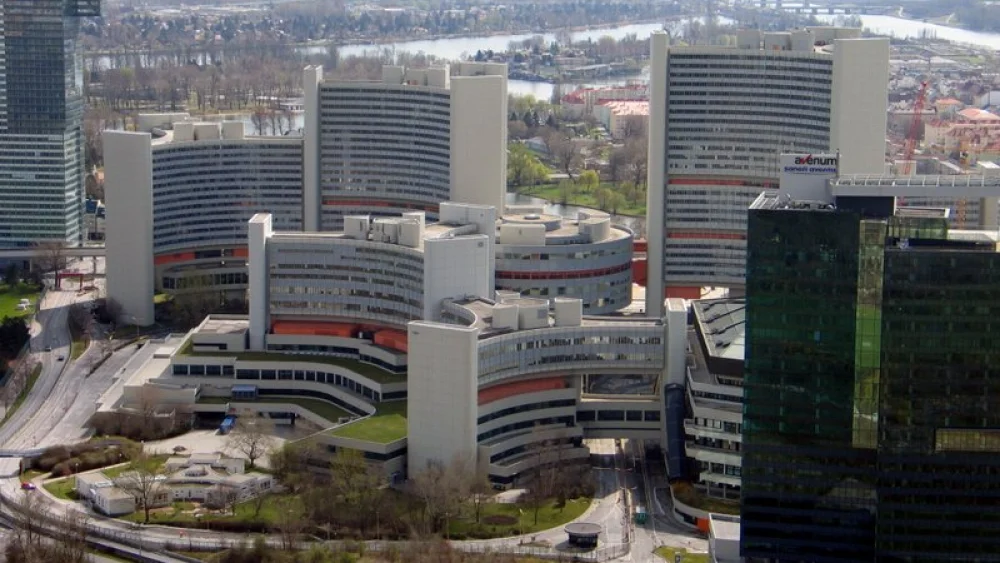
IAEA headquarters in Vienna, Austria. Credit: Wikimedia Commons.

The new director general of the United Nations International Atomic Energy Agency said on Tuesday that Iran still has to answer for the discovery of uranium particles at an undeclared site near Tehran.

IAEA head Rafael Grossi told the AP in an interview that the U.N. nuclear watchdog agency is in talks with Iran about the discovery, and that it is “not a closed matter.”

“The process continues. We have so far not received an entirely satisfactory reply from them, but the exchanges continue,” he said.

The United States and Israel have been pushing the IAEA to look into Iran’s Turquzabad site, which Israeli Prime Minister Benjamin Netanyahu described in a speech at the United Nations in 2018 as a “secret atomic warehouse,” the report noted.

Responding to criticism that the agency has been too soft on Iran, Grossi said, “The timely response to our questions is very important.”

The Argentinian Grossi succeeds Yukiya Amano, who died in July, as head of the U.N. agency. He will serve a four-year term.

Despite recent violent protests in Iran and the harsh crackdown by its government, Grossi said agency inspectors continue to carry out their work, the report added.

David Greenfield, CEO of Met Council, told JNS that the video “has strained relationships with a lot of us in the leadership, who have tried to work in good faith with the administration.”
U.S. President Donald Trump, who sought to unseat Cassidy, stated that “his disloyalty to the man who got him elected is now a part of legend, and it’s nice to see that his political career is over.”
A 31-year-old man of Moroccan descent ran over 7 people and stabbed another in a suspected terror attack near Milan.
“This is a strategic move designed to ensure Israel’s technological superiority, accelerate development in the field of AI, and maintain Israel’s position in the first line of world powers,” according to the Prime Minister’s Office.
“There are certainly many possibilities; we are prepared for any scenario,” the premier said.
The weekend statement from the Foreign Ministry comes six months after Jerusalem and the South American nation restored full diplomatic relations.