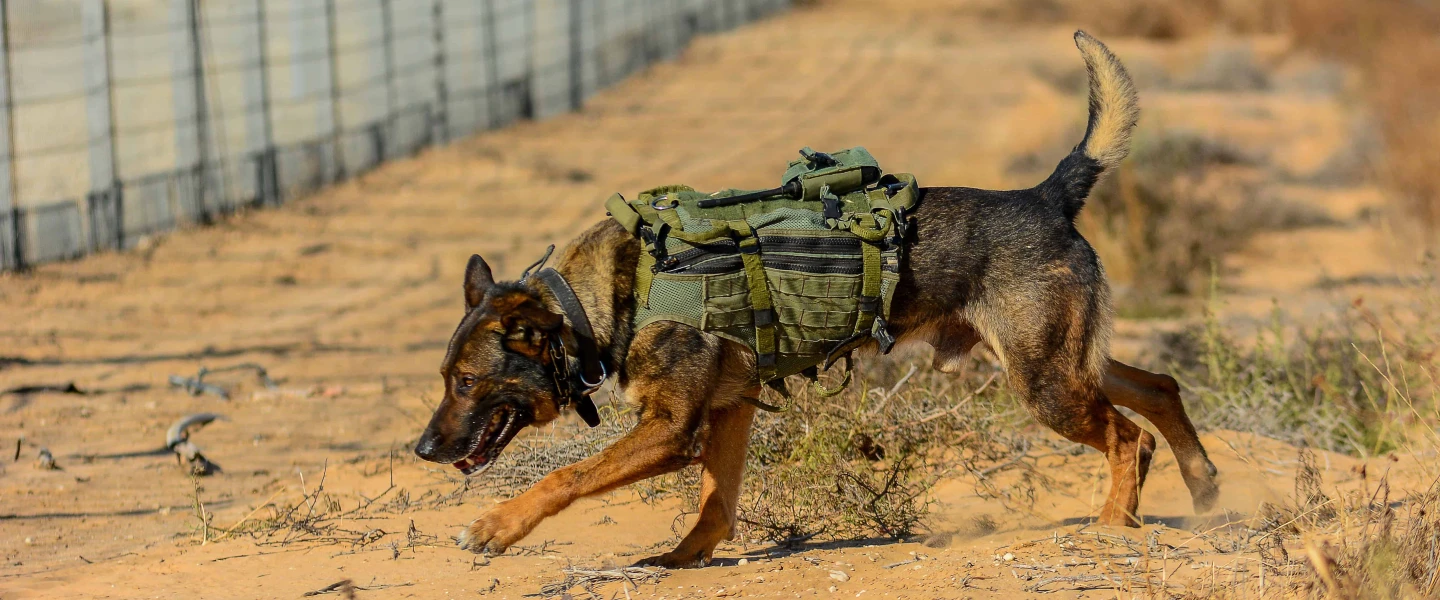
“Both Yotzi and Boogie were explosive-detection dogs. Over the past three years, Yotzi achieved significant success and saved many lives. He detected explosives alongside units such as Yamam and Sayeret Matkal and now deserves a good life,” Tomer, a reserve commander in the Israel Defense Forces’ Oketz canine unit, told JNS last week.
Tomer enlisted in the Oketz unit in 2019. During training, he was paired with his first canine partner, Yotzi, and completed the course with him. He later served with Boogie, conducting operations in northern and southern Israel before the war.
After completing his service, Tomer adopted Boogie, who was nearing the end of her military career. They spent a year and a half together in civilian life before she died from serious medical complications that required treatments, ointments, blood tests and thousands of shekels in veterinary expenses.
Two months ago, Tomer was given the opportunity to adopt Yotzi and did not hesitate, despite anticipating significant medical costs.
A bond forged in service
The bond between a soldier and his dog is forged from the first day of training through the final military operation, Tomer said.
“You sleep with him, eat with him and share your water with him. You learn how to care for him, protect him and keep him fit. You carry his food and equipment, and you sleep in the same sleeping bag so he won’t be cold,” he said.
During one operation in northern Israel, in freezing conditions on a hilltop, Tomer used his own sweatshirt to keep his dog warm.
When military dogs retire after years of service—often with significant physical ailments—soldiers do everything possible to give them the best quality of life.
“It’s impossible to refuse. He’s your best friend from the army,” Tomer said. “It’s every fighter’s dream to return to civilian life with his service dog.”
After Tomer adopted Yotzi, he began limping, and medical expenses have already reached 1,500 shekels (approx. $520, )with no end in sight.
Proposed legislation offers assistance
A bill initiated by Likud lawmaker Moshe Passal, together with the Oketz Veterans Foundation, would provide veterans who adopt their former service dogs with up to 5,000 shekels (Approx. $1,740) in veterinary assistance.
“This law does two things,” Passal told JNS. “It thanks the dog for standing with us in this fight, and it thanks the soldiers. The soldiers cannot abandon their dogs, but such expenses should not fall on them. The country benefited from their partnership and service, and it should be there for them.”
The bill has passed deliberations in the Knesset Foreign Affairs and Defense Committee and is expected to advance to its second and third readings in the Knesset plenum.
“Our IDF soldiers are heroes. Thanks to them, we live in this country,” Passal said. “They are the ones who fight for us on our borders against our enemies, and I always look for opportunities to support them.”
Passal noted that his brother served in the Oketz unit for 15 years.
Tomer said he hopes the legislation will help address the medical challenges retired military dogs face and ensure they receive proper care.
“These are not random wounds. There is a reason every dog leaving the unit has infections, wounds or cancer—it is because they saved lives on the battlefield,” he said. “Just as the army cares for us when we are wounded, it should do the same for these dogs.”
‘Part of the family’
Bar, a former Oketz combat soldier who adopted Luke, the dog with whom he served for about six years, described the financial burden many soldiers face after taking in their former canine partners.
“It’s a money pit you enter out of love without realizing it,” he said. “When something happens, it becomes an endless stream of expenses because there is no choice. That dog is like your son. He may not speak, but everyone at home loves him; he is part of the family.”
Moran Bruchim, CEO of the Oketz Veterans Foundation, who previously served as a combat-support commander in the unit and helped advance the legislation, told JNS that basic expenses for an Oketz dog that does not require special treatment—including food, vaccines and insurance—can reach 8,000 shekels (approx. $2,780) annually.
“Soldiers are usually discharged at 21. Those 5,000 shekels could be very helpful for a young person,” she said. “And that’s if the dog is healthy.”
Once the dogs retire at age eight or older, they are generally no longer eligible for insurance, leaving soldiers to shoulder the costs alone. Without insurance, veterinary expenses can reach 10,000-15,000 shekels (approx. $3,480-$5,200), Bruchim said, adding that one soldier incurred costs of 30,000 shekels (approx. $10, 440).
“They went through a lot together. It’s a bond that is difficult to understand outside the unit,” she said. “When the dog is released, many soldiers face financial hardship to provide proper treatment.”
The nonprofit assists soldiers with insurance coverage when dogs are younger than eight and helps cover medical expenses of up to 3,500 shekels (approx. $1,200) for older dogs requiring treatment.
“These dogs save the lives of many lives, and the soldiers see the dogs as an extension of themselves,” Bruchim added. “It makes sense that they want to take them home. It feels like a gift. Thanks to these dogs, there are fewer bereaved families, and the least the country can do is help.”