


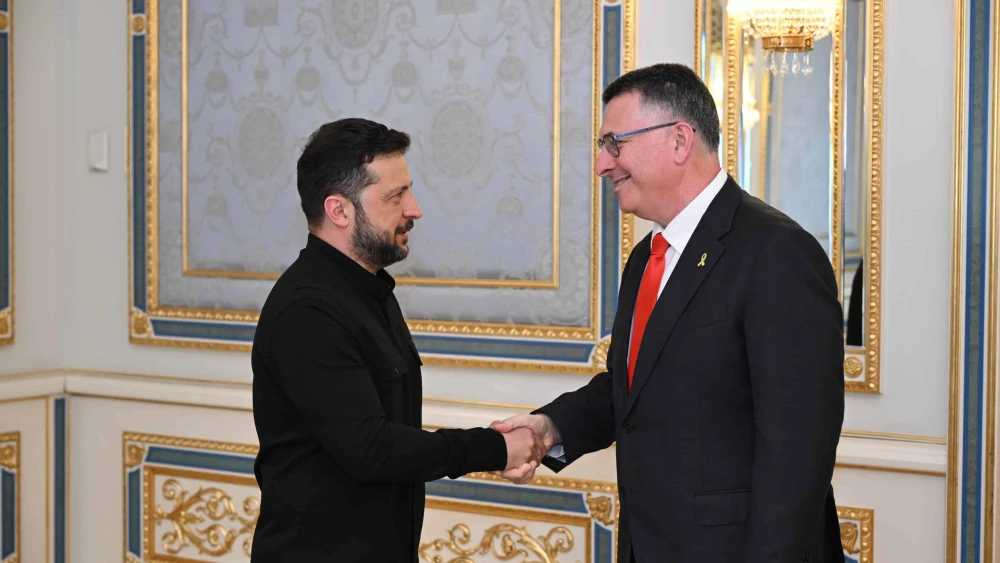
Israeli Foreign Minister Gideon Sa’ar met Ukrainian President Volodymyr Zelenskyy in Kyiv on Wednesday, marking the most senior Israeli diplomatic visit to Ukraine since early 2023.
“We discussed the importance of tightening bilateral relations between our nations, the war in Ukraine and the situation in the Middle East, with an emphasis on Iran,” Sa’ar wrote on X about the meeting, which he said was “good and friendly.”
Ukrainian-Israeli bilateral relations have seen tensions mount since Feb. 2022, when Russia invaded Ukraine. Israel condemned the invasion but has neither matched the passionate expressions of support for Ukraine by other Western countries nor followed their example in sending weapons to Ukraine.
Russia has maintained a military presence in Syria, where Israel repeatedly acted militarily, going after terrorists and weapons shipments. Russia has also been a key supplier of arms to Iran, and Israel was widely thought to be disinterested in antagonizing Russia.
Ukraine, meanwhile, voted in favor of several anti-Israel resolutions at the United Nations even as Zelenskyy urged Israel to take a more pro-Ukrainian stance in its war with Russia.
“I asked the President to lead to the designation of the Islamic Revolutionary Guard Corps (IRGC) as a terrorist organization in the Ukrainian Parliament. I also explained the necessity of the immediate activation of the SnapBack by the E-3 countries (Germany, France and the UK) and restoring sanctions on Iran,” Sa’ar said.
Sa’ar also presented Zelenskyy with the Dinah Project’s report on Hamas’s crimes of rape and sexual violence on Oct. 7, 2023, he said. Before the meeting, Zelenskyy visited Babi Yar, the site where German Nazis and their local collaborators killed some 33,000 Jews in 1941.
“In our meeting, I thanked President Zelenskyy for his commitment and actions toward safeguarding the memory of the Holocaust,” wrote Sa’ar.
Earlier on Wednesday, Sa’ar met with his Ukrainian counterpart, Andrii Sybiha. During a joint press conference in the capital, he condemned Russian strikes against civilians and asserted that Jerusalem stands with Ukraine and its people.
“We call for a durable and lasting peace which ensures security for Ukraine,” the minister said.
He emphasized Jerusalem’s support for Ukraine, citing examples such as opening the first field hospital in the country when the war with Russia broke out; providing generators, food, water and water equipment; sending experts to help with PTSD and resilience; and assisting injured Ukrainians in their recovery process in Israel.
“Two weeks ago, I instructed my ministry to provide potable drinking water systems to areas in Ukraine that lack clean water after being hit by Russian attacks. It will be done very soon,” Sa’ar said.
Sa’ar was also scheduled to meet with the deputy head of Ukraine’s parliament and representatives of the local Jewish community.
Also on Wednesday, Sa’ar met in Kyiv with Artyom Borik, a Ukrainian soldier whose family was killed in an Iranian missile strike in the seaside Israeli city of Bat Yam on June 15, during “Operation Rising Lion,” Israel’s name for its 12-day war against Iran.

“Artyom lost his 7-year-old daughter, Nastya, who had come to Israel for cancer treatment, his wife Maria, and three other family members in the missile strike,” said Sa’ar.
“I expressed my condolences and shared in the sorrow and pain over the heavy and tragic loss. I told Artyom that all of Israel stands with him in his grief,” the minister continued.
The Israeli foreign minister is expected to discuss bilateral relations, humanitarian aid and regional security challenges in his meetings with Ukrainian leaders.
This trip marks Jerusalem’s continued diplomatic engagement with Ukraine, following the visit of then-foreign minister Eli Cohen in February 2023.



