A university student in Ireland last month received death threats, lost a campus leadership position and was forced to stay away from campus for a week amid antisemitic harassment after supporting Israel publicly.
The student, Jamie O’Mahony, 21, told JNS that Dublin City University had failed to adequately support him in the aftermath of the ordeal.
Disillusioned and shocked, O’Mahony is now questioning his future in his native country, where he and other critics fear that anti-Zionism has fused with antisemitism to poison the public discourse on Israel.
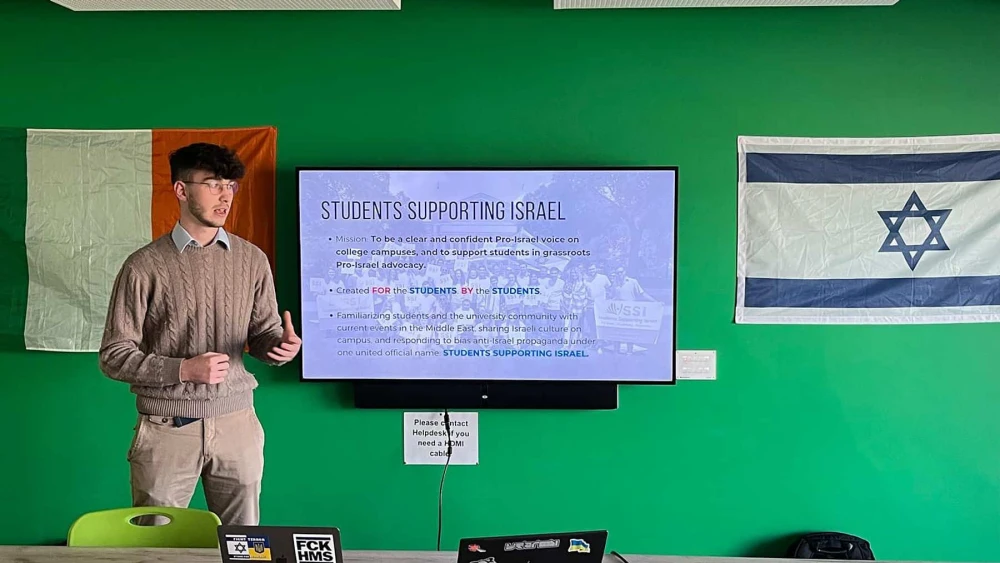
The ordeal began on March 6, when O’Mahony set up the Dublin City University chapter of the Students Supporting Israel international network (SSI). He and the chapter’s four other members held a tabling event on campus to advance their cause. The event occurred without incident, but an image of O’Mahony at the event was posted on Instagram, where it went viral with about 150,000 views and some 2,500 mostly negative comments. It led to a campaign of intimidation, he said.
“A lot of it focused on my appearance. People assumed I was Jewish and sent antisemitic messages,” he told JNS earlier this month. “But it got serious when my university timetable was posted online. People were saying, ‘He’s going to be in this room at this time—let’s get him.’”
As a result, O’Mahony stayed home for a week, missing classes out of concern for his safety. Though no physical attacks occurred, he described a hostile atmosphere on campus. “Even now, I walk through the hallway and hear insults. It’s not something you should have to think about when going to class,” he said.
One comment against Dublin City University’s SSI chapter, posted in response to a picture of O’Mahony and the remaining four members, read: “Can’t wait for these to get jumped,” followed by a skull emoji. Another said, “All 5 should be shot.” A third read: “Bring back public humiliation rituals.”

O’Mahony was removed from his position as chair of the university’s debate society. The student committee accused him of “endangering members” and “bringing the society into disrepute” because of his affiliation with SSI. He rejects this logic. “That makes no sense. Debate societies are supposed to host all kinds of views,” he said. “It’s not like the society suddenly became Zionist because I am.”
O’Mahony also pointed to a perceived double standard, noting that the university’s student union president openly endorses the Boycott, Divestment, Sanctions (BDS) movement. “No one raises an issue with that,” he said. “But sympathy for Israel is treated like something dangerous.”
He claimed the university administration was slow to respond to the threats. “They didn’t reach out to any of us—not me or the other four students in the photo—until we filed an official complaint,” he said. “It wasn’t until my father and the chair of the Jewish Representative Council of Ireland got involved that they made contact.”
The university administration ignored O’Mahony’s request that they condemn the harassment against him, he said.
While the university reportedly opened an investigation, no disciplinary action has been taken against those who made the threats, despite names being submitted. “The only thing they did was they gave us an app so that if we feel threatened, we press a button on this app and campus security comes to us,” said O’Mahony, before noting that no meaningful support or resolution has followed.
Queried by JNS for a reaction to O’Mahony’s complaints, a spokesperson for Dublin City University wrote in an email that the institution “has been engaging with Mr. O’Mahony and his family on this matter and will not be making any comment.”
SSI in a statement said that O’Mahony’s case shows “a massive antisemitism problem—one that runs deep, is openly tolerated,
and is becoming increasingly dangerous. The level of hatred, intimidation, and dehumanization directed at students who peacefully advocate for Israel is not just alarming; it is a direct threat to Jewish life on campus and beyond.”
For O’Mahony, the emotional toll extended beyond strangers. O’Mahony said some peers he had worked with on past student political events cut ties with him completely. “People I knew and liked just disavowed me. Deleted photos of us together, acted like I didn’t exist. It was like Soviet-style erasure,” he said.
Students across Western campuses have been exposed to varying levels of hostility toward Israel and its supporters after Oct. 7, 2023, when some 6,000 Hamas terrorists invaded Israel, murdering approximately 1,200 people and abducting another 251. Israel subsequently launched an ongoing military campaign to dismantle Hamas, in which it has killed at least 17,000 terrorists, according to the Israel Defense Forces.
Disputed statistics by the Hamas-run Health Ministry in Gaza speak of about 50,000 dead overall. Those statistics do not distinguish between terrorists and civilians.
Ireland’s government is among Israel’s most vociferous critics within the European Union, and anti-Israel sentiment is rife in Irish society.
In May, Ireland joined a handful of nations that recognized Palestinian statehood after Oct. 7, 2023. In January, Ireland joined South Africa’s case at the International Court of Justice (ICJ), which accuses Israel of committing a “genocide” in Gaza.
Israel in December closed down its embassy in Dublin to protest those policies.
Israeli Foreign Minister Gideon Sa’ar has publicly accused Irish President Michael D. Higgins of antisemitism after Higgins accused, apparently without proof, the Israeli embassy of leaking to the press a letter that he’d sent to his Iranian counterpart. In it, Higgins wrote that the regime in Tehran would play a “crucial role” in maintaining peace in the Middle East. Higgins later accused Israel of planning “settlements” in Egypt, among other places.

O’Mahony was aware of the anti-Israel stance in Ireland before he set up the SSI chapter, but his campus ordeal made him realize how deep anti-Israel hatred has seeped, he said.
“When it suddenly turned towards myself for standing up for a cause that I felt very strongly about, it definitely made me lose faith in the environment around me and Ireland over the coming years and has definitely made me think about whether I want to continue much of my life here after university,” said O’Mahony.
Like many other observers, O’Mahony traces the prevalence and pitch of the anti-Israel sentiment in Ireland to a historical narrative that draws parallels between Irish people and Palestinians, and which has been promoted by the Irish Republican Army and its advocates. That terrorist group had close ties with the Palestine Liberation Organization for decades.
But the parallel is based on ignorance, O’Mahony argued.
Irish people today “haven’t looked into it critically and seen that they’re actually very different cases. And so they have just decided that we should fit in, and our own historical story aligns more with the Palestinians, when any examination of history refutes that,” he said.