


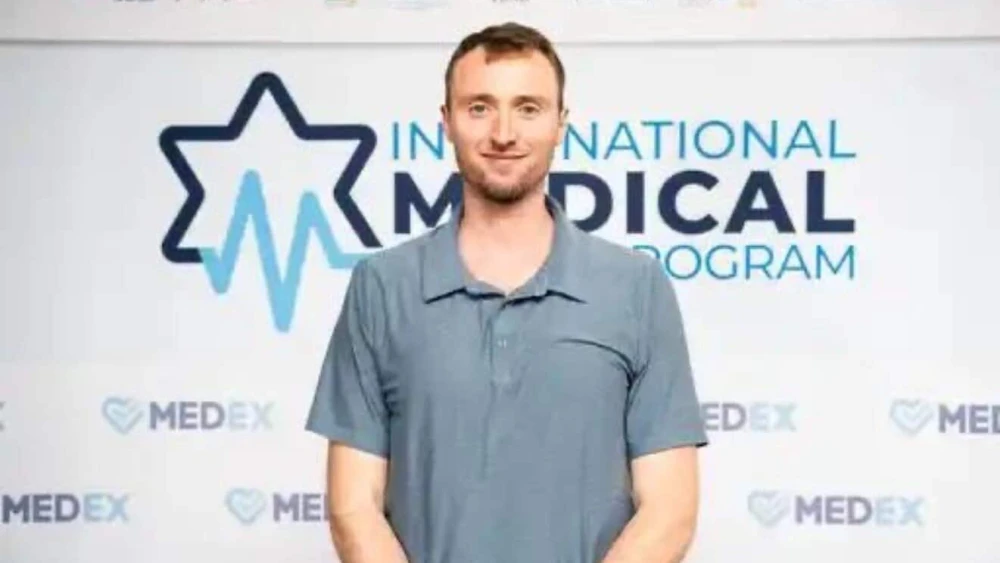
MELBOURNE, Australia—A decade and a half after immigrating to Israel on his own, straight out of high school, Melbourne native Avi Lewis was back in his childhood synagogue this week recounting his life story.
“It’s a huge full-circle,” Lewis, 33, told JNS in an interview on Monday.
Indeed, his story—from young teen to Israel Defense Forces soldier and then commander in an elite unit, from a Tel Aviv-based Meta software engineer to wartime reservist and social-media advocate for his fellow reservists—spans a large swath of Israeli society.
He said that he knew from a young age that he wanted to immigrate to Israel: “I was inspired by the dream of Jewish sovereignty in the Land of Israel for the first time in 2,000 years.”
The grandson of Holocaust survivors and the son of an Israeli-born father who relocated to Australia over half a century ago with his own parents at the age of 14, thinking it was only for a year or two, Lewis was educated in the modern orthodox Zionist Bnei Akiva and the Mizrachi movements.
The oldest of three children, Lewis recounts that as a teenager he was encouraged by his aunts, uncles and even grandparents to attend university in Australia, get on his own two feet, and then, when he was established, to do what he wanted.
“But I knew that if I did that, I would get stuck here,” he said. “I wanted to go and serve in the Israeli army with people my age.”
With the support of his parents, who sensed his motivation, at age 18, one month after graduating high school as a valedictorian, he turned down scholarship offers at Australian universities and got a one-way ticket to Israel.
From lone soldier to commander
After taking an intensive Hebrew-language course and enlisting through the Garin Tzabar program that assists soldiers without parents in the country, Lewis served in an elite unit where he was both the only non-Israeli-born and lone soldier.
“Avi is too an Israeli name for a new immigrant,” his commander told him, so he was known from then on as Lewis.
After a difficult five months of basic training, he was nearly kicked out of the top-tier unit, but told his commanders at an 11th-hour hearing that he had immigrated to serve and pleaded with them for a one-month extension to prove himself.
Doubling down, he finished the course; his parents were flown in from Australia for his graduation ceremony.
He went on to become commander of new recruits in the unit, in what he called “one of the most meaningful moments of his service.”
A fateful weekend
One weekend, after he had volunteered to stay on base over Saturday, telling his fellow soldiers, ‘You guys go home and enjoy your mom’s chicken soup,’ Lewis met the woman who would become his wife. His commander, moved by his offer to stay on base, gave him Sunday off instead. So that day, Lewis went up to the northern Israeli city of Tzfat with his sister, who was studying in Israel during her gap year after high school. On their last stop at a balcony overlooking Mount Meron, they came across an 18-year-old Canadian writing in her diary, looking to relax from a stressful week as a volunteer at Israel’s Magen David Adom rescue service.
Lewis was in a rush to head back to base, but overhearing their English, she turned to the siblings and wondered aloud where they were from. Next, she inquired whether they were dating.
“That’s how I met my future wife,” Lewis recounts.
After a brief stint in journalism following three years of military service, Lewis enrolled at Hebrew University, where he studied computer science. Eyeing a fellow student one row ahead of him applying for a job at Meta, then known as Facebook, during class one day, Lewis did the same, and was quickly accepted as a software engineer.
He would go on to write popular social-media posts in Hebrew about getting into the high-tech world, earning him a following on LinkedIn, which he would use to help fellow reservists throughout the war in Gaza.
Closing a circle
Selected by the Jewish Agency for Israel and the Zionist Federation of Australia to tell his very Israeli story, Lewis, now a father of four young children himself, was back in his hometown, not far from a synagogue that is still boarded up after being firebombed in an antisemitic attack last year.
But for Lewis, the move to Israel is not about the push, but the pull. “I don’t paint aliyah as a walk in the park,” he said. “You have to want it.”
And want it he did.
“I feel the prosperity of the Jewish people walks hand in hand with the success of the State of Israel,” he said. “For me, it was never what I can take, but what can I do to give back. I feel this is my life’s mission.”



