


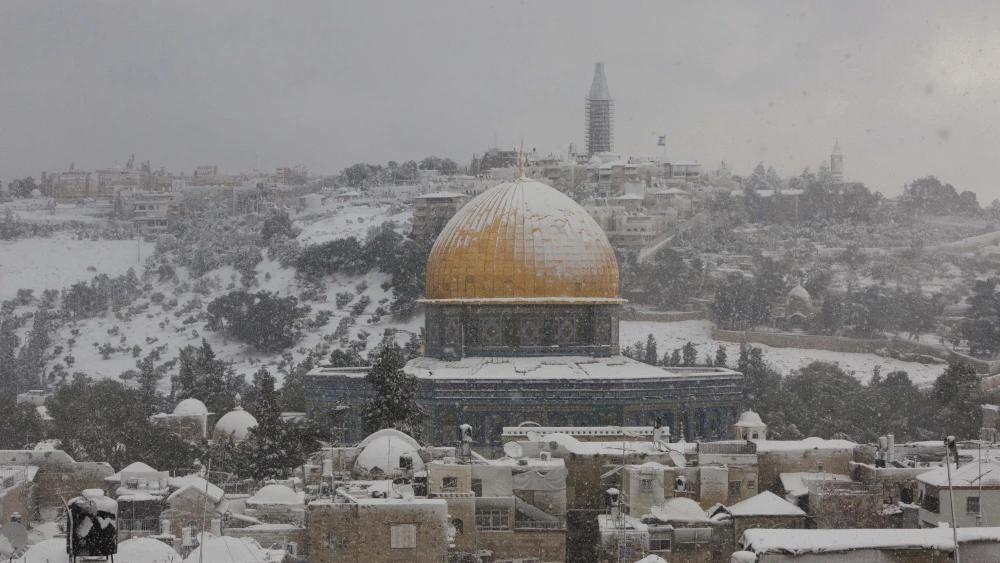
For the first time since the destruction of the Temple in Jerusalem in 70 C.E., more than 3,000 Jews prayed at Judaism’s holiest site during the month of Shevat, the Temple Mount Administration said on Thursday.
The Jewish rights group noted that the Hebrew month of Shevat, which started in late January and ends on Thursday night, is traditionally the least popular time for visits to the site due to rain and cold. However, this year, Shevat saw a 47% increase compared to 2024.
On the occasion of Rosh Chodesh (the new month of) Shevat, which this year fell out on Jan. 30, a record number of 536 Jews went up to the site.
Since the beginning of the Hebrew year on Oct. 2, at least 22,000 Jews have ascended the Mount, the organization stated, adding that the number marked an all-time high and a 20% increase compared to the previous year.
More than 55,000 Jews ascended the Temple Mount during the Hebrew year 5784 (2023-2024), according to the Beyadenu—Returning to the Temple Mount movement, another advocacy organization that monitors Jewish visits to Judaism’s holiest site.
Under a status quo arrangement reached with Jordan in the wake of the 1967 Six-Day War, non-Muslims may visit the Temple Mount but not pray there.
Israel signed a peace treaty with Jordan in 1994, but the kingdom has a majority Palestinian population and its government has taken an increasingly hostile tone since Hamas’s Oct. 7, 2023, massacre of some 1,200 people in southern Israel and during the ensuing war in Gaza.
While Israeli government officials have repeatedly stressed Jerusalem’s commitment to the status quo understanding with Amman, police in recent years have increasingly turned a blind eye to Jewish prayer.
Otzma Yehudit Party chairman Itamar Ben-Gvir, whose office oversaw the Israel Police until he resigned as national security minister last month, declared in a speech last summer, “I am the political echelon, and the political echelon permits prayer on the Temple Mount.”
The Prime Minister’s Office at the time disavowed Ben-Gvir’s words, issuing a statement saying that “Israel’s policy of maintaining the status quo on the Temple Mount has not changed and will not change.”



