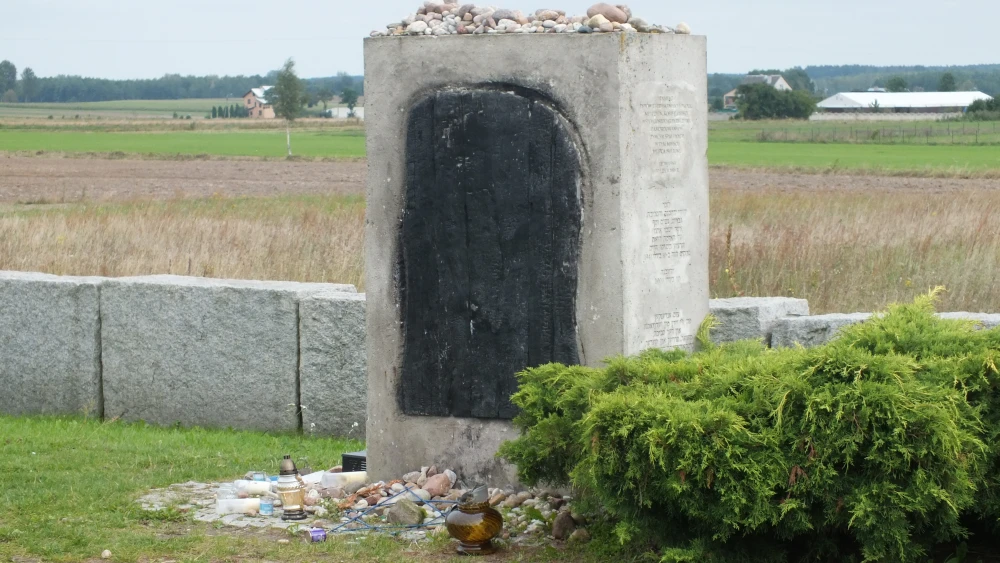
Jewish leaders, Polish officials and international representatives gathered Friday in Jedwabne, Poland, to commemorate the 85th anniversary of the wartime massacre of the town’s Jewish community, as far-right activists held nearby demonstrations challenging the established historical record of the atrocity.
The ceremony, organized by Poland’s chief rabbi and the Jewish community of Warsaw, included prayers for the victims and remembrance of the Jewish community destroyed during the Holocaust. Among those attending were Israeli Ambassador to Poland Yaakov Finkelstein, U.S. Special Envoy for Holocaust Issues Ellen Germain, Yad Vashem Chairman Dani Dayan and representatives of the International Holocaust Remembrance Alliance.
The American Jewish Committee said that Polish police maintained security around the memorial, allowing mourners to gather despite nearby demonstrations. According to AJC, extremists held a two-day rally near the site featuring speakers who promoted antisemitic views and Holocaust distortion. The organization said similar demonstrations took place during last year’s anniversary, reflecting what it described as growing efforts to rewrite the history of the massacre.
On July 10, 1941, at least 340 Jews were murdered in Jedwabne after being rounded up and burned alive in a barn by their Polish neighbors under Nazi German occupation, according to Poland’s Institute of National Remembrance (IPN).
For decades, the massacre remained largely absent from public discussion. International attention was renewed with the publication of historian Jan Tomasz Gross’s 2000 book Neighbors, which prompted a national debate over Polish participation in anti-Jewish violence during World War II. A subsequent IPN investigation concluded that local residents carried out the killings with German instigation during the occupation. The findings led then-Polish President Aleksander Kwaśniewski to issue a formal apology in 2001.
AJC also condemned displays erected near the memorial site that it said sought to distort the history of the massacre, including a large cross bearing an inscription disputing the accepted account of the killings. The organization said shipping containers had been installed nearby to serve as an “information center” connected to groups associated with Holocaust distortion and antisemitic activity.
“The Jedwabne Pogrom is a deeply painful memory for the Polish people,” said Agnieszka Markiewicz, director of AJC’s Shapiro Silverberg Central Europe Institute. “It is heart-wrenching that less than a century ago such a heinous crime was possible.”
“But with that pain comes a responsibility,” she added. “The Jedwabne Pogrom is a warning of what can happen when we allow antisemitism and hate to go unchallenged.”
Markiewicz stated that efforts to deny the massacre demonstrate why preserving historical memory and confronting antisemitism remain essential.
“The movement to deny these crimes is yet another example of why Poland must adopt a national strategy to combat antisemitism,” she said. “Democratic Poland has already done the hard work of officially recognizing what happened on July 10, 1941. Now, just as the government confronted our difficult past, it is imperative that it takes action against those who would deny and distort history and spread antisemitism.”
AJC said Polish police maintained security around the ceremony, allowing mourners to gather despite demonstrations nearby.
Among those attending the commemoration were relatives of Shmuel Wasserstein, one of the few survivors of the pogrom. His 1945 testimony, recorded by the Jewish Historical Institute, became one of the earliest eyewitness accounts of the massacre. AJC accompanied the family in meetings with Polish officials to discuss preserving Holocaust memory and countering efforts to distort the historical record.
The delegation also met with Polish Justice Minister Waldemar Żurek to discuss Holocaust remembrance, combating historical distortion and addressing antisemitism. AJC said preserving the Jedwabne memorial site and confronting Holocaust denial remain essential to ensuring the victims are remembered accurately more than eight decades after the massacre.