


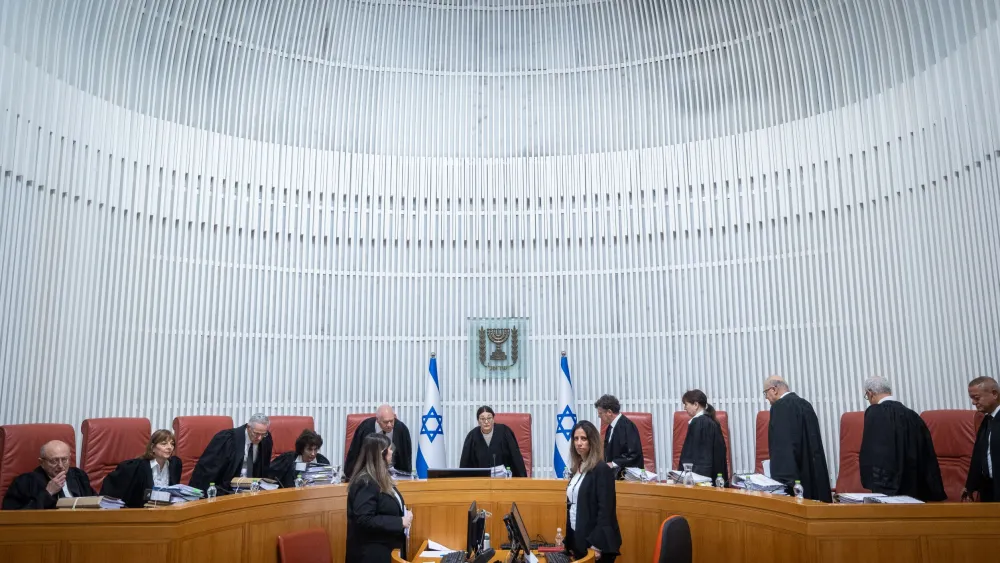
National Security Minister Itamar Ben-Gvir on Sunday criticized the Supreme Court, which barred him from giving instructions to police regarding the control of protests directed against the government’s judicial reform program.
“Judge Yitzhak Amit states that I cannot give instructions to the police regarding the riots of anarchists and the blocking of roads,” Ben-Gvir said at a Sunday evening press conference.
“In a half-page decision, Judge Amit canceled the executive branch,” he continued. “The decision, according to which the minister can only outline a general policy without any ability to implement his policy, is not only unprecedented, it’s a coup in every respect.
“As far as Judge Amit and some of his friends are concerned, the prime minister and the ministers of the government are potted plants. They can say what they think should be done, but they cannot carry out anything and cannot make sure that their policy is implemented.
“This decision by Judge Amit only reinforces the urgency of legal reform,” Ben-Gvir added.
Amit ruled on Sunday that Ben-Gvir, the minister responsible for the police, cannot interfere in police operations, which are at the discretion of the “professional ranks of the police and commanders in the field.”
Although Amit ruled that Ben-Gvir may “outline policies and general principles for the Israel Police,” even the mere “mention” of those policies “during a concrete operational event while it is still underway may be interpreted as an operational directive.”
Referring to the law passed by the Knesset in December granting authority over the police to the newly minted position of minister of national security, Ben-Gvir said, “Apparently this amendment [to the law] was not clear enough even though it is very explicit.”
“Judge Amit decided to trample it; therefore we will amend the Police Ordinance Act with another amendment in which it will be clear that the minister of national security will not only outline the policies of the police but will also ensure that his policies are carried out in a practical way on the ground,” Ben-Gvir said.
“It’s sad that there should be such an amendment because in a democracy it should be self-evident, but Judge Amit drags us to still more and more legislation in order to clarify what is self-evident: The executive authority is what it sounds like, the authority that acts. That is democracy,” Ben-Gvir said.



