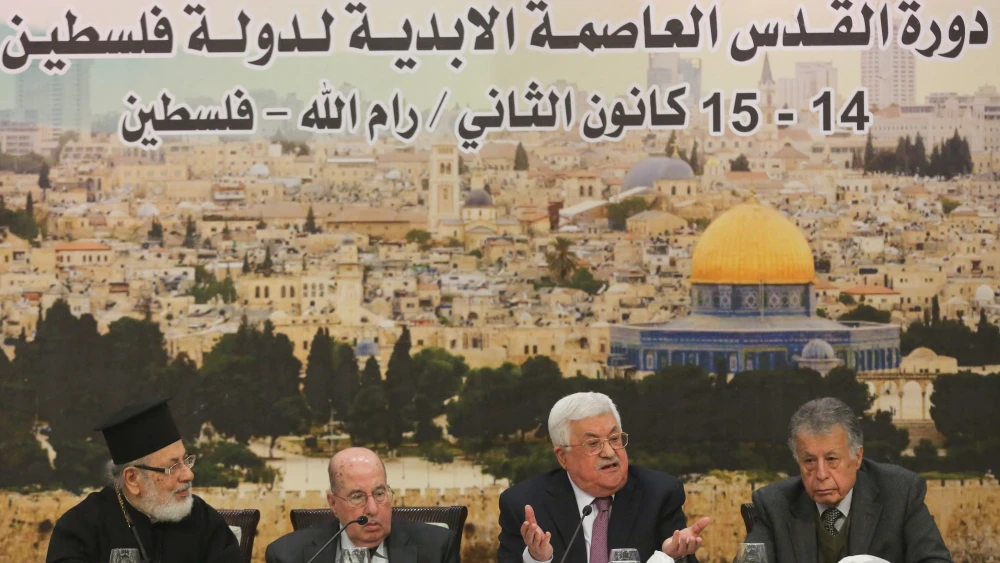
Palestinian Authority leader Mahmoud Abbas attempted to walk back anti-Semitic remarks made earlier in the week, when he argued that Jewish persecution in Europe had been caused by Jewish social behavior, not by religion.
In his apology on Friday, Abbas both condemned anti-Semitism and called the Holocaust “most heinous crime in history.”
The statement added: “If people were offended by my statement in front of the PNC, especially people of the Jewish faith, I apologize to them. I would like to assure everyone that it was not my intention to do so, and to reiterate my full respect for the Jewish faith, as well as other monotheistic faiths.”
In speech on April 30, Abbas told the Palestinian National Council that Jews living in Europe has suffered massacres “every 10 to 15 years in some country since the 11th century and until the Holocaust.”
Abbas added that “the Jewish question that was widespread throughout Europe was not against their religion, but against their social function, which relates to usury and banking and such.”
He also said that Zionism and the founding of Israel was a European colonial project, saying “history tells us there is no basis for the Jewish homeland.”
International leaders, Jewish groups and Israeli leaders widely accused Abbas of anti-Semitism and Holocaust denial.
The Yad Vashem Holocaust museum and memorial in Jerusalem said Abbas’s speech was “replete with anti-Semitic tropes and distortions of historical facts,” and accused the Palestinian leader of “blatantly falsifying history to the point of accusing the Jewish victims as being responsible for their own murder.”