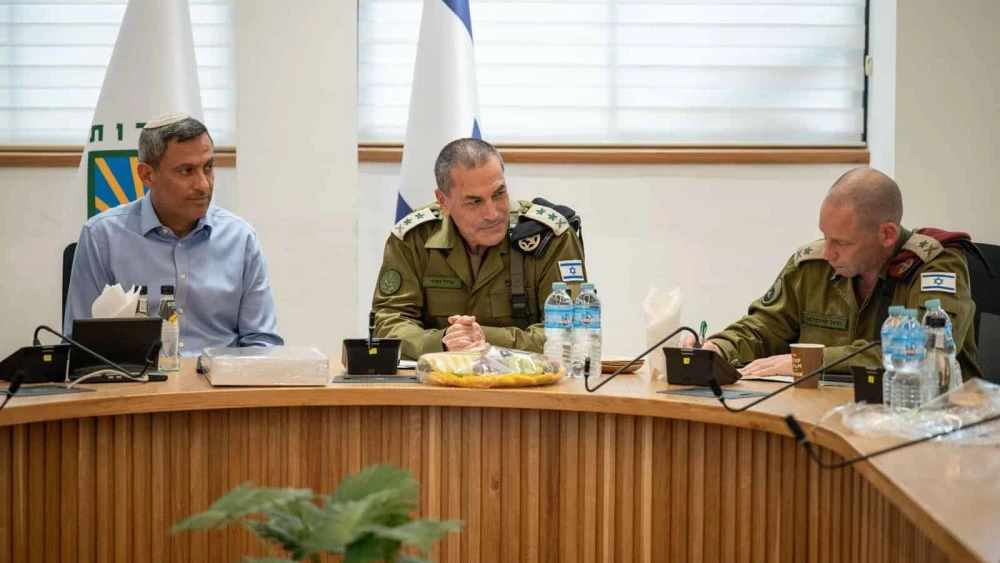

A dispute has erupted between the Israeli defense establishment and security coordinators in Gaza Envelope communities following the Israel Defense Forces’ decision to scale back the number of reserve duty personnel guarding communities between four to seven kilometers (2.5 to 4.3 miles) from the Gaza Strip.
The move shifts the burden of gate guarding and standby duties to the communities’ local civilian rapid response teams.
The decision is a result of the government’s plan to reduce the number of reserve personnel in 2026 from 60,000 to 40,000 and cut their hours, aiming to ease the burden on reservists after over two years of war.
As a result, communities in the affected areas are reportedly due to receive three reserve soldiers alongside the local security coordinator and a deputy coordinator, leaving personnel shortages for gate-guarding duties.
Brig. Gen. (res.) Harel Knafo, who returned to duty and served in IDF Southern Command in the immediate aftermath of the Oct. 7, 2023, Hamas onslaught on Israel, told JNS that the risk was reasonable in light of Hamas’s weakened position.
“This is indeed a reasonable risk,” Knafo stated. “The IDF is deployed [inside Gaza], with reinforced forces. Hamas is weakened and distanced [from the border]. And in addition, we are attacking everything that we see developing into terror.”
According to an IDF statement, the military has no intention of reducing the quantity of defense personnel in the communities, despite a reduction in the number of reserve days.
However, a source familiar with security arrangements in the Gaza Envelope drew a comparison between the current decision and the assessments that predated the Oct. 7 attacks.
“I fought hard on this issue in the past,” the source told JNS, referencing a long campaign of protests held opposite the homes of successive defense ministers—from Avigdor Liberman and Naftali Bennett to Benny Gantz and Yoav Gallant, over the issue of local response squads guarding communities in the Gaza envelope.
“We held demonstrations even before the war regarding the cuts they made to the rapid response teams and to the communities in general across the country,” the source said. “This included a letter I passed to Gallant before Oct. 7, stating that we are in danger.”
The source recounted being told that the security barrier would provide the needed protection.
The pre-war assessment was that the billion-dollar “smart fence” rendered local human defenders obsolete. “They told me, ‘You don’t need a vehicle, you don’t need a security coordinator, you don’t need standby squads or anything.’”
The source challenged the assumption that an IDF presence deep inside Gaza creates an impermeable shield.
“Okay, there is an army, so Oct. 7 won’t be the script. But that doesn’t mean a terror cell cannot penetrate. A cell, or two cells, could carry out a suicide mission on a few communities,” he stated.
On Dec. 31, during his visit to the United States, Prime Minister Benjamin Netanyahu told Fox News, “Hamas committed to disarm. They have 20,000 fighters with Kalashnikov rifles—they execute anyone who opposes them. They have a total of 60,000 rifles. We need to take all the weapons and dismantle hundreds of kilometers of terror tunnels.”
He added that if Hamas continues to refuse to disarm, “it will be done another way.”