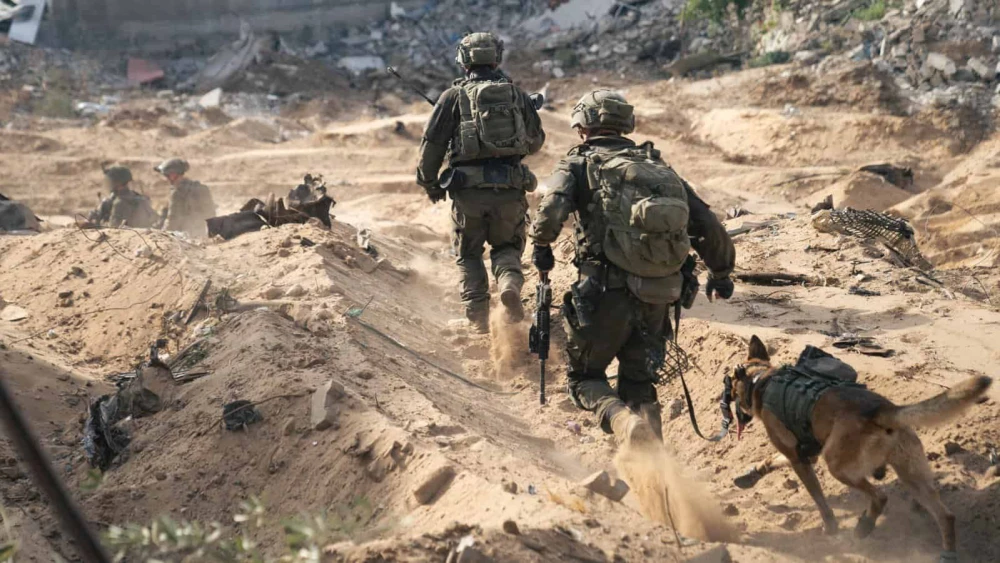

While the war in the Gaza Strip continues, Israel has successfully dismantled Hamas as an organized terrorist army but is now facing a persistent, scattered guerrilla force that remains capable of carrying out hit-and-run attacks and rocket launches.
A senior Israeli military official told JNS that the IDF has eliminated most of Hamas’s senior command, destroyed its weapons production and smuggling capabilities, and established control over two-thirds of the Gaza Strip, but thousands of fighters remain in pockets of resistance, primarily in areas not yet cleared by ground forces.
The official, speaking on July 15, provided a detailed assessment of Hamas’s current state, emphasizing the fundamental change in its operational capacity.
“The main difference, our main achievement, is primarily in the dismantling of Hamas as a military organization. Hamas does not function as a military organization; it currently functions as a guerrilla organization,” the official stated. “Its capabilities are guerrilla capabilities. It cannot fight in an organized manner.”
Hamas is limited to hit-and-run attacks, the source stated, adding that Hamas does not have the command and control of a military organization like it had on Oct. 7, 2023. “It is an organization that never wanted to fight army versus army, because it is a terror organization that operates with the methods of a terror organization, but today it also cannot do so, even if it wants to. It does not have the ability for coordinated control; rather, it has pockets in different areas.”
This degradation is a direct result of Israel’s systematic targeting of the organization’s capabilities, leadership, infrastructure and personnel.
“The absolute majority of Hamas’s senior command that existed on Oct. 7 has been eliminated,” the official said. “Today, those considered its senior command are people who were promoted during the war because so many people were eliminated.”
The current leader of Hamas is Izz al-Din al-Haddad, a member of the organization’s military council and formerly head of the military wing’s Gaza Brigade.
In addition to the leadership, Israel has focused on crippling Hamas’s ability to rearm.
“Another important element that we have damaged is their production and smuggling capability. They have neither smuggling nor production,” he explained. “What they fire, they cannot replace, except for foolish things. They can always take an explosive and a street sign and try to produce something basic, but except for this, everything they fire, they cannot replace. They have no way. This is a most significant achievement.”
This degradation in military capability has forced Hamas to change its recruitment tactics, further eroding the quality of its fighting force.
Hamas is estimated to have lost tens of thousands of terrorists, with thousands currently in its ranks. This has created a vacuum that Hamas is struggling to fill, leading it to recruit teenagers for its guerrilla operations. This new generation of operatives lacks the training and experience of those eliminated by the IDF.
The battle is also being waged over the sources of Hamas’s power within the Gaza civilian population, which Hamas uses as its sources for power and money.
Controlling the distribution of humanitarian aid is therefore key to breaking the terror group’s grip on Gaza. By commandeering aid trucks, as Israeli soldiers on the ground reported seeing in late June, Hamas not only secures resources but also demonstrates its authority over the population. This was the driving force behind the establishment of the Gaza Humanitarian Foundation, which has distributed tens of millions of meals and is free from Hamas looting since distribution centers are secured by Israel.
On the diplomatic front, Hamas and Palestinian Islamic Jihad attempt to project an image of unwavering strength, despite their massive losses. Following a high-level meeting in Doha on July 13, the terror groups issued a joint statement affirming that any negotiation must lead to a complete end to the war and a full withdrawal of all Israeli forces from the Gaza Strip. This public stance is aimed at securing their primary objective: the survival of their regime in Gaza through gaining back territories lost to the IDF.
Recent IDF and Shin Bet announcements, meanwhile, regarding strikes over the past two weeks that eliminated commanders from Hamas’s weapons production headquarters and its Military Intelligence unit, indicate a growing Israeli intelligence infiltration of Hamas.
On the ground, the IDF is intensifying its operations. On July 14, combat engineering forces conducted large-scale demolitions of structures in Jabalia, a dense urban area in northern Gaza, and in Khan Younis, a major city in the south. The IDF’s elite Multidimensional Unit recently completed a mission in Jabaliya where it eliminated over 100 Hamas terrorists.
The IDF now controls over 65% of the Gaza Strip, with the Morag Axis in the southern Strip serving as a critical logistical and operational corridor that separates areas under IDF control from those that are not. The establishment of this axis is a key pressure lever against Hamas, as it demonstrates Israeli control over territory, which the terror group fears most.
Despite these achievements, the military official acknowledged that a significant threat remains. “They still have thousands of terrorists,” he said, though he clarified their nature. “But these are terrorists, usually with simple weapons, who do not operate as an organized body but as scattered groups in different areas that can carry out terror attacks.”
These remaining pockets of Hamas control are concentrated in areas where the IDF has not yet conducted extensive ground operations, such as the central Gaza camps and Gaza City. “In the areas that the IDF does not hold, we know there are still terrorists hiding behind civilians,” the official stated. “We are advancing step by step, entering an area, evacuating the population, fighting terror..”
The official emphasized that while Hamas can still harm soldiers, its primary goal of attacking Israeli civilians in the Gaza envelope communities is being thwarted. “Hamas would like to carry out terror against Israeli civilians in the Gaza envelope [the western Negev], and it is not succeeding because we are there,” he said. “Unfortunately, it succeeds against soldiers, but the soldiers are standing between Hamas and the citizens of Israel.”