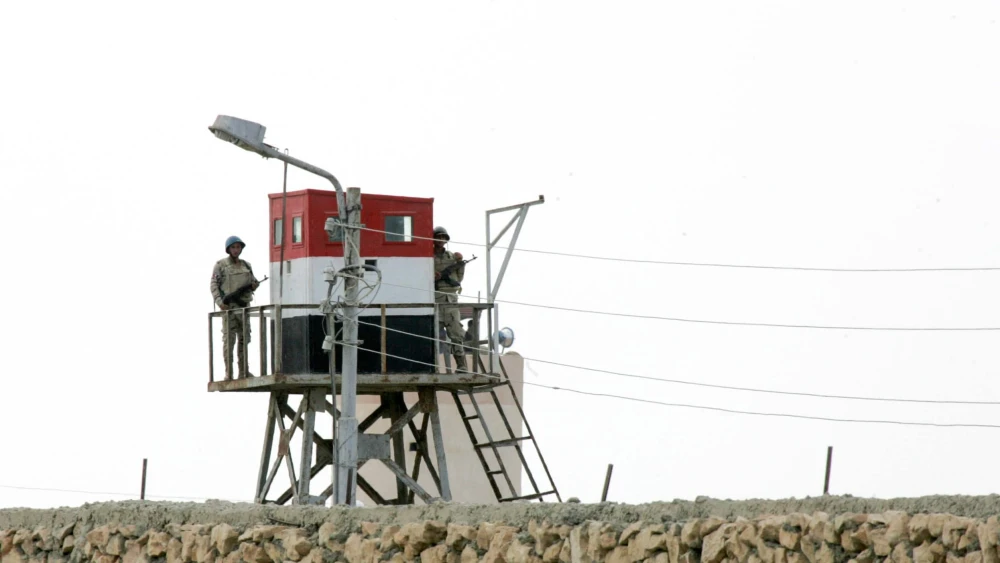

A significant and ongoing Egyptian military presence in the Sinai Peninsula, which violates the terms of the 1979 peace treaty between Egypt and Israel, raises eyebrows and questions.
While the military build-up had occurred with Israeli consent over the years to allow Egypt to fight a stubborn ISIS insurgency, its scale and offensive nature, after the ISIS threat has been diminished, have led to growing concern among some in Israel, following the Oct. 7, 2023, mass murder attack by Hamas.
The puzzle for Israeli decision-makers is how to interpret the Egyptian military posture. One school of thought argues that the Egyptian military buildup must be understood through the prism of the Egyptian regime’s worldview and internal pressures.
Ruth Wasserman Lande, a research associate at the Misgav Institute for National Security and Zionist Strategy, a former MK (Blue and White) and former Israeli deputy ambassador to Egypt, told JNS on Wednesday that the Egyptian leadership operates under a deeply ingrained, distorted perception of Israeli intentions.
“There is no rational motive for Egypt to build a force that is essentially offensive against Israel. It doesn’t make sense,” Wasserman Lande stated. “For this, one needs to understand the Egyptian state of mind, which perceives, at the highest decision-making levels, the State of Israel as an imperialist state that aspires to expand, with an emphasis on the current government. That is, the highest echelons [in Egypt] see steps taken by Israel as steps whose purpose is imperialistic.”
She provided an example of this mindset, describing how the November 2024 killing of Israeli historian and archaeologist Ze’ev Erlich, 71, in Lebanon, who was studying a fortress in southern Lebanon before being shot dead by Hezbollah terror operatives, was interpreted by senior Egyptian officials “as an attempt to gauge Israel’s ability to invade and expand into Lebanon.”
Similarly, she said, Israel’s creation of a security buffer zone in southern Syria following the collapse of the Assad regime was not seen as a defensive measure.
“They see it as an imperialistic step on the way to a ‘Greater Israel.’ They are truly convinced of this and this is not [just] at the military level or the level of the people; it is at the highest level of Egyptian decision-makers, including the most senior officials,” she argued.
This perception is compounded by a second, equally powerful factor: decades of state-sponsored anti-Israel and antisemitic incitement that has created a deeply hostile domestic environment, Wasserman Lande said.
“This is the feeding of the people for many years with anti-Israeli and purely antisemitic messages, and basically the building of a very, very great hatred,” Wasserman Lande explained. “Whether it’s in the education system, in culture, in universities, in movies, in all the socialization of the young generation and in general against Israel and the Jews. And then the inability to cope with the expectation of the people and the street from the regime to act accordingly.”
This dynamic, she argued, creates a trap for the regime. The hatred it fosters makes any pragmatic cooperation with Israel politically toxic, even when it serves Egypt’s tactical interests.
“The hatred among the people in Egypt is, I would say, the largest and most severe of all Arab countries,” she stated. “This is a country that is supposedly at peace with us for the longest period, but the hatred of the people surpasses all Arab countries … And this is something that is not organic; the regime, for a reason that is truly puzzling, continues to do this.”
At the same time, she assessed, “at this period, with an emphasis on the years that Trump is in power, I do not assess that the Egyptians will, de facto, launch a war. At this time, it would be suicidal for them.”
Dalia Ziada, an award-winning Egyptian writer and a senior fellow at the Jerusalem Center for Security and Foreign Affairs, who has held leading positions at regional and international thank tanks and civil society organizations, told JNS on Monday, “From the Egyptian national security perspective, the Sinai Peninsula has always been a problematic (if not the most troublesome) province.”
“The Egyptian public largely perceives the security situation in the Sinai Peninsula as interconnected to the situation in the bordering Gaza Strip. While the Egyptians view Gaza as an extension of Egypt and they have a strong cultural affinity with Palestinians and the so-called Palestinian cause, they reject availing Sinai as a refuge for Gazans. This schizophrenia is the result of decades of indoctrination by the consecutive communist governments and political Islamists,” Ziada said.
Ziada emphasized that the military buildup is not new and has occurred with Israeli consent to combat terrorism. “The number of Egyptian troops in Sinai increased in 2024, after the military relocated some of the forces of the Second and Third Field Armies, initially based in cities along the Suez Canal, to bolster the existing troops in Sinai. The troops were moved close to the Rafah border only after the Israeli military took over the Philadelphi corridor in Gaza and got too close to the Rafah border from the other side,” she said.
“This does not mean that the Egyptian army moved its troops close to the Rafah border in preparation for a war with Israel. If the Egyptians really care about the Gazans beyond the screens of their mobile phones and the click of their keyboards, they would have at least taken the Gazans as refugees in Sinai. However, the deployment of troops to these sensitive locations was a necessary move to appease the domestic audience inside Egypt and the broader audience in Arab and Muslim countries, which have been boiling with anger at Israel,” Ziada added.
Despite current tensions, the strategic partnership between the two countries, anchored in shared threats, will endure, she forecasted. “Looking ahead, I foresee Egypt-Israel security cooperation not only persisting but deepening in pragmatic, intelligence-driven dimensions. Don’t forget that both states share converging interests in containing jihadist movements in Sinai and Gaza,” Ziada said.
In a May 2025 article for Jerusalem Strategic Tribune, Haisam Hassanein, an adjunct fellow at the Washington D.C.-based Foundation for the Defense of Democracies, described three schools of thought that have emerged in Egypt’s military establishment since the 1979 peace treaty with Israel.
“The first sees Israel as a permanent adversary. Officers aligned with this camp, often steeped in Nasserist ideology, believe Egypt must remain in a latent state of hostility toward Israel, limiting cooperation to treaty-mandated security coordination in Sinai and rejecting normalization of any kind,” Hassanein wrote.
“The second school adopts a more guarded stance. It views Israel not as an enemy but as a persistent strategic competitor. Israel’s superior military capabilities, technological dominance, and close alignment with the United States feed a sense of unease. Many in this group see Israel’s success not only as a regional imbalance but also as a reminder of Egypt’s own stagnation in defense modernization,” he said.
“Finally, a smaller third camp advocates for a pragmatic and transactional approach. These officers support cooperation when it aligns with Egyptian national interests, particularly in combating terrorism and countering political Islam. This camp views Israel less ideologically and more operationally. It was from this camp that President Abdel Fattah el-Sisi emerged.”
In February, JNS reported that the considerable Egyptian military presence in the Sinai Peninsula and ongoing infrastructure work has some observers in Israel alarmed.
Officially, the Israeli defense establishment says that coordination between the two militaries remains tight and contributes to regional stability. However, the concentration of forces in Sinai is not easily explained by previous justifications, such as fighting ISIS, and raises the more troubling possibility that Egyptian President Abdel Fattah el-Sisi and his army view Israel as a potential future adversary.