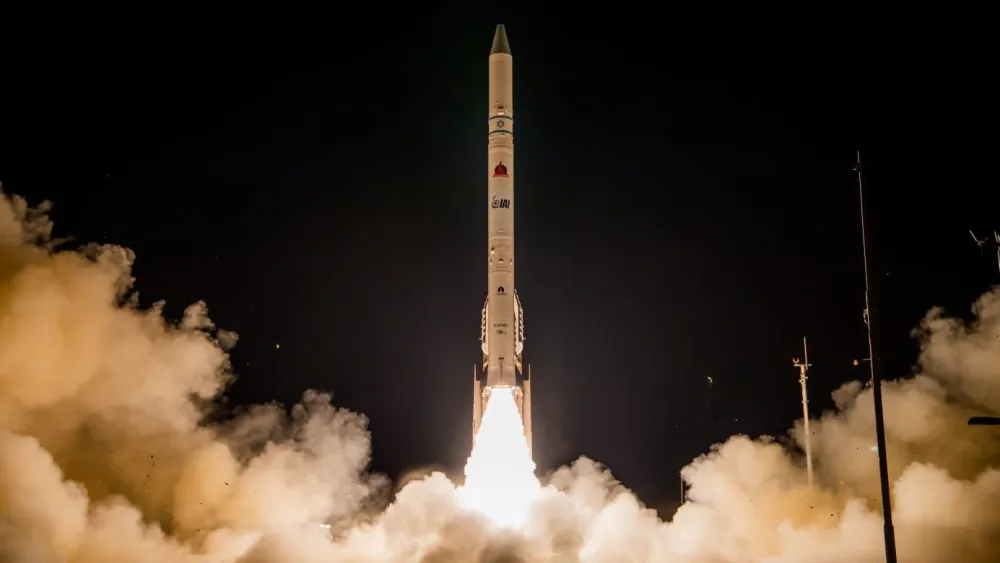

When Israeli and American forces struck Iranian installations during “Operation Roaring Lion” in this year, the decisive margin of advantage was found not only in the cockpit but also in orbit. According to the Israeli Ministry of Defense, Israeli satellites surveilled hundreds of thousands of square kilometers of Iranian territory daily throughout the campaign, generating tens of thousands of satellite images that guided strike planning, enabled immediate battle-damage assessments after each wave, and served as a critical early warning system for the home front.
Maj. Gen. (res.) Isaac Ben-Israel, a former chairman of the Israel Space Agency (ISA) and the National Council for Research and Development, who now heads the Security Studies program at Tel Aviv University, told JNS that space-based systems played a direct role in protecting Israeli civilians during the recent war.
Israelis would not have received the missile alerts they became used to, he said, “without those space activities.”
While the emerging importance of space in modern combat is but one of the many shifts made evident by “Roaring Lion,” the implications of this lesson were not lost on the defense establishment. Maj. Gen. (res.) Amir Baram, director-general of the Israel Ministry of Defense, declared unequivocally that “the ‘Swords of Iron’ war, particularly ‘Operation Roaring Lion,’ demonstrated that modern warfare extends into space.”
In this sense, Israel’s space sector is now confronting a fundamental strategic question revealed by the operational reality of Israel’s own wars. Can Israel’s space institutions, investments, and doctrine keep pace as space moves to the forefront of modern combat?
The Israeli space race
Israel’s space program, like most major national projects, was initially founded out of military necessity. Ben-Israel explained that the origin of Israel’s space program was tied directly to the peace agreement with Egypt in 1979. Once Israel had withdrawn from Sinai under the Camp David Accords, it could no longer verify Egyptian compliance by sending reconnaissance aircraft over Egyptian territory without violating Egyptian sovereignty.
“It was connected to security and defense, but because of peace,” he said, describing the paradox that pushed Israel toward independent space capabilities. The civilian infrastructure was formalized when ISA was established by government decision in 1983, as a state body within the Ministry of Science and Technology. ISA’s civilian mandate ran from the outset alongside a parallel, defense-driven track managed by the Ministry of Defense’s Directorate of Defense Research and Development (DDR&D), with Israel Aerospace Industries (IAI) serving as the central industrial builder and IDF Unit 9900 as the primary consumer of satellite-derived intelligence.
The foundational breakthrough came on Sept. 19, 1988, when the Ofek 1 satellite was launched from Palmachim Airbase aboard IAI’s Shavit rocket, making Israel the eighth country in the world to independently build and launch a satellite. When the Israeli Defense Ministry declassified launch footage three decades later, it described the program as developed “under a shroud of secrecy... to preserve its comparative regional advantage and its intelligence capabilities.”
Those initial successes of the 1980s were merely the beginning of a long-term project to expand the Israeli space footprint. Since then, there has been a persistent national policy of cultivating and expanding the domestic engineering and manufacturing base around satellites, sensors, and launchers, to further expand the domestic space-tech sector.
Space and modern combat
Initiating a military space program may have seemed overly ambitious and impractical for Israel in the 1980s. Over the past decade, however, it has become clear that this decision was a farsighted leap that provided the foundation for Israel’s current defense posture.
Israel’s wartime lessons are the sharpest illustration of a transformation already underway across every advanced military on the planet. In the modern battle space, satellites have become the connective tissue binding together otherwise disconnected elements.
Intelligence, surveillance, and reconnaissance assets locate missile launchers, air defenses, command centers, and nuclear infrastructure. Dedicated communications satellites provide secure channels for air, naval, special operations, and intelligence operations across a wide front. Infrared tracking satellites detect ballistic missile launches within seconds of ignition. Precision navigation and timing data synchronize strike waves over vast distances. Battle-damage assessment imagery confirms whether a target survived a given wave of strikes.
Dr. Deganit Paikowsky, a senior lecturer in international relations at the Hebrew University of Jerusalem specializing in techno-strategy, told JNS that the global trajectory is toward “more space-integrated warfare,” in which space is shifting from “supportive infrastructure” into an inseparable part of the battle.
The clearest evidence of the rising importance of space for modern combat lies in the vast investments currently being directed into this sector by the U.S. military. The most concrete expression of this doctrinal shift is the U.S. Space Development Agency’s Proliferated Warfighter Space Architecture. Its Tranche 1 constellation, including 126 transport satellites and 28 tracking satellites, is designed with battle management, secure communications, and mission data processing modules integrated into one interconnected system. Initial combat capability is currently projected for 2027.
Beyond command, communication, and reconnaissance capabilities, the exponential improvements in missile technologies and the looming threat of hypersonic missiles have resulted in a race to update space capabilities to handle the new offensive landscape.
On May 20, 2025, U.S. President Donald Trump announced the Golden Dome initiative, a national missile defense architecture that would “deploy next-generation technologies across the land, sea, and space, including space-based sensors and interceptors.” Masao Dahlgren, Missile Defense Project fellow at the Washington-based Center for Strategic and International Studies (CSIS), explained the critical nature of the space layer, saying, “If you don’t have a space-based sensor layer, you can’t do hypersonic defense.”
Israel’s wartime record
While Israel cannot boast of multibillion-dollar mega-projects in space like the U.S., the current war has demonstrated both Israel’s impressive capabilities and the critical role that space holds in Israel’s defense architecture. During this war, Israel’s defense agencies have operated at scale farther from Israel’s borders than during any other conflict.
On battlefields including Yemen, Syria, Iraq, and Iran, the IDF has recently expanded its footprint in ways that demonstrate high technological capacity. The farther the battlefield extends beyond Israel’s borders, the more the IDF’s targeting accuracy, communications, and strategic decision-making serve as evidence of uninterrupted access to sovereign space infrastructure.
Currently, two satellites bookend Israel’s wartime transition in space, and both are built around the same operational necessity.
Ofek 13, launched in March 2023 under the DDR&D Space Program Office in coordination with Unit 9900, was a synthetic aperture radar (SAR) observation satellite engineered precisely to deliver reliable imaging despite cloud cover, darkness, or other forms of interference. Ofek 19, launched on Sept. 2, 2025, continued that trajectory directly. Developed by IAI and operated jointly with Unit 9900, it is an advanced SAR platform capable of imaging objects smaller than 50 centimeters regardless of interference.
Boaz Levy, president and CEO of IAI, framed the satellite’s operational relevance at the launch event. “These capabilities are essential now more than ever, especially following ‘Operation Rising Lion’ [against Iran in June 2025], which underscored that having advanced observation capabilities in our region is critical for achieving aerial and ground superiority,” he said.
The record from “Rising Lion” demonstrates precisely why that claim is not rhetorical. On Dec. 2, 2025, Avi Berger, head of the Space and Satellite Administration at Israel’s Defense Ministry, provided the most detailed public accounting yet of what Israel’s space assets delivered during the campaign. “The Israeli satellite constellation was a full partner in all operational activity before, during, and after ‘Operation Rising Lion,’” Berger stated.
“Over the 12 days of [the Israel-Iran War], we collected tens of millions of square kilometers of extremely high-quality imagery, day and night. Targets were built in real time, and critical communications were provided with high availability to support strike operations discreetly and without risking our forces,” he said.
While the precise role of Israel’s space command in “Operation Roaring Lion” has not yet been published due to the ongoing operational reality, Ben-Israel noted that a similar role at a greater scale was likely played during the most recent round of fighting.
This wartime performance has produced a direct shift in official language, with space assets no longer seen as intelligence supplements, but as a strategic imperative requiring multi-billion-shekel, sustained investment.
Baram made this shift explicit at the Ofek 19 launch, saying, “In the coming decade, we will invest billions in deploying a satellite constellation that will allow us to maintain persistent, simultaneous surveillance of any point throughout the Middle East.”
Beyond reconnaissance
Israel’s wartime space shift extends well beyond reconnaissance. On July 13, 2025, the Dror 1, a 4.5-ton communications satellite developed and manufactured by IAI, was deployed from Cape Canaveral into geosynchronous orbit approximately 36,000 kilometers above Earth.
Built at a cost of approximately $200 million over seven years and designed for an operational life of at least 15 years, Dror 1 is the first in a planned series of roughly ten satellites explicitly conceived to provide Israel with independent communications capabilities for both civilian and security use, particularly in emergency conditions. Brig. Gen. (res.) Uri Oron, director of ISA, described the launch as the opening of “a new era of independence and Israeli technological power in space.”
Furthermore, on Dec. 25, 2025, ISA and the Israel Innovation Authority announced the 60 million shekels ($20.5 million) “Access to Space” national R&D laboratory, led by Creation Space and backed by 40 million shekels ($13.6 million) in pooled government grants, offering Israeli startups and research institutions at least 35% discounts on launch, testing, and in-orbit services, with a target of supporting a minimum of 15 experimental payloads within three years.
Paikowsky noted that this incentivized environment has led to “a growing commercial ecosystem involving the defense industrial base, including IAI, Rafael, Elbit, startups, academia, and international partnerships.”
The remaining gaps
Despite the impressive achievements of Israel’s space sector, external competition and the constant development of new hostile technologies mean that Israel cannot rest on its laurels but, rather, must redouble its efforts on this critical new front.
According to the CSIS “2025 Space Threat Fact Sheet,” China and Russia are “pursuing a wide range of counterspace capabilities to disrupt and degrade” allied space assets, encompassing jamming, spoofing, directed-energy weapons, maneuverable co-orbital satellites, and cyberattacks on ground infrastructure. CSIS independently documented widespread GPS jamming and spoofing throughout the Middle East as a continuing operational pattern. A satellite architecture built around a limited number of high-value platforms and concentrated ground stations presents precisely the targets that adversaries will seek to exploit.
Paikowsky warned that these threats should not be understood in isolation. “Threats should be understood as systemic,” she explained. “A growing dependence on orbital infrastructure creates vulnerability across physical, cyber, electromagnetic, and environmental dimensions.” Protection, she added, requires greater resilience through “distributed architectures, redundancy, cyber hardening, anti-jamming and anti-spoofing protections, integration with commercial systems, coalitions, and support for responsible space norms.”
Beyond hostile action, the basic economic backbone needed to achieve consistent access to space remains “the main obstacle” for Israeli technology innovation in this sector, according to ISA. Recent ISA reports have consistently found that the industrial layer underwriting Israel’s space capacity still faces critical bottlenecks, including dependence on external launch providers and a satellite production pace far too slow to generate the scale that modern war will increasingly demand.
Israel’s space program was born from the need to preserve a military edge over neighboring threats. Its next test will be whether it can preserve its superiority in an era of hypersonic missiles, electronic warfare, and space competition. The record of IDF operations “Rising Lion” and “Roaring Lion” against Iran suggests that space is no longer a supporting layer of Israeli national security, but one of its central domains.
Whether Israel can translate its proven technological track record into a more resilient and more robust space architecture will help determine whether it maintains military superiority in the wars ahead.