Newsletter
Newsletter Support JNS

Yad Vashem releases rare photos of Kristallnacht pogrom

The album was kept for many years in the home of a soldier who served in the counterintelligence department of the U.S. Army in Germany during World War II.

Yad Vashem: The World Holocaust Remembrance Center releases rare photos of Kristallnacht, the Nazi pogrom of 1938. Credit: Yad Vashem.

A newly discovered photo album recently donated to Yad Vashem, Israel’s Holocaust Museum, features rare photos of the events of the November Pogrom of 1938, termed “Kristallnacht” by the Nazis.

The museum released the photos to the public on Wednesday.

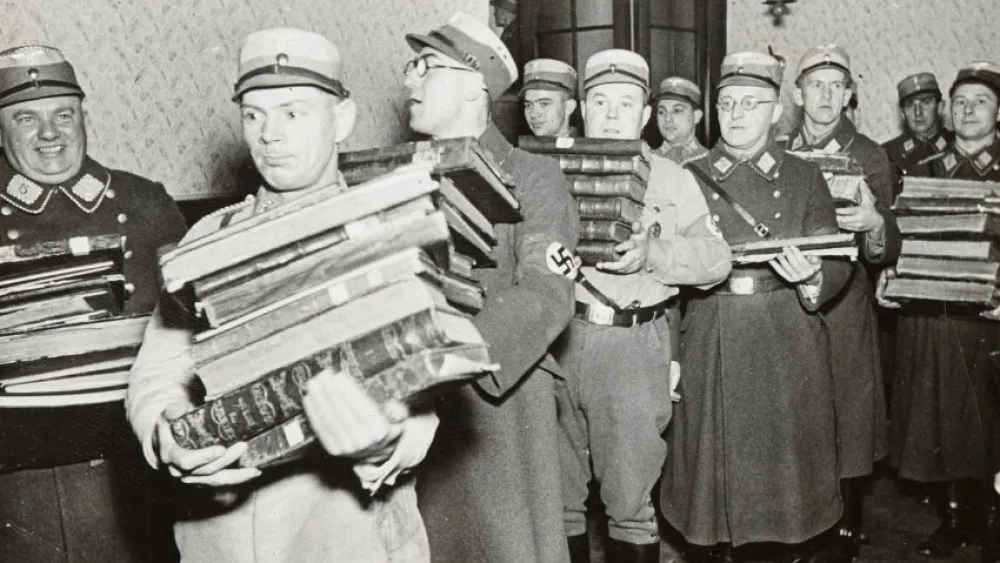
The album contains photographs of vandalized Jewish homes, images of Jews in dressing gowns or pajamas, some wounded, and others still in bed—classic propaganda photos taken by the Nazis—and pictures of SS men gathering piles of books, presumably collected in order to burn later.

The photos, taken by Nazi photographers, depict scenes from one location, but are representative of the attack on the Jewish community across much of Germany and Austria during the two-day pogrom.

Jewish victims from a rare album featuring photos taken by Nazi photographers during the November pogrom of 1938. Credit: Yad Vashem.
Jewish victims depicted in the album featuring photos taken by Nazi photographers during the pogrom of 1938. Credit: Yad Vashem.

Yad Vashem Chairman Dani Dayan said, “Seeing these images of humiliation of Jews, and the destruction of their homes, businesses and even synagogues is extremely disturbing and difficult.”

The album was kept for many years in the United States in the home of a Jewish American soldier that served in the counterintelligence department of the U.S. Army in Germany during World War II.

After he passed away, his daughter, Ann Leifer, and her two daughters discovered the album while cleaning up her father’s house.

“When I opened the album, I felt as if a hole had been burned through my hands,” said Elisheva Avital, the soldier’s granddaughter, describing that moment when they first saw the photos contained in the album.

Between Nov. 9-10, 1938, German and Austrian mobs looted, torched and vandalized many Jewish-owned shops, businesses and homes. In just a few hours some 1,400 synagogues were set ablaze and destroyed.

Gideon Sa’ar congratulated the country’s leaders, citing a “new chapter” in relations between Ljubljana and Jerusalem.
The IHRA definition could have a “chilling effect on political speech,” said the British Medical Association, drawing condemnation from Jewish medical groups and Holocaust educators.
Washington is said to be looking to move ahead with a $750 million sale of jet engines to Turkey, bypassing congressional review • The U.S. president said Turkey stayed out of the Iran war at his request.
Adam Muhammad Ibrahim Abu Hadid, who oversaw weapons production, was eliminated in a strike in Khan Younis, according to the Israeli military.
The shooting guard, 22, is the son of legendary Maccabi Tel Aviv basketball star Derrick Sharp.
The demonstration caused heavy traffic, including a chain accident on Highway 1 in which a pregnant woman was moderately injured.
Benny Gantz, JNS editor-in-chief Jonathan S. Tobin, Gilad Erdan, Mosab Hassan Yousef, Nissim Black and leading voices in security, diplomacy, media, law and Jewish communal affairs headline the summit’s third day in Jerusalem.