Newsletter
Newsletter Support JNS

Court upholds anti-BDS law in state of Arizona

The original law was blocked by a federal court in September 2018, citing a possible violation of the First Amendment. A modified version was enacted the following April.

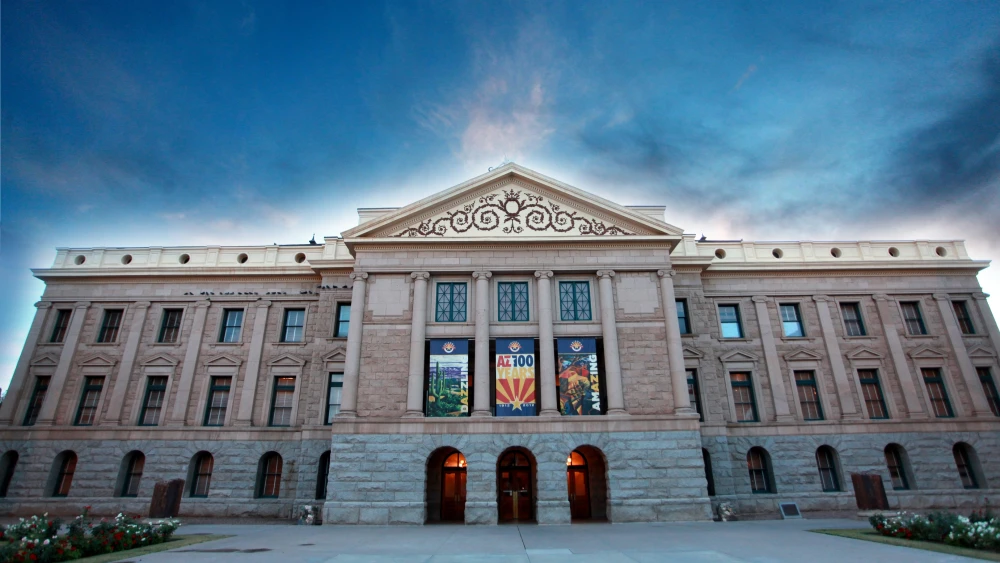
The Arizona Capitol Museum building in Phoenix. Credit: Gage Skidmore via Wikimedia Commons.

The Ninth Circuit Court of Appeals upheld Arizona’s anti-BDS law on Monday, vacating the preliminary injunction against the 2016 measure, which underwent changes in early 2019, making the plaintiff’s suit moot.

The original law was blocked by a federal court in September 2018, citing a possible violation of the First Amendment. The modified version, enacted the following April, applied to state contractors with more than 10 employees and those that receive a contract that is at least $100,000.

The plaintiff was attorney Mikkel Jordahl, who boycotts the Jewish state due to “Israel’s occupation of the Palestinian territories,” according to the ACLU, which opposed both versions of the Arizona law.

“We are pleased to have played a leading role in helping the Jordahl case meet its end. States like Arizona have created laws that carefully regulate commercial activity and not the conduct of private speech,” said IAC for Action executive director Joseph Sabag in a statement. “Anti-BDS laws are narrowly tailored, anti-discrimination laws, similar to many other anti-discrimination laws that protect, among other categories of people, women, racial minorities and LGBTQ individuals.

“There is a direct connection between the BDS movement and anti-Semitic crime and discrimination. Sadly, the BDS movement has no greater asset today than the sophisticated legal support it receives from the ACLU,” he continued. “Their cynical cultivation of the Jordahl case was a prime example of that fact. Thankfully, with the release of so much evidence and documentation of BDS’ anti-Semitic nature, it’s becoming more difficult for the ACLU to exploit deficiencies in judicial and legislative understanding of the matter.”

“Anti-Zionism can be a framework for justifying anti-Jewish hostility,” Rafaela Dancygier, of Princeton University, told the N.J. Advisory Committee to the U.S. Commission on Civil Rights.
A board member at the Orthodox synagogue told the FBI that members began attending services less frequently after Kevin Charles Pyles allegedly targeted the synagogue in separate July and August 2025 incidents.
The Senate rejected a resolution calling for the removal of U.S. forces from the war against Iran after U.S. President Donald Trump hammered Senate Republicans for approving a similar measure the day before.
“When someone uses the N-word on campus, no one thinks about free speech. No one talks about, ‘Let’s understand what they’re thinking. Let’s have a discussion,’” Rep. Randy Fine said. “But somehow when it came to Jews, everyone wanted to rediscover the idea of free speech.”
“Leadership should be responding with moral clarity, not suggesting that the act of teaching about the Holocaust has somehow ‘missed the mark,’” said Kurt Schwartz, CEO of CAMERA.
The judges said the sanctions, which the United States imposed in response to the Hague-based court’s targeting of Israel, are unlawful.
Benny Gantz, JNS editor-in-chief Jonathan S. Tobin, Gilad Erdan, Mosab Hassan Yousef, Nissim Black and leading voices in security, diplomacy, media, law and Jewish communal affairs headline the summit’s third day in Jerusalem.