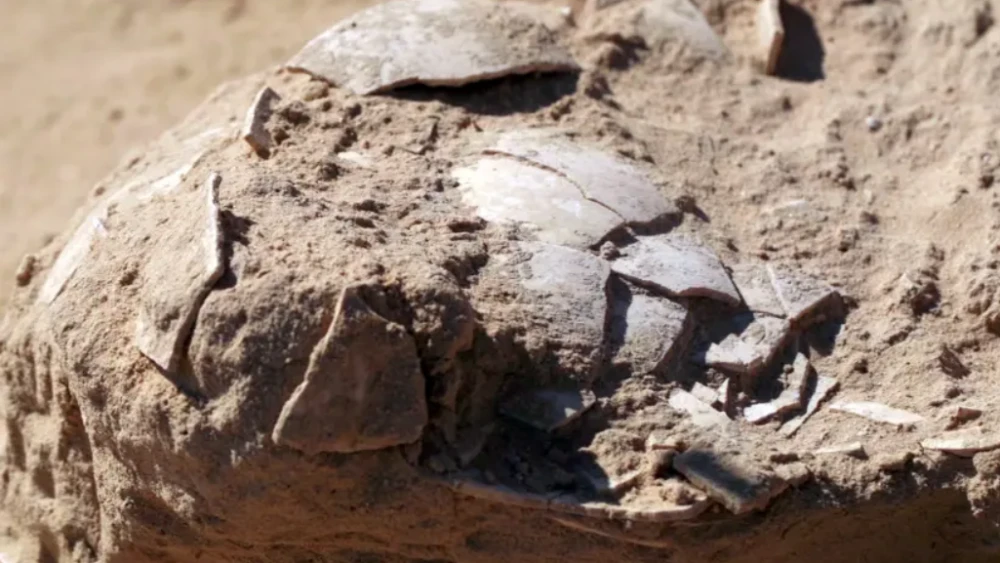
The Israel Antiquities Authority (IAA) recently uncovered a number of ostrich eggs dating back thousands of years during an excavation near an ancient fire pit in the Negev desert.
“We found a campsite, which extends over about 200 square meters, that was used by the desert nomads since prehistoric times. At the site we found burnt stones, flint and stone tools as well as pottery sherds, but the truly special find is this collection of ostrich eggs,” said IAA excavation director Lauren Davis.
“Although the nomads did not build permanent structures at this site, the finds allow us to feel their presence in the desert. These campsites were quickly covered over by the dunes and were re-exposed with the sand movement over hundreds and thousands of years. This fact explains the exceptional preservation of the eggs, allowing us a glimpse into the lives of the nomads who roamed the desert in ancient times,” she added.
Ostriches were common in the region from early prehistoric periods until they became extinct in the wild during the 19th century. Their eggs have been found in archaeological sites from several periods, reflecting their importance as a raw material.
“We find ostrich eggs in archaeological sites in funerary contexts, and as luxury items and water canteens. Naturally, they were used as a source of food: one ostrich egg has the nutritional value of about 25 normal chicken eggs!” said IAA researcher Dr. Amir Gorzalczany.
“There is sometimes even evidence of decorating and incising on ostrich eggs, showing their use as decorative items. It is interesting that whilst ostrich eggs are not uncommon in excavations, the bones of the large bird are not found. This may indicate that in the ancient world, people avoided tackling the ostrich and were content with collecting their eggs,” he added.
For her part, Davis noted that the proximity of the group of eggs to the fire pit indicated that they were collected and thus likely used as food.
“After the excavation we will reconstruct the eggs, just like a puzzle. The whole egg may tell us the species, and exactly what they were used for. As far as I’m concerned, every eggshell is worth its weight in gold! I am really looking forward to the research in the labs. The best is yet ahead!” said Davis.