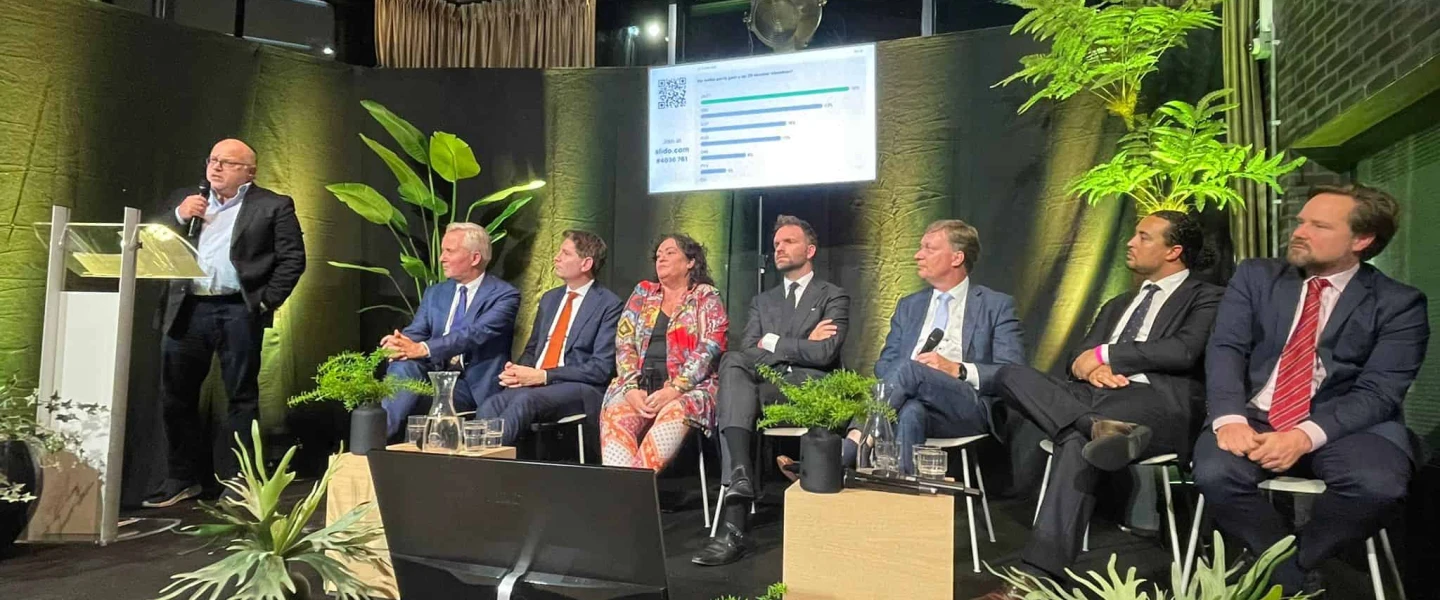
For about three hours last month, leading representatives from several of the Netherlands’ largest political parties faced off in a spirited debate aimed at convincing Dutch Jews of their support for both the local Jewish community and for Israel.
The event was part of a long-standing tradition: the pre-election debate organized by the Center for Information and Documentation on Israel (CIDI), Dutch Jewry’s main advocacy body.
Since the 1990s, CIDI has hosted such debates ahead of nearly every general election, bringing together politicians from across the political spectrum to what was widely considered not just a Jewish townhall meeting, but a tour de force for the community.
But this year’s edition, held amid a surge of antisemitism in the Netherlands, felt markedly different, its makeup and venue underlining how support for Israel can exist only in bubbles and enclaves in a country where it was once a consensus.
The atmosphere was friendly and familiar, and security was light—reminiscent of a time before antisemitic threats reshaped Jewish life in the country. Yet for the first time, several major parties declined to participate, and all major Amsterdam venues refused to host the event, citing security concerns.
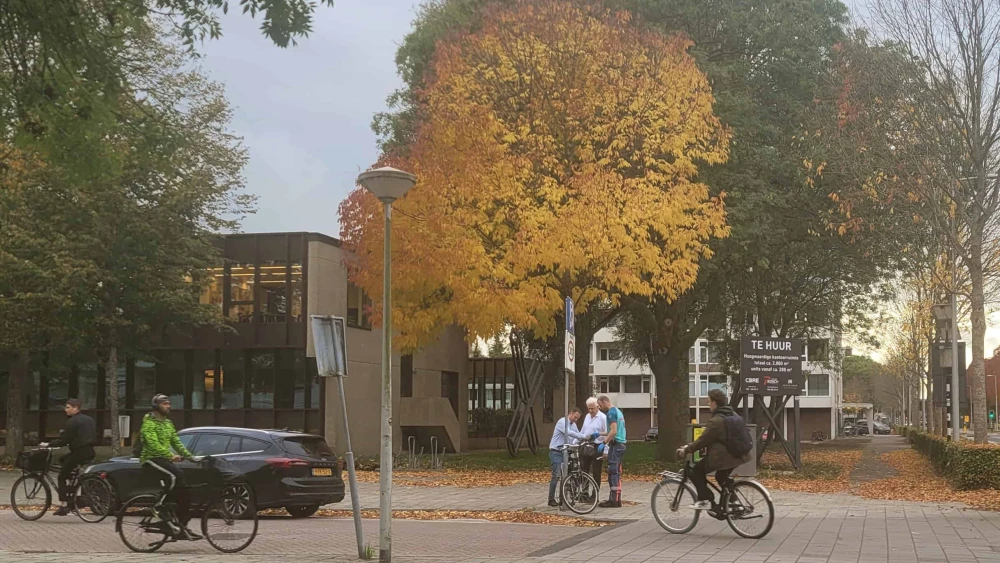
As a result, what was once a prestigious gathering in central Amsterdam had to be relocated to the suburban offices of a Jewish-owned firm, providing a physical dimension to a feeling of isolation and inward movement within the Jewish community.
“The event was useful and the messages expressed were mostly good to hear, but it also added to a feeling of isolation,” said Ronny Naftaniel, a former director of CIDI. “It symbolized a drawing inwards—away from the center of society and consensus—to an almost ghetto-like environment.”
The Netherlands’ Jewish population is electorally negligible, numbering about 30,000 in a country of 17 million, including at least one million Muslims. Many in the community regard the elections that took place on Oct. 29 as crucial for their safety and for Israel’s standing in Dutch politics—especially amid an unprecedented rise in antisemitic incidents following Hamas’s Oct. 7, 2023, attacks on Israel.
The elections, held on Oct. 29, saw Geert Wilders’ right-wing Party for Freedom (PVV)—long considered staunchly pro-Israel—lose 11 seats, undermining its status as the country’s largest party.
PVV’s 26 seats leave it roughly equal in size to the center-left D66, whose leaders have accused Israel of committing genocide in Gaza. Under Dutch law, the largest party receives the first chance to form a coalition, and D66 is expected to court left-wing partners critical of Israel.
CIDI has documented 421 antisemitic incidents over the past year—a record high, up 11% from the previous all-time peak in 2023. Dutch Chief Rabbi Binyomin Jacobs told JNS that interest in aliyah (immigration to Israel) is growing, while he hopes the next government will “curb the import of the Gaza conflict.”
One particularly traumatic episode occurred on Nov. 7–8, 2024, when hundreds of Muslim men coordinated attacks on Jews and Israelis returning from a soccer match between Maccabi and Ajax. Some described the assaults as antisemitic “pogroms.” Since then, Jewish gatherings have required heavy police protection.

Against this backdrop, the ruling coalition’s stance toward antisemitism and Israel is viewed as decisive for the future of Dutch Jewry. CIDI events have increasingly drawn hostile protests that critics say blur the line between anti-Israel sentiment and antisemitism.
This year’s debate was peaceful—likely because it was moved to the offices area of the leafy and heavily-Jewish suburb of Amstelveen. “At the last CIDI event I attended, there were fires, screaming, and chaos,” recalled Roel Abraham, a Dutch Jew from Almere. “I feared a repeat, but to my great relief, there wasn’t a single agitator.”
CIDI director Naomi Mestrum explained why: every venue in Amsterdam, including the iconic Rode Hoed, had refused to host. “We tried hotels, debate centers, churches, theaters—none wanted to run the risk,” she said.
Among the attending parties, the center-left D66 represented the political left. Its lawmaker Jan Paternotte said Israel “may have perpetrated” war crimes in Gaza, called for “new leadership” in both Jerusalem and Ramallah, and urged recognition of a Palestinian state in “the occupied West Bank.” Abraham, though critical of Paternotte’s remarks, called his attendance “courageous,” noting that “few Palestinians today support a two-state solution.”
Caroline van der Plas of the right-wing Farmer–Citizen Movement (BBB) consistently steered discussion back to antisemitism in the Netherlands, expressing deep solidarity with Dutch Jews and Israel. The only woman on the panel, “Her emotional attachment to the issue was clearly visible,” noted Abraham.
Diederik van Dijk of the Reformed Political Party—a small Protestant movement—delivered one of the evening’s most passionate defenses of Israel. Rejecting allegations of systemic war crimes, he urged Israel to “Build, build, build!” in Judea and Samaria while raising his fist.
Notably absent were the far-left parties but also Wilders’ PVV. The no-show by Labor and its partner, Green Left, was striking as Labor had long been the political home of many Dutch Jews. It has called for an arms embargo on Israel, including parts for the Iron Dome missile defense system. The joint Labor-Green Left bloc lost five seats in the election.
The absence of those parties, Naftaniel observed, undercut the event’s representative breadth. “It was a very nice debate, with many reassuring things said about Israel, the Jewish community, and the fight against antisemitism,” he said. “But it no longer reflected the broader reality of Dutch society.”