


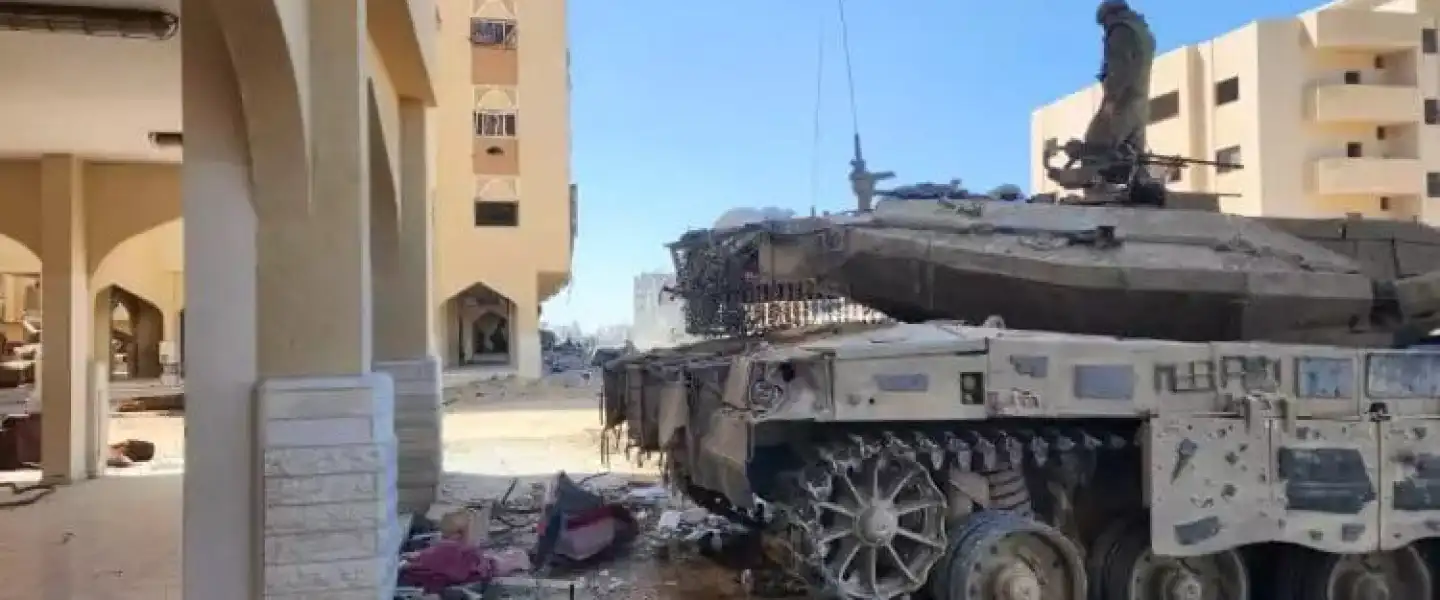
“We have been fighting for five months already, but this is the toughest combat zone we have been in so far. The terrorists here are suicidal, they fight for every square foot,” the leaders of the IDF Commando Brigade say as we walk around inside the Gaza Strip.
We stand outside a multi-story building in the heart of the affluent Hamad neighborhood in Khan Yunis. The luxury homes, built by Qatar, are located just a few hundred feet from the sea, with a view of the ruins of the former Israeli communities of Netzarim and Kibbutz Kfar Darom.
Despite the apparent standstill in the Gaza war reflected in the news coverage, the moment you cross the security fence into Khan Yunis, that illusion is shattered. Miles of demolished, ruined homes can be seen through the dust scattered by the armored personnel carrier.
I have visited combat zones in the past, including in the Kyiv area, but that didn’t come close to what the IDF has done in Khan Yunis. The city is effectively gone.
In the Hamad neighborhood, some of the Israel Defense Forces’ most elite units have been operating for 11 days—the Egoz guerilla warfare unit, Maglan, which specializes in operating behind enemy lines, Shayetet 13 naval commandoes and the Givati Brigade’s Reconnaissance Battalion, together with armored, engineering and air units. Every multi-story building is a separate battle arena, and a platoon-size force clears it floor by floor.
“This is a very complex battle, there isn’t a single building where we didn’t find ammunition and enemy combatants working in an organized and coordinated manner,” the commander of the Commando Brigade, Col. Omer Cohen, tells us.

We move forward after Lt. Col. M., the commander of the Egoz unit. He is a father of five and a resident of Samaria. He was wounded in the fighting on Oct. 7 but he returned to combat a short time later.
“This neighborhood looks nice, but it is actually one big battlefield,” says M. “There isn’t a single location where we didn’t encounter terrorists or find ammunition. This has been a major battle with very significant achievements. Unfortunately, two of our soldiers were killed right here, just dozens of meters away. There were amazing fighters here who fought desperately and did great things.”
On the third floor of one of the buildings, there is an arsenal of weapons, seized inside a single building: Kalashnikov and M-16 rifles, RPG rocket launchers, explosives and boxes of Israeli–made ammunition. In one of the nearby buildings, the personal weapon of the Nahal Brigade commander Col. Yonatan Steinberg, who was killed in an exchange of fire with terrorists on Oct. 7, was found.
The terrorists fled from other neighborhoods to the Hamad quarter as the fighting in the Gaza Strip intensified and prepared for battle. Alongside the weapons, there are also books providing impressive details about the various IDF units. One of the Egoz fighters opened one of the books to a page describing his own unit.
As we exit the building, we find that the adjacent building has become a combat zone. Tanks are charging into the compound, firing their machine guns and cannons. The soldiers instruct us to take cover. Eventually, they direct an aircraft towards the site and eliminate the terrorists.

“Encounters are a daily occurrence. There isn’t a day that we don’t engage the enemy. There is a very large number of them here, an unusual amount compared to what we have experienced so far in Khan Yunis,” explains Col. Y., the deputy commander of the Commando Brigade. There are a lot of terrorists who decided to retreat to this area in recent months from other areas. This is a significant center of gravity.”
In one of the buildings, a terrorist used his family members as human shields. The soldiers identified a woman and two children raising their hands, with the barrel of the terrorist’s gun behind them. The forces managed to kill the terrorist, while the woman was only lightly injured. “The terrorists are making horrific use of their families here,” says Lt. Col. M.
Behind the buildings stands the Hamad Mosque. This is an impressive structure, but it was hit during the fighting. The terrorists may have used the underground facilities there as a platform to descend into a tunnel. “The working assumption is that everywhere in Gaza there is fighting above and below ground,” clarifies Col. Cohen.
Last Saturday, Maj. Amishar Ben David, who was the battalion commander’s command and control officer, was killed in the neighborhood, dozens of meters from where we are standing with Col. Cohen. “He was a hero of Israel,” his commander says.
“Unfortunately, I still haven’t had a chance to meet the parents. I extend my condolences to all the bereaved families that I haven’t been able to reach yet due to the intensity of the war. My heart is with them.”
Originally published by Israel Hayom.


