


The flag bearer rode a donkey. Two children led the animal, another helped hold the flag, and the rest followed in pairs, singing.
It was July 27, 1885, and the agricultural settlement of Rishon Letzion was celebrating its third birthday.
Israel Belkind, a founder of the Bilu pioneering movement, had made it with Fanny Meirovitch, a young immigrant whose family was among the town’s founders. Shortly afterward, he described their work in a letter to his friend Zeev Dubnov.
“And this was the flag we made,” he wrote: “a piece of white cloth, with two pairs of blue stripes at its two ends, like our tallit, and a blue Star of David in the middle.”
There was no Jewish state yet. The First Zionist Congress was still 12 years away. But the colors and symbols that Israel would eventually adopt were already being carried through the streets.
On Oct. 28, 1948, Israel’s Provisional Council of State formally adopted the national flag. The decision, whose 78th anniversary fell recently, settled a question that might seem surprising today: Should the new country use the familiar Zionist flag, or have a different one of its own?
From the prayer shawl to the procession
Belkind’s description leaves little doubt about the inspiration for the Rishon Letzion flag. The stripes followed the example of the tallit, the Jewish prayer shawl.
The design differed slightly from the flag Israelis know today. Belkind and Meirovitch used two pairs of blue stripes rather than two single bands. Between them, they placed the Star of David.
His letter also recorded how the flag became part of the anniversary festivities. Children accompanied the flag bearer through the settlement, with “all the other children, two by two in a row, with songs on their lips.”
Today, the Rishon LeZion Museum tells the story in its flag exhibition at Beit Heisman. Its windows overlook Founders’ Square, where the museum identifies the site of the flag-raising. A reconstruction follows the design described in the letter.
The written account is particularly valuable because different versions of the flag’s origins developed over the years. With assistance from the National Library of Israel in Jerusalem, the museum located Belkind’s original Russian manuscript in the library’s collections and checked it against the Hebrew translation published decades earlier.
Here was the flag’s maker explaining what they had done, shortly after the celebration itself.

Herzl’s seven stars
Theodor Herzl understood the importance of a flag, although his proposal would have looked quite different.
“We have no flag, and we need one,” he wrote in The Jewish State, published in 1896. He proposed a white background with seven golden stars, explaining: “the stars are the seven golden hours of our working day.”
The seven-hour day was part of his vision for the society Jews would build. The flag would carry that promise alongside the idea of statehood.
Herzl’s designs evolved. A sketch sent to the British Zionist Jacob de Haas in 1896 incorporated a Star of David into the arrangement of seven stars. But it was the blue-and-white design associated with David Wolffsohn, the second president of the Zionist Organization, that became the familiar banner of the Zionist movement.
Wolffsohn’s account of preparing for the First Zionist Congress in Basel in 1897 gives the story a practical turn. Alongside the arrangements for the gathering, was the question of a flag.
“What flag would we hang in the Congress Hall?” he recalled asking himself.
The answer, he explained, came from the prayer shawl. He ordered a blue-and-white flag with a Star of David painted on it.
“That is how the national flag, that flew over Congress Hall, came into being.”
The Rishon Letzion flag had preceded that congress by 12 years. Wolffsohn’s account describes how the same source of inspiration—the tallit—helped furnish a flag for a movement bringing Jews together from different countries.
By May 1948, blue-and-white flags flanked Herzl’s portrait behind David Ben-Gurion as he declared independence. They had become so familiar that their presence at the ceremony seemed natural. Their official status still had to be settled.
Could one flag belong to everyone?
The difficulty was that the flag already belonged, in an emotional sense, to Jews who would probably never become citizens of the new state.
For decades, Jewish communities had raised the Zionist banner to express their connection to the Land of Israel and support for the movement. Making it a national flag could change how those displays were understood.
Foreign Minister Moshe Sharett, then known as Moshe Chertok, explained the concern in July 1948: Jews abroad could appear to be flying “the flag of a state of which they are not citizens.”
A separate Israeli flag might protect them from accusations of dual loyalty. Yet a new design could also suggest a separation between the state and the Jewish communities that had helped bring it into being.
Sharett sought the views of Zionist leaders abroad. Their responses favored retaining a common flag. Reporting back to the flag committee, he said they supported “the unity of the flag.”
Rabbi Abba Hillel Silver in New York, president of the Zionist Organization of America, argued for keeping the Zionist flag as Israel’s national flag with minimal changes. He considered the concern about complications overseas “somewhat exaggerated.”
The familiar design prevailed. On Oct. 28, 1948, the Provisional Council of State adopted the blue-and-white flag.
A bedsheet and blue ink
In March 1949, Israeli troops were heading south through the desert toward the Red Sea. “Operation Uvda,” the last major operation of the War of Independence, would establish Israeli control over the southern Negev and bring the army to Umm Rashrash, the British police post out of which the city of Eilat would grow.
The Negev Brigade crossed the desert highlands while the Golani Brigade advanced through the Arava.
But as the forces moved toward their destination, Negev Brigade commander Nahum Sarig discovered an omission: They had no Israeli flag to raise.
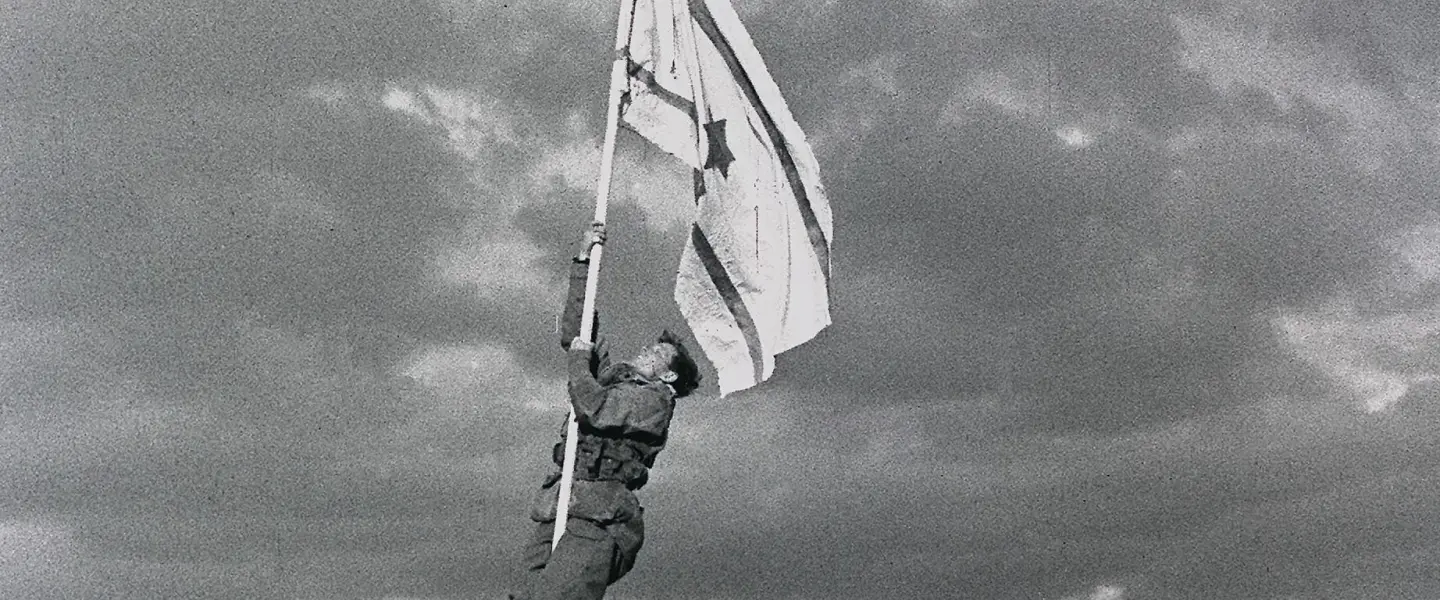
At the brigade’s headquarters at Sde Avraham, his secretary, Puah Arel, helped solve the problem. Using a white bedsheet and blue ink, she painted the familiar stripes and Star of David.
On the morning of March 10, Sarig handed the homemade flag to company commander Avraham “Bren” Adan.
That afternoon, the troops reached Umm Rashrash. The Jordanian forces had withdrawn, leaving the police post abandoned.
Adan climbed the pole while the soldiers below held it steady. Micha Perry took the photograph that would become one of the defining images of the war: a man clinging to a flagpole, his comrades gathered beneath him and an improvised flag overhead.
The ceremony ended with “Hatikvah.”
The message sent by the Negev and Golani brigades announced:
“On Haganah Day, the 11th of Adar, the Palmach Negev Brigade and the Golani Brigade present the Gulf of Eilat to the State of Israel.”
An iconic image of a country less than a year old, raising a flag its people had revered for decades.


