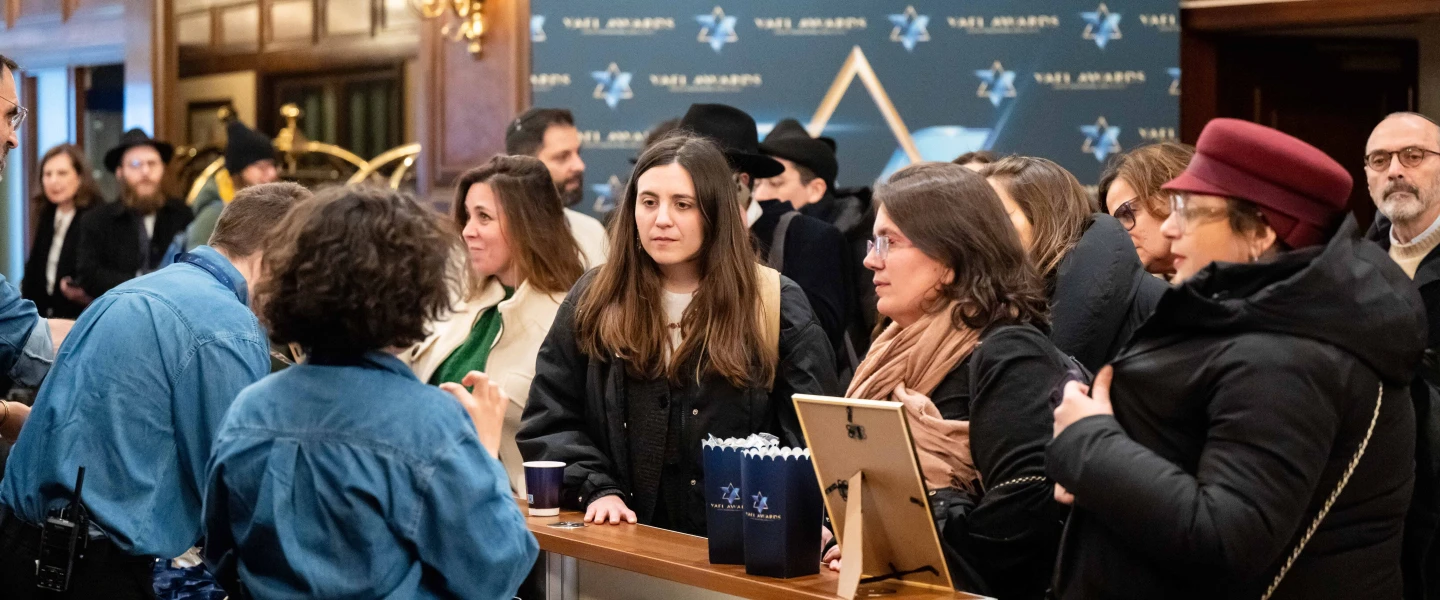
What was once a community of just five families seeking a Jewish life in Bulgaria has grown to some 200 families today, Maxim Delchev, executive director of the Organization of the Jews in Bulgaria, Shalom, told JNS at the Yael Foundation’s fourth annual summit on Tuesday.
“We don’t believe our future lies in building museums and only preserving history. We want to stay in Bulgaria, stay in Europe and continue to exist,” Delchev told JNS. “If that means having our own guards, more people volunteering to help secure the community and at the same time more people in synagogue, more people debating what it means to be Jewish, and more people discussing their grandmothers’ recipes, I’m fine with that.”
This year’s summit focuses on innovation, leadership, Jewish identity and the challenges of modern education. It also features the Yael Awards Ceremony, a flagship event honoring leading schools—selected by parents—for excellence in education.
Lectures at the summit included, on Tuesday, Positive Leadership: The Science of Happiness by Tal Ben-Shahar, which explores the intersection of leadership, psychology and well-being; and on Wednesday, Harnessing the Hacker Mindset by Keren Elazari, linking cybersecurity, innovation and leadership, as well as Igniting Excellence in the Next Generation, outlining the vision of Yael Foundation CEO Chaya Yosovich.
Delchev described Bulgarian society as largely tolerant, while acknowledging a 200% increase in minor antisemitic incidents in recent years.
“It’s significant,” he said, “but compared to attacks in Paris or London, here it might mean graffiti on a synagogue wall or the desecration of a Holocaust memorial.”

Hope and a sense of unity
The community is increasingly uniting, Delchev said, with Israelis now living in Bulgaria seeking stronger connections. Of the 250 students at the country’s only Jewish school, located in Sofia, half have at least one parent who is Israeli or Ukrainian.
“The tragedy of Oct. 7 brought hope and a sense of unity and togetherness to the community,” he said, referring to the Hamas-led invasion of southern Israel on Oct. 7, 2023.
As a post-communist community, Delchev explained, Jewish life in Bulgaria was nearly nonexistent 40 years ago: synagogues were largely empty and mixed marriages stood at 90%. Today, however, the community is growing again, centered around a Jewish school that opened seven years ago and expanded from 70 students to 250. “Next year, we will have our first graduates,” he said.
“Our school places a strong emphasis on Hebrew and Jewish studies,” Delchev said. “Our students will take a final exam organized by the Hebrew University of Jerusalem, similar to the bagrut exam taken by Israeli students their age. We are trying to create a safe haven within Bulgarian society. The national education system is not very strong, and we want to ensure that every child can excel in what they are good at.”
The school also welcomes children with special needs and disabilities. “Even if society is not always as inclusive, we are,” he added.
Focus on Israel
Since Oct. 7, Delchev said, the community has placed an even greater focus on Israel. Israel has long been central to Bulgarian Jewish identity: in 1948, some 45,000 of Bulgaria’s 50,000 Jews immigrated to Israel, and many of those who remained have close family ties there.
In recent years, however, Israel had become more of a relational topic; now, Delchev said, the school is emphasizing Zionism and the depth of that connection.
Before the establishment of Bulgaria’s only Jewish school, Delchev explained, Jewish children’s exposure to Israel was largely limited to public schools that taught Hebrew as a foreign language, without connecting it to Jewish texts, tradition or religious life.
“In the 1990s, this was the best way we had to introduce Hebrew and some level of Jewish knowledge to our children,” he said. “The program began in 1993, and we only opened the Jewish school in 2019. It took nearly 30 years to develop and to ensure we had the right staff in place.”
The school operates with government support, follows the Ministry of Education curriculum, receives public funding and is audited by the ministry.
On July 18, 2012, a Lebanese-French suicide bomber attacked a group of Israeli tourists at Burgas Airport in Bulgaria, killing six people—including himself—and wounding 32 others. The attack occurred shortly after the tourists arrived on a charter flight from Tel Aviv and boarded a bus to their hotel. Israeli and Bulgarian authorities attributed the bombing to the Iranian-backed Hezbollah terrorist organization.
Even though only minor antisemitic incidents have occurred in recent years, Delchev said the community is preparing for the possibility of more serious threats.
“Our country is not fully prepared to understand antisemitism,” he said. “It is easy to dismiss these incidents as vandalism or the actions of teenagers who don’t know what they’re doing, but we are not that naive.”
Security measures have been increased, he said, including private guards trained by the community’s chief of security and cooperation with other European Jewish communities.
“We worked on a project with 16 communities across Europe on how to build a shared system of resilience and security,” Delchev said. “We are preparing ourselves.”