Anyone who has lived in Israel—especially since Oct. 7, 2023—could use some stress relief. A recent report by Israel’s state comptroller found that an estimated three million Israelis are dealing with mental-health issues as a result of the war.
Another survey by Ben-Gurion University found that nearly half of Israeli adults ages 18 to 30 are showing signs of severe post-traumatic stress disorder (PTSD), with rates soaring to 60% in communities evacuated during the war.
For all of these people, there are just 17,000 psychologists and psychiatrists in the country.
“We are not equipped to deal with the mental health crisis,” Dr. Cathi Lawi, founder of EmotionAid, told JNS. “There is an increased rate of burnout among community workers and mental health professionals. We want to provide tools to help community workers around the country.”

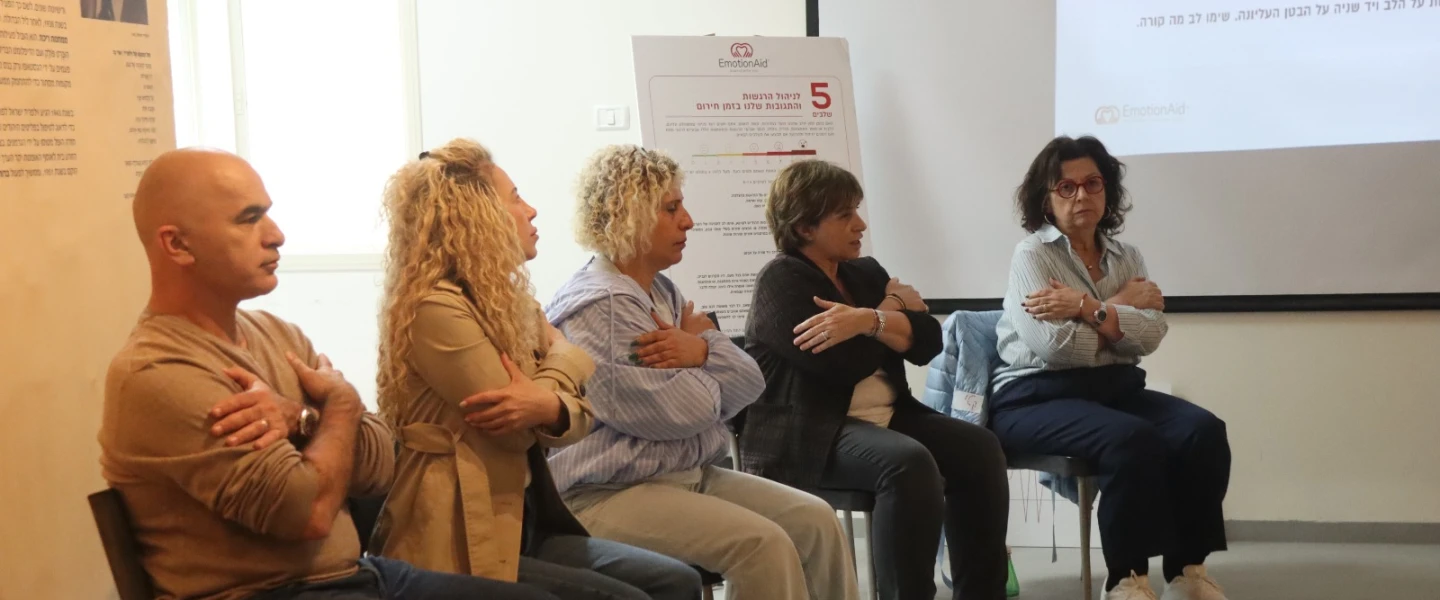
Lawi, a trauma therapist, international trainer and former biotech executive, founded EmotionAid in 2014. The organization offers a five-step protocol that takes just five minutes and can be done almost anywhere.
The techniques include neuroscience-based exercises drawn from somatic therapy. One, known as the “butterfly tap,” involves sitting in a chair, crossing the arms and alternately tapping the upper arms 25 times before taking a deep breath and repeating the process. Another technique, called “grounding,” asks participants to sit upright with their feet on the floor and identify objects around them by color and texture.
“Our protocol is based on advanced research in neurosciences and psychology,” Lawi said. “We turned complex scientific theories into an easy-to-use, fast-response product that can be adopted by all, from children to seniors. Once acquired, it is a resource that stays with you, for life.”
The goal is to train resilience facilitators who can then use the techniques in their work with broader communities, helping people reduce tension and better manage stress.
One of those facilitators is Yair Li Baranes, director of the community center in Ma’ale Yosef, which serves communities near the Lebanese border, including Shlomi, Ma’alot and Nahariya.
Having recently completed the training, he said the techniques are helping him personally.
“When I go to the scene of an attack [by Hezbollah], I am calmer and can direct people more effectively,” he told JNS. “My whole staff is doing this training, and we are using it every day.”
Baranes said he has already approached the umbrella organization representing community centers across Israel to explore offering EmotionAid training nationwide.
Lawi said EmotionAid is also working with the Darca school network to train teachers, who can then pass the techniques on to students. She said the need is especially acute in communities along the northern border, where Hezbollah attacks have intensified in recent weeks.
According to the Israeli Pediatric Association, 83% of Israeli children have experienced emotional distress since October 2023, with more than 19,000 officially recognized as victims of terrorism.
Lawi said early intervention is critical in addressing trauma symptoms before they become deeply entrenched.
By treating symptoms early, she said, people are better able to resume their daily lives and function effectively.
A second-generation Holocaust survivor, Lawi said she was exposed to trauma from an early age. She recalled one client who worked at a community center whose home was damaged when a Hezbollah missile strike shattered all of its windows.
She said she thought of the biblical injunction to “choose life” and returned to work.
“This idea of choosing life is very familiar to me,” she said. “Their house just exploded and yet they are going to work to save others. That really resonated with me.”