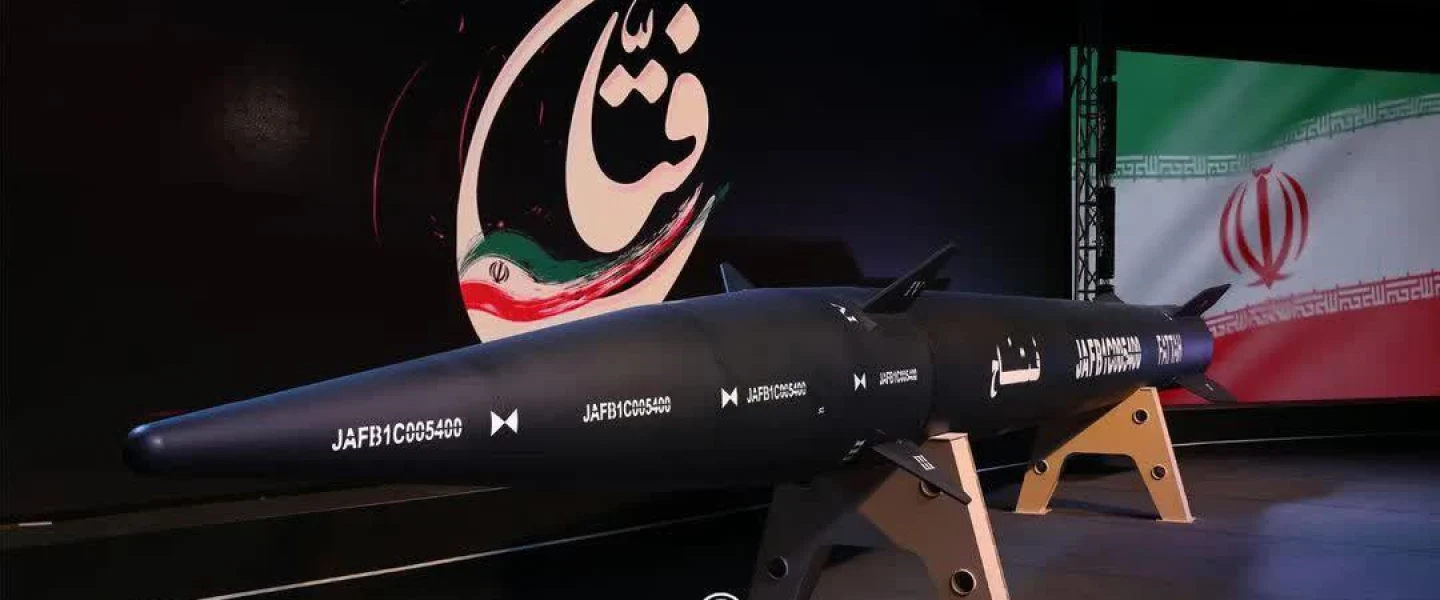
A recently unveiled Iranian missile, described by its makers as being the Islamic Republic’s first domestically made hypersonic weapon, does indeed pose a threat to Israel, yet contrary to Iranian claims there are defense systems that can stop it, according to a leading Israeli missile expert.
Tal Inbar, a senior research fellow at the Missile Defense Advocacy Alliance, a nonprofit organization that promotes public support for missile defense systems, told JNS on Wednesday that the claims being made by Iran about the missile’s features, range and precision appear to be true.
The missile, he said, is a “new product, that has no equivalent in the world. It can open, for Iran, a new operational door.”
He added, however, that in his assessment the missile was still in the flight trial phase.
“This is a real missile that formed out of Iranian planning, which displays original thinking alongside impressive technical capability,” he said.
However, he added, “Regarding the claim that it can surpass any active defense system—that’s inaccurate.”
On June 6, Iranian state media released images of the “Fattah” missile at a ceremony attended by Iranian President Ebrahim Raisi and senior commanders from the Iranian Revolutionary Guards Corps.
“The precision-guided Fattah hypersonic missile has a range of 1,400 kilometers and it is capable of penetrating all defense shields,” said Amirali Hajizadeh, the head of the IRGC Aerospace Force, according to Reuters.
Hypersonic missiles fly at least five times faster than the speed of sound, and have non-predictable trajectories, making them harder to intercept compared to standard ballistic missiles. The “Fattah” missile has a re-entry vehicle—the part of the weapon that reenters the atmosphere from space, with four steering fins, and is powered by a solid rocket motor.
“It can bypass the most advanced anti-ballistic missile systems of the United States and the Zionist regime, including Israel’s Iron Dome,” according to Iranian state TV, which claimed that its top speed is Mach 14, or just over 9,300 miles per hour.
A Western source told JNS that the missile likely means Iran will be less dependent on North Korea for future missile development, and that it creates new challenges for Israel with regard to threat detection.
Israel’s Arrow 3 air defense system intercepts ballistic threats in space, while the Arrow 2 operates in the upper atmosphere. The David’s Sling system operates below the Arrow 2, and Iron Dome defends against aerial threats further down, creating a multi-tier defense system that is described by many observers as being the most advanced in the world.
In February 2021, the Israeli Defense Ministry announced that it had begun developing Arrow 4, the next-generation Israeli air defense system, which will operate both above and within the atmosphere. Few other details have been released about it to date, including whether it can deal with hypersonics.
The Western source noted that hypersonic missiles undermine air defense systems’ ability to be selective, reducing the available time in which to select the most pressing threat in a multiple-attack situation.
Iran possesses the Middle East’s largest and most varied missile program, and is also building an arsenal of unmanned aerial vehicles, like the “Shahed 136,” which Russia has used against Ukraine.
The “Shahed” UAVS have small warheads but are precise, long-range threats.
Iran’s terror proxy Hezbollah is assessed to possess more than 200,000 missiles and rockets of various types.