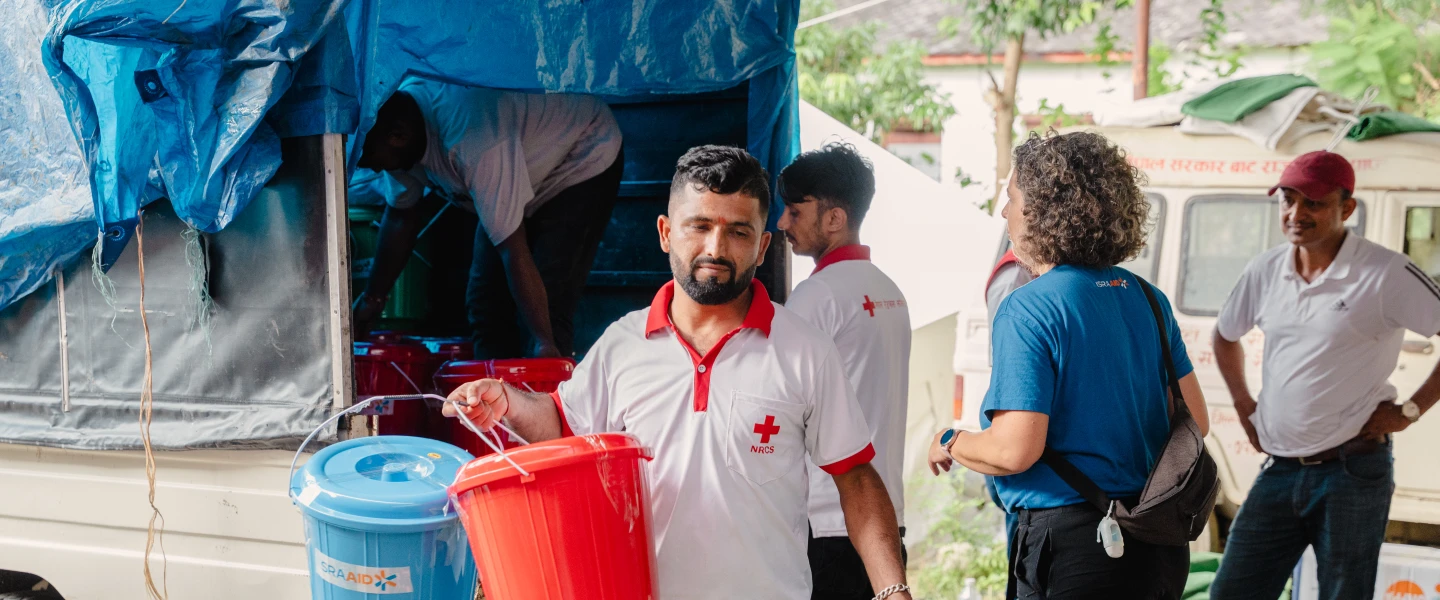
Just two days after catastrophic flash floods swept through Nepal, IsraAID, an Israeli nongovernmental humanitarian aid organization that responds to emergencies and disasters around the world, began distributing hygiene kits and offering mental-health support to thousands of children in affected areas.
The Aug. 26 disaster, triggered by the collapse of a glacier in the Himalayas, has killed at least 1,259 people in Nepal and left more than 5,000 missing.
“The situation on the ground is still very challenging, as search and rescue is still the priority of the government,” Mai Leshem, head of IsraAID’s mission in Nepal, told JNS. “Many of the most highly affected areas are still not accessible, but we are doing everything we can.”
She said IsraAID has a team of seven people, both locals and internationals, some of whom worked for the organization following the devastating earthquake in Nepal in 2015.
So far, IsraAID has focused on providing family hygiene kits with basic items such as soap, toilet paper, toothbrushes, toothpaste, menstrual-hygiene products and other essentials. In addition, Leshem said, the organization is working to provide psychological support for children.
Thousands of people have been displaced from affected areas and are staying in temporary shelters.
More than a week after the floods struck the Bhotekoshi-Trishuli river basin, at least 22,000 children urgently need safe drinking water, sanitation and hygiene support, the United Nations Children’s Fund (UNICEF) said.
Water systems have been damaged across affected districts, while toilets and other sanitation facilities have been damaged or destroyed, raising the risk of waterborne and infectious diseases. There are also fears of additional flooding in the coming weeks.
“Families here are still living through the uncertainty and distress of emergency, but we have been moved by the strength and commitment of the local volunteers and communities who are supporting survivors and evacuees through this challenging time,” Leshem said.
“We are doing everything we can to aid and amplify their efforts and make sure that the support we bring reaches those who need it most.”
IsraAID has an emergency fund that allows it to deploy teams quickly and connect with local partners. In countries such as Nepal, the organization already has relationships with local groups on the ground.
Because it is independent of the Israeli government, IsraAID can also operate in countries where political considerations have prevented or complicated direct Israeli government assistance.
“We are very clear on who we are—we are the leading Israeli NGO—and people know who we are,” IsraAID Communications Director Ethan Shwartz told JNS. “Politics are irrelevant in a moment of crisis.”
He said the organization would remain in Nepal as long as it could be helpful. Following the 2015 earthquake, for example, an IsraAID team remained on the ground for four years.
Last month, IsraAID provided assistance following a magnitude 7.4 earthquake in western Colombia that destroyed hospitals, schools and homes. According to IsraAID, it was the strongest earthquake to hit Colombia since record-keeping began in the early 1920s.
IsraAID already had a team in Colombia that had been operating there since the beginning of the Venezuelan refugee crisis in 2019. Since then, Shwartz said, the mission has responded to frequent emergencies and crises.
“Just a month and a half after the devastating earthquake in Venezuela, Colombia is now facing a similarly difficult situation, with communities that were not prepared to confront an event of this magnitude,” said Karina Garcia Uribe, IsraAID Colombia country director. “In an emergency, acting in time can make the difference between vulnerability and the possibility of rebuilding hope.”
Operating with small teams, IsraAID is able to move quickly and begin providing assistance soon after a disaster. Leshem said the organization does not conduct search-and-rescue operations but focuses on immediate humanitarian needs.
Shwartz said IsraAID has an annual budget of $26 million. In recent years, the organization has responded to earthquakes and hurricanes across Latin America and the Caribbean, including in the Bahamas, Colombia, Dominica, Ecuador, Guatemala, Haiti, Jamaica, Mexico and Puerto Rico.