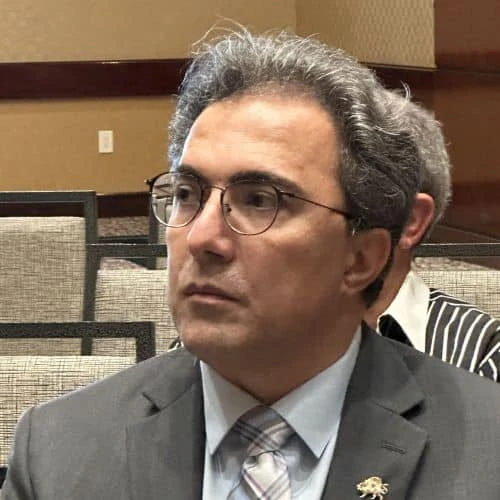
For as long as he can remember, M.R. Manheim felt an obligation to preserve his family’s wartime story.
“My wife said I’ve been writing this book since I was 10 years old,” Manheim told JNS in a recent interview.
That childhood memory came during a family vacation with his uncle Elliot, when stories about World War II suddenly began flowing freely around the dinner table.
“I always knew my dad and his brothers had served in the war, but this was the first time they started telling stories,” Manheim recalled. “Elliot loved getting laughs from the story about telling off the captain of his boat, and we all roared in response.”
Even then, he sensed something larger beneath the humor.
“I had a gut feeling that if I didn’t tell their stories, they’d be lost,” he said. “I was already learning about the Holocaust and somehow understood the weight of the era in which they served.”
The desire to ensure those stories were not forgotten eventually materialized into Manheim’s debut book, Elsie’s Boys. The memoir chronicles the lives of three Jewish brothers from working-class Philadelphia who served in different branches and theaters of World War II after Pearl Harbor. More than a military narrative, Manheim says, it is a story of family, Jewish identity, sacrifice, patriotism and memory.

Publication on D-Day
At the center of the story is the writer’s grandmother, Elsie, who held the family together after her husband abandoned them during the Great Depression.
“My dad was about 8 when their father left,” Manheim said. “Nobody knows what they’re capable of until circumstances demand it, and she somehow held the family together during the Depression. That was no small feat.”
Over the course of roughly 18 months following Pearl Harbor, all three brothers enlisted, leaving Elsie facing the terrifying reality that each of her sons could be killed overseas.
“The stories they told were often funny,” Manheim said. “But underneath that, my father and Uncle Stanley both saw combat and went through very difficult experiences.”
One brother, Stanley, shipped out shortly after the Battle of the Bulge, Nazi Germany’s final major offensive against Allied forces in Europe.
As the manuscript neared completion, Manheim and his publisher, Beverly House Press, decided to release the book on June 6 to coincide with the anniversary of D-Day, when Allied forces launched the Normandy invasion of Nazi-occupied France in 1944.
“D-Day heralded the beginning of the end of World War II,” he said.

From Philadelphia to Rehovot
Born in Philadelphia and raised in Glen Rock, N.J., Manheim later spent 18 months studying and working in Israel before marrying his wife, Dina, whose family comes from Columbus, Ga., in Jerusalem’s Geula neighborhood. After 35 years in Atlanta, where they raised three children, the couple made aliyah in 2019 and now live in Rehovot, where two of their children also reside with their families. The third lives in West Hempstead, N.Y.
Manheim and his wife, who have been married for 47 years, have “barely enough fingers and toes” to count their grandchildren.
A licensed clinical social worker and psychotherapist by profession, Manheim spent much of his four-decade career specializing in family therapy, child psychiatry and developmental disorders, serving on the clinical faculty at Emory University before retiring. (He writes opinion pieces for JNS under the name Moshe R. Manheim and volunteers for the U.S. National Association of Social Workers’ national ethics committee.)
“For many, understanding who we are as Jews is easy,” Manheim told JNS. “For others, having a connection to the Jewish people is much more difficult. Knowing who one is, having a very deep sense of one’s own identity, is critical. A favorite question I saw years ago asked, ‘Do you want your grandchildren to be Jewish?’ For some of us, that’s a given; for others, not so much. If that’s important to you, then you’ll have to structure things to make it more likely. I fear for much of Western Jewry, given the tides we see sweeping through what I used to value as liberal thought.”
Manheim’s professional background deeply shaped the themes explored in the book.
“My understanding of attachment theory taught me how central family bonds are to human identity,” he said. “We have the opportunity, maybe even the obligation, to preserve our family stories.”
He worries that many younger Jews underestimate how quickly those stories can disappear. “The opportunity to preserve these memories is fading with time,” he said.
In the book, he urges readers not to delay in seeking out the history of their own relatives. “Time passes quickly,” he writes. “You never know what you may learn—or what may be lost if you wait.”
From World War II to now
Manheim sees disturbing parallels between today’s rise in antisemitism and the atmosphere that preceded World War II.
“In the last 10 years, I’ve become increasingly concerned about renewed antisemitism,” he said. “It predates Oct. 7, though people sometimes forget that.”
He added that the rise in anti-Zionism and anti-Jewish hatred around the world has forced him to reconsider assumptions he once held about liberal Western society.
“I came of age in the 1960s and ’70s believing in personal growth and human progress,” he said. “Over time, I’ve become deeply concerned that we underestimated the evil that exists in the world.”
He added that “the parallels to the 1930s are striking. There can never be another World War II because warfare itself has changed so dramatically. But once again, we are living through an era of widespread hatred and bigotry, and Jews somehow find themselves in the center of it.”
At its core, Manheim’s book is ultimately about Jewish continuity. He notes with pride that although his father and uncles came from what would today be described as a broken home, all three built stable, lasting marriages and families of their own.
“History is not destiny,” he said. “My father and his brothers made conscious decisions not to repeat the mistakes of the previous generation.”
For Manheim, preserving those stories is about more than nostalgia.
“Knowing who you are matters,” he said. “If Jewish identity and continuity are important to you, then you have to make decisions that strengthen them. Nothing is guaranteed.”
With Elsie’s Boys, he hopes a new generation will better understand not only the sacrifices made by American Jews during World War II, but also the enduring importance of family, identity and continuity.
“It is easy to lose a sense of what happened last week, let alone a war that ended 80 years ago,” he writes in the preface. “Yet I have felt an obligation to pass on the stories of my father and his brothers since I first heard them. Their experiences offer a window into a unique era, one that has fascinated me since childhood. Their stories are individual, but the fact that they unfolded during the upheaval of World War II gives them gravity that cannot be ignored.”